Boho Bridal Braids for 2026: Effortless, Romantic Styles for Every Bride
Oksana Williams starts visualizing your braid before you even book a trial; here's how to match the right boho structure to your hair type, venue, and veil.
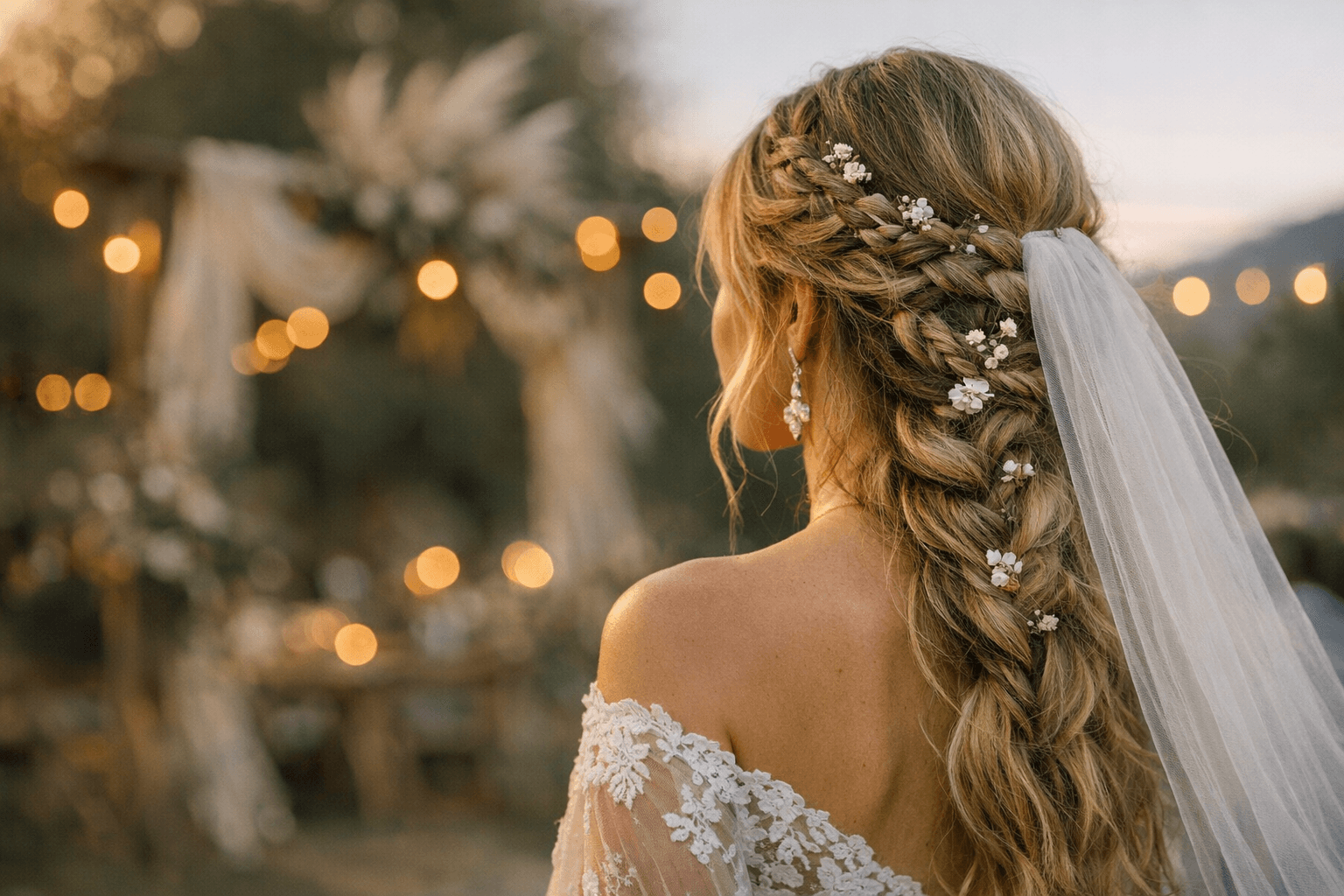
Maidenhead-based hair and makeup artist Oksana Williams is direct about her process: "Braids or plaits are the first thing I think of when a bride says she wants to have a relaxed, boho wedding. I love creating whimsical, dreamy looks and very often find myself visualising which hairstyle would suit each individual bride, even prior to her trial with me!" That instinct is backed by something more practical than aesthetics. A well-built braid is the only wedding hairstyle that genuinely improves in a sea breeze, holds its architecture through a humid afternoon reception, and photographs with equal drama from thirty feet down the aisle and two inches from a portrait lens. The range is wider than most brides expect, running from delicate structures "woven into a bohemian up or down style, to a dramatic chunky braid feature which stands out even at first glance," versatile enough to be "modern, fun, romantic and even structured."
Here is how to choose yours.
Why Braids Win When the Weather Doesn't
The biggest invisible enemy at an outdoor ceremony is not the caterer or the seating chart. It is wind, followed closely by humidity. Traditional blowouts collapse. Pinned-up styles shift. A braid, by design, is a locked structure, and the more texture built into it before the first guest arrives, the less damage any afternoon gust can do. This is the structural logic driving boho braids as a dominant 2026 wedding hair trend: they are built to perform across an eight-hour day, not just to look beautiful in the first portraits. The goal, as framed by the MatchedHearts 2026 trend gallery, is a bohemian bridal look "that still reads refined on camera," which means every style below has been considered for both the ceremony processional and the close-up portrait session that follows. Veil compatibility, hair-type adaptations, and product choices to maintain texture without stiffness are all part of that calculation.
Relaxed Fishtail Braids
The fishtail is the gateway braid for brides who want visible texture without sculptural commitment. The structure is loose enough to feel genuinely undone but tight enough to hold through dancing and wind. Hampshire makeup artist and hairstylist Jessica Penfold's "beautiful loose and tousled bridal fishtail braids" set the standard: unstructured at the edges, romantic in overall silhouette, and adaptable across hair textures. Fine hair benefits from light backcombing before braiding to build density into the sections; thicker hair can go straight into the plait.
- Veil note: A fishtail worn to one side clears the opposite shoulder entirely for a traditional veil attachment at the nape or crown.
- Photo test: From the aisle, a fishtail reads as a single flowing shape. In close-up, the woven texture becomes its own detail story. Shoot from a three-quarter angle at medium distance for the most flattering combination of both perspectives.
Fishtail with Fresh Flowers
One of Jessica Penfold's two signature variations threads fresh flowers directly into the braid, transforming the structure from romantic to fully ceremonial. The distinction between a finished look and a thrown-together one here is placement: blooms tucked into the looser sections of the weave rather than pinned on top read as organic rather than arranged. Compact florals with firm stems hold best through movement and light wind, and at outdoor ceremonies where blooms can be cut the morning of the wedding, the look stays fresh through the vows without refrigeration.
- Veil note: Skip the veil entirely, or use a short floaty style that does not compete with the botanical detail.
- Photo test: In close-ups, the flowers carry the shot on their own. From the aisle, the braid reads as one lush, garden-gathered statement. Both perspectives work; this is the most dual-purpose look in the lineup.
Fishtail with a Seed Pearl Hair Vine
Penfold's second fishtail variation swaps florals for a delicate seed pearl hair vine woven through the plait, a look she developed during a boho bridal hairstyling workshop with the Bridal Stylists. Where the flower version skews warm-season and garden-forward, the pearl vine reads year-round and formal-adjacent without crossing into stiff territory. As MakeMeBridal notes, both Penfold fishtail looks "are perfect for a romantic bride, and look especially stunning on highlighted hair." The pearls catch light softly in photography without adding bulk to the braid's structure.
- Veil note: A pearl-braided fishtail pairs naturally with a pearl-edged veil for a cohesive bridal palette; a plain-edge veil works equally well and lets the braid detail lead.
- Photo test: The pearl vine is a close-up detail shot waiting to happen. At aisle distance, the threading creates luminous sheen rather than identifiable beading. Plan for both distances in your shot list.
Halo Braids with Tiny Florals
A halo braid circles the entire head as a continuous plait, and its circular structure distributes the weight of added florals evenly across the scalp rather than concentrating it at a single anchor point. Because the braid anchors against the head all the way around, there are no loose ends for wind to catch, making this one of the most weather-resistant options for outdoor ceremonies at coastal or exposed venues. The 2026 trend galleries specifically call out halo braids adorned with tiny florals as a leading look, and the combination of sturdy structure with delicate botanical detail is exactly why it holds up where other styles don't.
- Veil note: Position a long veil beneath the halo braid at the nape; the braid frames the veil's fall without competing with it.
- Photo test: From the aisle, a halo braid reads as a full sculptural crown. In close-ups, individual florals and the woven surface texture become the focus. This style photographs well at every focal length.
Crown Braid
Closely related to the halo, the crown braid is the boho world's most structurally versatile style. "The beauty of this hairstyle lies in its versatility as it can be customized to suit different face shapes and hair types." For oval and heart-shaped faces, a full crown braid draws the eye upward with natural balance; for rounder face shapes, a slightly off-center crown elongates; for squarer jaw lines, loosened braid sections at the temples create a soft natural frame. It is the rare bridal look that genuinely works across the full range of face shapes without significant modification.
- Veil note: A dropped veil from beneath the crown creates a dramatic cathedral-length effect; a shorter blusher veil sits forward of the crown cleanly without tangling in the plait.
- Photo test: Ask for one overhead portrait. Crown braids were made for that angle, and most photographers do not think to capture it unless prompted.
Crown Braid with Florals and Hair Accessories
The crown braid's structural loop creates natural pockets for accessories that other styles simply cannot hold in place. Pearl pins, ribbon, and both fresh and dried florals can be woven directly into the plait, held secure from all sides by the surrounding braid rather than relying on a single pin. "Adding florals or other hair accessories to the crown braid is a great way to add some personality to the look while keeping it elegant and timeless." The proportion rule matters here: a full floral wreath competes with the braid's texture; three to five strategic blooms let the plait remain the hero while the accessories add personality.
- Veil note: Heavy accessory placement in a crown braid makes a veil redundant in most cases. If you want both, keep accessory count minimal so the look does not read as overcrowded.
- Photo test: From the aisle, woven blooms read as a garland-like wreath. In portraits, individual flower varieties become identifiable. Choose blooms with visual interest at both scales.
Loose Dutch Braids into Low Buns
The Dutch braid sits raised from the scalp rather than lying flat, adding structural height to the crown before the hair gathers into a low bun at the nape. The visual result is a look that has the architecture of a formal updo with the romantic softness of a down style. The critical detail is the loose strands pulled free from the braid at the temples and cheekbones; without those, the look reads as polished rather than boho. The low bun provides a secure anchor point for a veil without requiring pins through the braid itself.
- Veil note: A bun-anchored veil at the nape gives maximum veil length with zero interference to the braid's texture above it; longer veils sit cleanly beneath the low bun.
- Photo test: The raised Dutch section photographs as a structured crown in wide shots. In close-ups, the bun's rope-twisted texture and any loose framing pieces become the editorial detail worth capturing.
Half-up Dutch Braids with Beachy Waves
For brides who want to keep length visible, the half-up Dutch braid is the 2026 practical sweet spot. Two Dutch plaits originate at the crown and meet at the back, anchoring the upper section while the lower half falls in textured waves. "For a modern boho style, keep the hair shiny and healthy, over-processed curls are not the goal!" The waves should read like the result of a night with braids in, not a curling iron at maximum heat, which means sea salt spray and a light texture mist over aggressive hot-tool styling. This is also the half-up structure that manages humidity best, because the braided upper section stays locked even if the waves beneath soften.
- Veil note: A veil positioned beneath the braided half-up section sits centered and stable throughout an outdoor ceremony without clips shifting.
- Photo test: Beachy waves photograph best in movement. Ask your photographer to capture a candid walking shot; this look is genuinely wasted in static posed portraits.
Pearl-Interspersed Braids
Beyond the Penfold fishtail application, pearls can be threaded through virtually any braid structure: Dutch plaits, waterfall braids, crown styles, or loose three-strand plaits. The effect reads as bridal at any scale without crossing into formal updo territory. Fine-haired brides benefit most from pearl accents because scattered luminosity reads as visual density in photographs, adding apparent fullness to braids that might otherwise appear delicate. The key to keeping pearl-interspersed braids looking intentional rather than costumy is spacing: pearls placed two to three inches apart through the structure rather than clustered at intervals.
- Veil note: Pearl braids and pearl-edged veils create cohesive bridal elegance; a plain-edge veil also works well and lets the braid's detail lead without competition.
- Photo test: Scattered pearls are a close-up stylist's dream. At distance, they create luminous sheen rather than readable detail. Both reads are beautiful; plan for both distances in your shot list.
Waterfall Braid
The waterfall braid's defining feature is its cascade: sections of hair are released through the structure as the braid progresses, creating a flowing fall of loose strands beneath a woven upper layer. "The waterfall braid cascades down the back of your head like a beautiful, flowing waterfall, forming an impressive yet effortless look." Its outdoor-venue performance is the practical argument: "It's also a great option for outdoor weddings because it keeps your hair out of your face while adding a touch of glamour." The woven upper section anchors firmly against the scalp while the released strands below can move freely in a breeze without unraveling the overall structure, making it one of the few truly wind-tolerant down styles.
- Veil note: A waterfall braid worn horizontally across the back leaves the full length below free for a veil drop; a side-positioned waterfall sweeps the veil to the opposite shoulder for an asymmetric editorial effect.
- Photo test: This braid is made for movement photography. In static portraits the cascading strands can look heavy; in candid or wind-assisted shots, the cascading effect is genuinely cinematic.
Braided Chignon
The braided chignon is where boho softness meets elevated formality, making it the default recommendation for brides managing a ceremony-to-evening-reception transition in a single look. A loose plait is coiled and pinned at the nape or crown with the weave of the braid visible at the surface, creating deliberate craft rather than hidden structure. This is not the smooth, lacquered chignon of traditional weddings; it reads textured and intentional, which holds up in both natural afternoon light and warm artificial evening light equally well.
- Veil note: A braided chignon at the nape is the most veil-compatible updo on this list: the coiled structure creates a stable anchor, and the height of the bun keeps the veil's fall long and clean.
- Photo test: The braid's weave reads as surface pattern at all distances. From the aisle it looks like a sculpted updo; in close-ups the interlocking sections become the focus. It also works as a back-of-dress detail shot when the gown's construction is worth documenting.
Updo with Woven Flowers
A braided updo with flowers woven directly into the construction, rather than pinned on afterward, achieves a cohesion that styled hairpieces rarely match. The woven approach integrates botanicals into the hair's structure so that both move as a single unit; florals pinned on top of an updo tend to shift out of place by mid-afternoon, particularly in humidity or light rain. For summer outdoor weddings especially, woven flowers resist wind and humidity better than pin-attached arrangements because they are held from multiple anchor points within the braid rather than from a single pin.
- Veil note: A florally woven updo reads as visually complete on its own. If a veil is desired, either a very long, simple style that lets the hair detail lead, or a very short blusher, works best.
- Photo test: Wide ceremony shots read as lush and botanical from any distance. Close-up portraits reveal individual bloom varieties and braid texture simultaneously. Brief your photographer to capture both before the reception lighting changes.
Chunky Braid Feature
At the opposite end of the delicate spectrum sits the chunky braid: an oversized plait that makes no attempt at invisibility. The range of boho bridal braids runs exactly from the whisper to the announcement, and the chunky braid is the announcement. It works best on thick hair because the volume is structural rather than engineered; fine-haired brides wanting the same scale should discuss padding techniques with their stylist before committing to this look at the trial. Where fine braids read as jewelry-scale detail, a chunky plait reads as the entire silhouette decision.
- Veil note: A chunky side-swept braid leaves one shoulder completely clear for a traditional veil attachment; worn centered down the back, a veil layered over the braid creates deliberate high-drama layering.
- Photo test: This is an aisle look, not a portrait look. The scale of the plait reads with maximum impact from distance. In close-up, direct the camera to the braid's edge where individual strands are most defined.
The Chooser Guide: Hair Type, Veil, and What to Ask at Your Trial
Choosing a boho braid is not about which style looks most beautiful on a mood board. It is about which structure holds against your specific hair texture, your venue's conditions, and the weight of whatever you plan to wear on your head.
For fine hair, crown braids and pearl-interspersed styles add apparent visual volume and photograph with more density than their actual weight. Avoid extremely chunky plaits, which can appear stretched rather than full on finer strands.
For thick hair, Dutch braids, chunky braid features, and waterfall braids manage natural volume rather than fighting it. The hair's own weight gives these structures staying power through a full day outdoors.
For shorter or shoulder-length hair, halo braids and crown styles are the most reliable options; half-up Dutch braids are achievable from the nape forward with creative sectioning even at medium length.
What to ask your stylist at the trial:
- Can this structure support a veil attachment point, and where exactly?
- How does this look perform in high humidity or sustained wind?
- Which products do you use to maintain texture without stiffness?
- Can we test a partial version of this now to see how it holds after four hours?
The consistent principle across all fifteen looks is this: boho braids are designed to be imperfect. A strand out of place is not a failure. It is, as Oksana Williams understands intuitively before a bride even sits down in her chair, the entire point.
Know something we missed? Have a correction or additional information?
Submit a Tip