How to Clean and Preserve Your Wedding Dress for Years to Come
Your dress survived the wedding; now the real work begins. Act within days, not months, or those invisible champagne stains will yellow permanently.

Your wedding dress isn't just a piece of clothing. It's a symbol of love, joy, and one of the most special days of your life, and the way you treat it in the days immediately following your wedding will determine whether it stays that way for decades. Whether you plan to pass it down as a family heirloom, repurpose it, or simply cherish it as a keepsake, proper preservation is the difference between a gown that looks breathtaking at your daughter's fitting and one that crumbles out of a dusty box.
The good news: the process is straightforward. The bad news: the window to get it right is shorter than most brides realize.
Act within days, not months
The first and most important rule of wedding dress preservation is speed. After the big day, your dress may have invisible stains, from sweat, champagne, and body oils, that aren't visible to the naked eye but will yellow over time as they oxidize into the fabric. Dirt and even perfume residue can cause long-term damage if not treated properly. What looks pristine the morning after your reception may be irreversibly stained six months from now.
The target timeline, confirmed consistently across preservation guides: get the dress professionally cleaned within days or, at most, a few weeks after your wedding. Every day it sits bagged in a closet, those invisible contaminants are doing quiet damage. Don't let the post-wedding haze of honeymoons and thank-you notes push this task to the bottom of your list.
Have your dress professionally cleaned
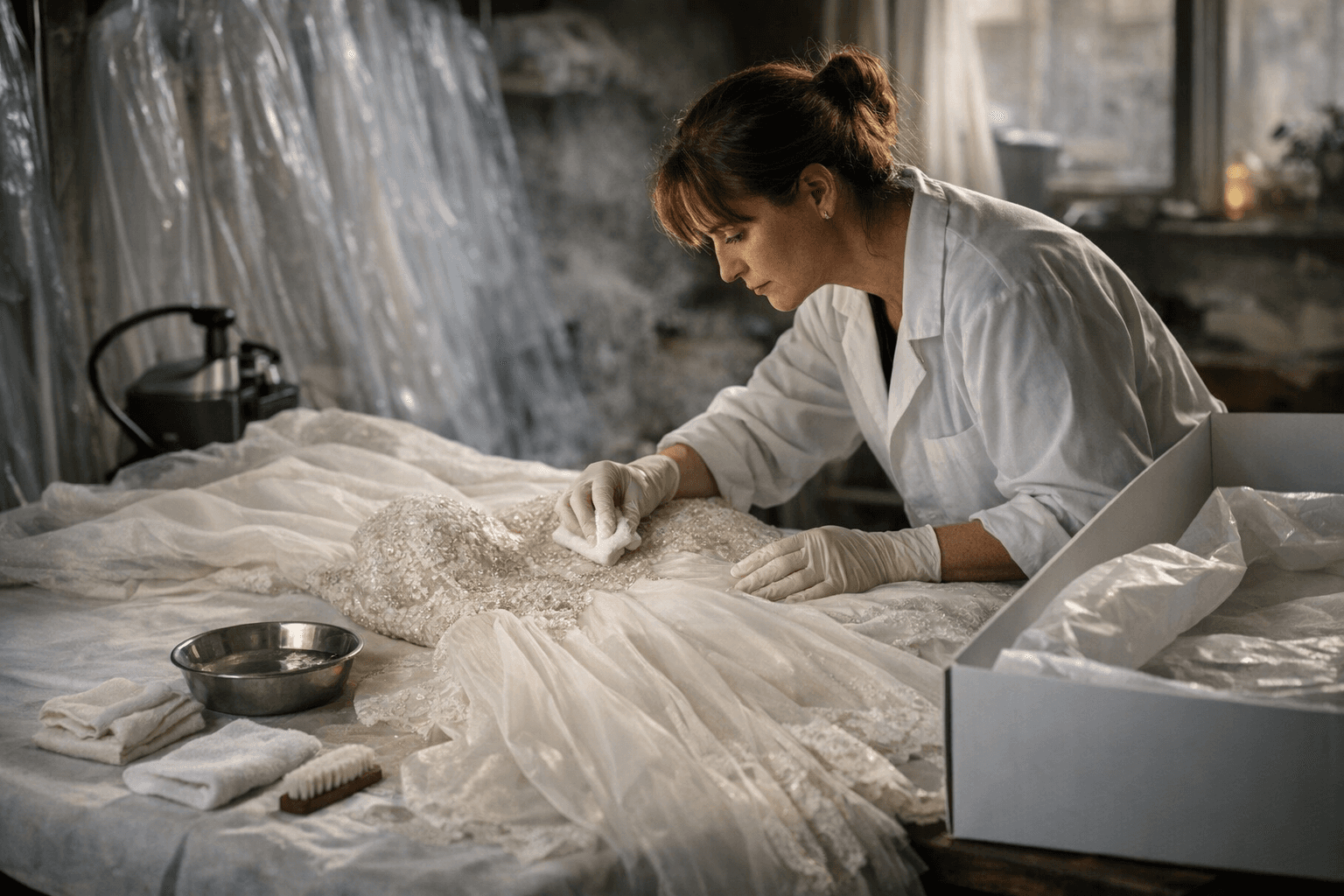
Before you think about storage, your wedding dress needs a deep clean, and that clean should be handled by a specialist, not a standard dry cleaner. Wedding gowns involve construction and materials, including structured boning, delicate lace, hand-sewn beading, silk organza, and layered tulle, that require someone who understands bridal textiles specifically.
When you're searching for a cleaner, look for businesses that specialize in bridal or heirloom garments rather than general dry cleaning services. Ask specifically how they handle your gown's primary fabric and any embellishments. A cleaner who treats a heavily beaded ballgown the same way they treat a simple slip dress is not the right choice. This step is worth doing carefully: the cleaning determines the condition of everything that follows.
Choose the right storage box
Once your gown has been professionally cleaned, storage becomes the long game. If you're boxing the dress, the container itself matters enormously. The box should be acid-free, pH-neutral, and lignin-free. These aren't just technical terms: acidic materials and lignin, a compound found in wood pulp papers and cardboard, will actively break down fabric fibers over time, yellowing and weakening even the most pristine gown.
Many wedding dress preservation kits come with these specialized boxes, so if you're purchasing a kit rather than sourcing the components separately, verify that the included box meets all three criteria before assuming it does. The specifics matter. An acid-free box that isn't lignin-free still poses a long-term degradation risk.
When folding the gown into the box, handle delicate areas, particularly lace overlays and beaded bodices, with care. The goal is to minimize sharp creases in fabric that will sit folded for years.
Where you store it matters as much as how
The storage environment is as critical as the container. Sunlight and heat weaken fabric fibers over time, and humidity accelerates the kind of mold and mildew growth that can destroy a gown without any visible warning. Store your dress in a cool, dark closet, under a bed, or in a temperature-controlled space specifically to avoid exposure to light and humidity. Attics and garages are off the table: both experience significant temperature swings and humidity fluctuations that are damaging even to sturdy textiles, let alone the delicate construction of a wedding gown.
A climate-controlled interior closet or a temperature-stable area under a bed are your best everyday options for most homes. If you live in an environment with particularly high humidity, a temperature-controlled storage space may be worth the investment for long-term security.
Never hang it long-term
This is the preservation mistake that causes irreversible damage most quietly. Never hang your wedding dress for long-term storage. The weight of the gown can stretch the fabric over time, and the damage is particularly pronounced in delicate lace and heavy beading, where both the textile and the attachment points for embellishments are under sustained stress. What starts as a slight distortion in the bodice or hemline becomes permanent.
Hanging is appropriate for short-term display or for the brief window immediately after the wedding while you arrange cleaning. It is not a storage strategy. The box is the method; hanging is the shortcut that costs you.
Schedule regular check-ups
Preservation isn't a one-time task you complete and forget. Once the dress is cleaned, boxed, and stored correctly, plan to inspect it periodically. Open the box, check for any discoloration, moisture, or signs of fabric stress, and reseal it carefully. Catching a problem early, whether it's a box that's been compromised by humidity or a fold point that's developing a stress crease, is far easier to address than discovering damage years later when the gown is intended for use again.
No single frequency is universally prescribed, but an annual check is a reasonable baseline for most storage conditions. If your environment is less stable, check more often.
The bottom line
The preservation of a wedding gown comes down to one non-negotiable principle and several supporting habits: act immediately, clean professionally, and store in the right container in the right environment. The gown you wore on one of the most significant days of your life deserves more than a plastic garment bag thrown in the back of a closet. Done correctly, preservation is a relatively modest investment of time and care that extends the life of a piece you may want to wear again, pass on, or simply keep intact as a reminder of what that day felt like.
Know something we missed? Have a correction or additional information?
Submit a Tip