Marmar Halim's Spring 2026 Bridal Collection Blends Sculptural Tailoring With Fluid Romance
Sculptural corsets meet fluid skirts in Marmar Halim's Spring 2026 bridal collection, and the five design moves inside it are already reshaping how brides are shopping.

The bridal internet has a pattern. A collection drops, the mood boards update within hours, and suddenly every bride with a 2027 date is rethinking the gown she swore she'd already decided on. Marmar Halim's Spring 2026 bridal collection, which debuted March 27, did exactly that. Not because it was loud, but because it was precise: five decisions in construction and proportion that translate, with striking clarity, into the gowns brides will actually be trying on by year's end.
Halim is an Egyptian designer who trained at the Fashion Design Center in Cairo alongside Italy's Istituto di Moda Burgo, and she built her label around a conviction that bridal wear should function as what The Loft Bridal describes as "wearable sculpture." Her Spring 2026 collection is the fullest expression of that philosophy: engineered draping, three-dimensional floral embroidery, and modern corsetry set against fluid, floor-grazing skirts. The collection is available through U.S. stockists at a range of roughly $4,000 to $10,000, placing it between accessible bridal and true couture, which is precisely where its design language lives.
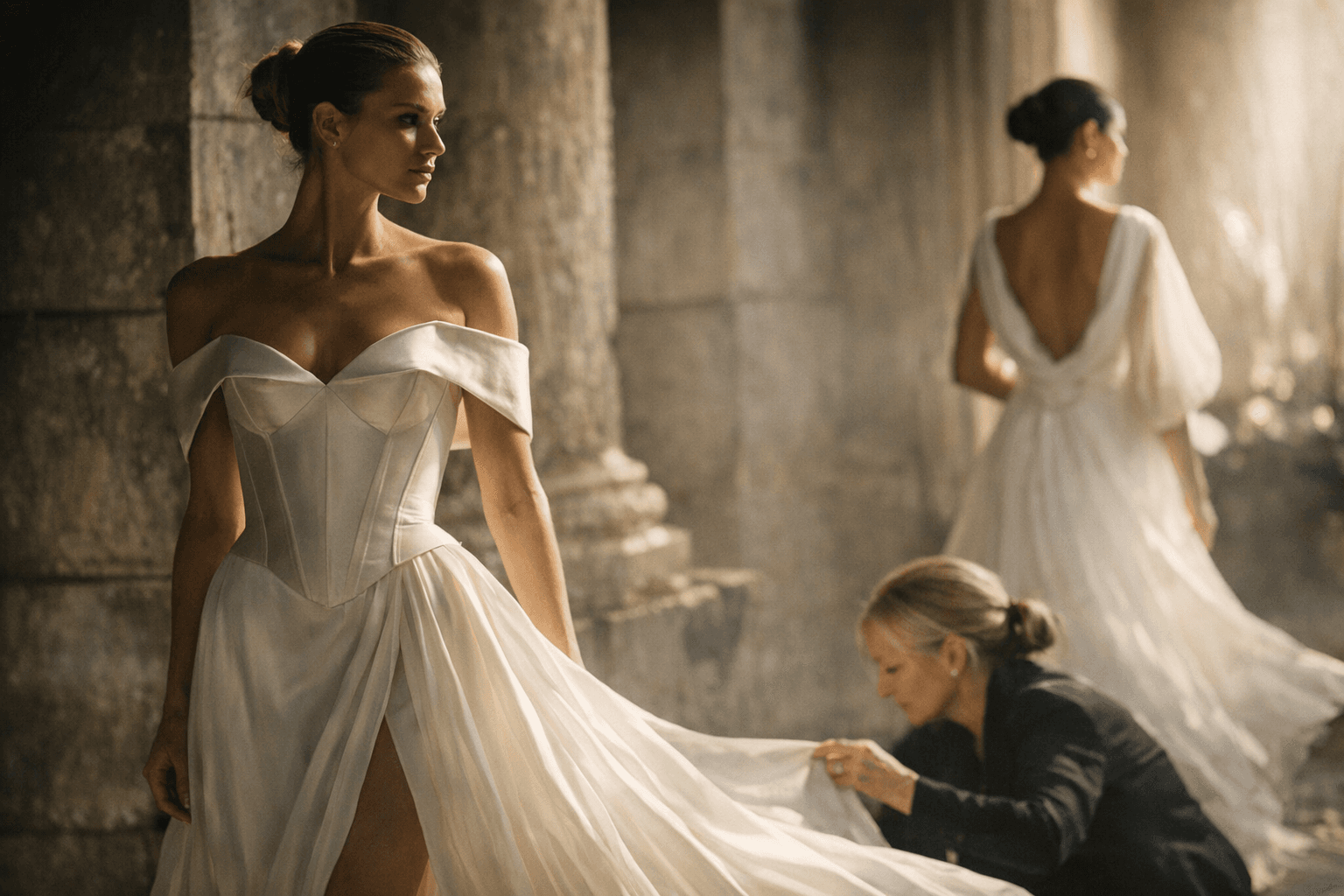
The first direction worth tracking is the corset, reread entirely as architecture. Halim's version does not reference vintage bridal history. The boning is engineered into the bodice at the seam level, creating waist definition without compressing the frame, and the silhouette it produces, an hourglass proportion released into a fluid skirt below, reads across a ballroom without requiring the bride to alter how she stands or breathes. This is the corset for brides who want structure in the photograph but not against their ribcage during a six-hour reception. It flatters most naturally on brides with a defined waist, and it registers with particular authority in grand ballroom, estate, or cathedral settings where the gown needs to hold its own against architectural scale. If the exact Halim silhouette isn't available at your nearest stockist, request any fitted crepe or mikado bodice with seam-engineered internal boning and a chiffon or silk skirt attached at the natural waist. The combination produces the same proportional argument.
The second takeaway is about placement. The three-dimensional floral embroidery in this collection sits at the neckline and bodice, not scattered across the skirt. That decision matters more than it might seem at first. Concentrated embellishment at the upper body controls where the eye lands in portraits, keeps the gown from reading as costume, and leaves the skirt clean enough to move through a ceremony without visual noise below the waist. For brides who love texture but worry about excess, this is the strategic choice: the detail is where cameras are pointing, and the rest of the gown steps back. Garden ceremonies and intimate venue settings, where guests are close enough to appreciate three-dimensional relief work, are the natural home for this kind of surface craft.
Third, strapless is back with a structural argument. The Spring 2026 collection leans into strapless silhouettes, but each one is built with internal support so the neckline holds its shape without visible external boning at the edge. The result is a clean line rather than a corseted appearance from outside the gown, which is what most brides are actually looking for when they say they want strapless. The neckline remains one of the most universally flattering for formal and semi-formal weddings and works across body types when the structural engineering is correct. If your salon's Halim stock is limited, ask specifically for any strapless construction where the boning begins at the cup seam rather than at the neckline edge. That single specification separates gowns that hold from gowns that require constant adjustment.
The fourth and most commercially significant direction is the detachable cape worn over the bridal gown in place of a veil. Multiple looks in the Spring 2026 collection pair capes with strapless silhouettes, and this is where the collection makes its clearest prediction about where bridal accessories are heading. Capes offer veil-level drama during a ceremony entrance without the length management problem at reception; they detach cleanly, they photograph as architecture from behind, and they add a layered dimension to a strapless or off-shoulder neckline that a floating veil doesn't produce. For brides with broader shoulders or anyone who wants layering without adding volume at the hip, the cape is a better structural choice than the traditional cathedral or chapel veil. Multi-designer boutiques can often source a detachable silk or chiffon cape as a standalone accessory to layer over an entirely different designer's gown.
Fifth, every strong bodice in the collection releases into a fluid, often asymmetric skirt. The movement built into these silhouettes is practical intelligence: brides who intend to actually dance need a skirt that cooperates. Asymmetric hems and high slits recur across the collection, and the taffeta and silk fabrications Halim favors carry enough weight to move with purpose rather than collapse. For hourglass and pear-shaped brides, this upper-structure-to-fluid-skirt ratio is one of the most proportionally flattering frameworks in bridal. For modern loft venues, outdoor ceremonies, or beach settings, the fluid skirt communicates ease in a way that ballgown volume does not.
On access: Spring bridal collections typically reach salon floors six to nine months after their runway debut, placing Marmar Halim's Spring 2026 line in U.S. stockists between September and December 2026. Brides with summer 2027 weddings should be scheduling consultations now. In the U.S., the brand is carried at multi-designer boutiques including Union Square Couture in New York and The Loft Bridal, both of which attend New York Bridal Market and can advise on lead times and special orders. Custom pieces from the brand's Dubai atelier typically require four to six months for construction.
Context also helps here. Halim's Fall 2026 bridal collection, which she named "1998" after the year of her first marriage and built around the question of what she might wear if she could walk down the aisle again, follows Spring 2026 with twelve gowns and the same structural logic applied through a more personal emotional lens. Taken together, the two collections make clear that Halim is not responding to bridal trend cycles. She is building a consistent visual argument: that structure and softness are the same thing, approached from different directions. Spring 2026 is where that argument is most sharply dressed.
Know something we missed? Have a correction or additional information?
Submit a Tip