Pratt Institute Honors Indigenous Designer Korina Emmerich With 2026 Visionary Award
Pratt Institute named Korina Emmerich its 2026 Fashion Visionary, and her made-to-order, Puyallup-rooted practice is the slow fashion blueprint bridal needs right now.

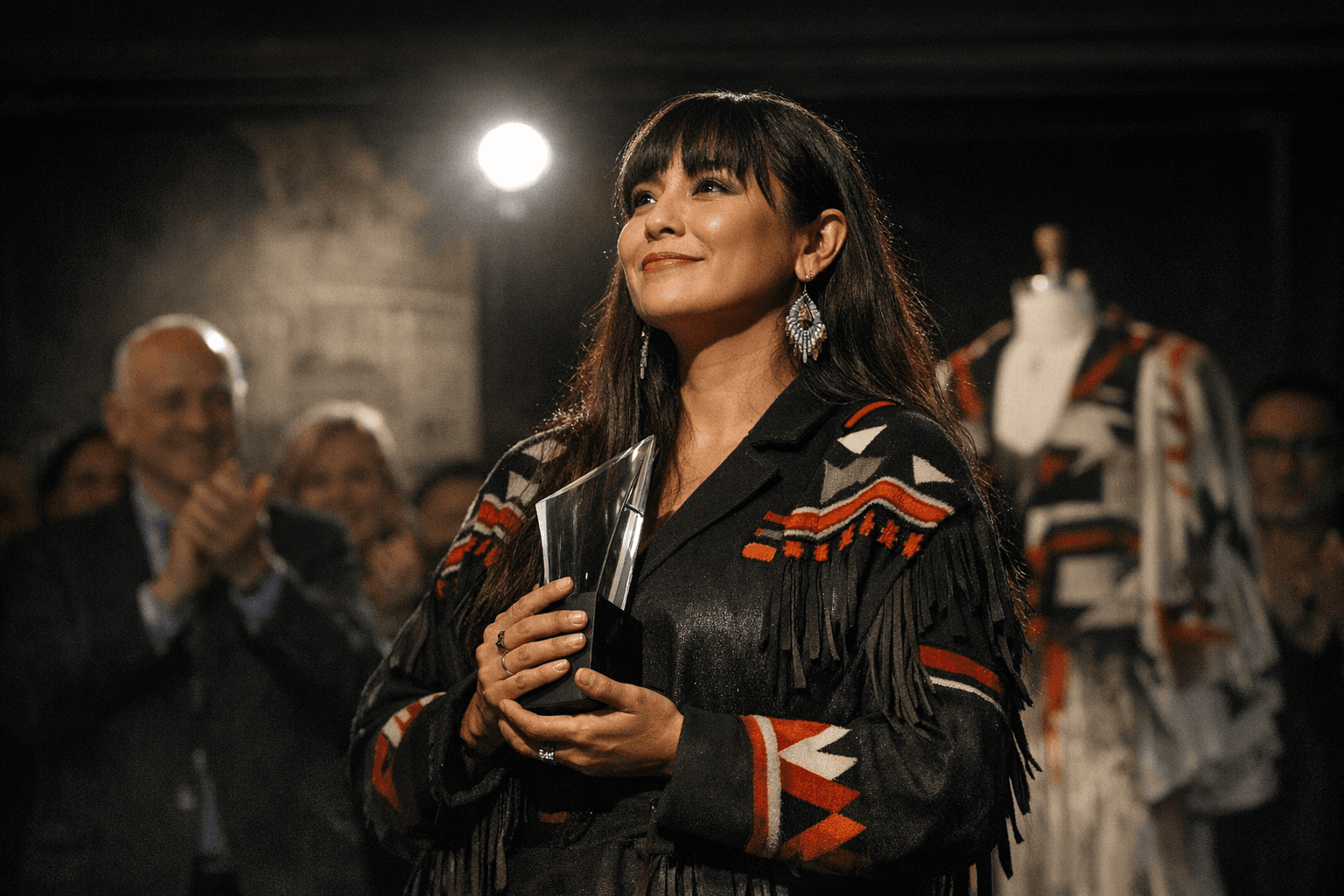
Pratt Institute named Korina Emmerich, the Puyallup designer and founder of EMME Studio, its 2026 Pratt Fashion Visionary Award recipient on April 7. The recognition will be formalized at the 2026 Pratt Shows: Fashion on May 14 at Powerhouse Arts in Brooklyn, the 125th edition of the school's annual graduating senior showcase. For brides who have spent the past few years sorting through an avalanche of brands claiming an ethics they can't document, Emmerich's work offers both a model and a measuring stick.
Emmerich founded EMME Studio in 2015, rooting her label in her patrilineal heritage from the Coast Salish Territory and the Puyallup tribe. Born and raised in Eugene, Oregon, she now runs the label from Brooklyn. EMME Studio is built on a slow fashion and ethical fashion methodology centered around a respect for the earth, and the brand's operational structure reflects that commitment at every level: "All of our items are made-to-order in our Brooklyn studio," Emmerich has said. That single production decision eliminates overstock, compresses waste, and shifts the purchasing relationship from transactional to considered, which is exactly what a wedding dress commission should be.
Her stated focus is on "decolonizing the fashion industry and using Indigenous expertise to promote slow fashion, biodegradable materials, ethical consumption, fair trade, and fair wages globally," and her career history shows that framing is not aspirational copy. She is actively involved in txʷəlšucid language and storytelling revitalization within the Puyallup tribe, meaning the cultural motifs that inform her silhouettes carry living linguistic context, not borrowed aesthetic. Her work has been featured in the Metropolitan Museum of Art, MoMA, MoMA PS1, the Denver Art Museum, La Biennale d'Art Contemporain Autochtone, the Musée McCord Stewart, the Textile Museum of Canada, the Boston Museum of Fine Arts, and the Institute of Contemporary Art Boston. The Snoqualmie dress she designed appeared on the August 2021 cover of InStyle worn by Interior Secretary Deb Haaland, earning InStyle the 2021 Adweek Magazine Cover of the Year.
In 2025, Emmerich organized the inaugural Indigenous New York Fashion Week. She also holds leadership roles with the Slow Factory Foundation and the Fibers Fund, and co-founded Relative Arts, a community space in New York City's East Village dedicated to Indigenous creativity and education. These aren't honorific board seats. Slow Factory works on open education and systems change in fashion; the Fibers Fund supports regenerative fiber production. Her organizing infrastructure is as coherent as her design practice.
The 2026 Pratt Shows: Fashion on May 14 at Powerhouse Arts in Brooklyn will highlight the final collections of the Pratt Fashion department's graduating seniors, each of whom is required to incorporate at least 20 percent repurposed or responsibly sourced garments. That threshold, built into the academic curriculum, is the kind of structural mandate that separates institutional commitment from rhetoric.
For brides using Emmerich's framework as a filter, the questions to ask every designer are specific and sequential. Start with who benefits: does purchasing directly support Indigenous artisans and their communities, or does money flow to a brand using "Indigenous-inspired" as a marketing modifier? Then move to collaboration transparency: has the designer named specific collaborators, communities, or cultural advisors by name? Vague acknowledgment of "global craft traditions" is not the same as documented partnership. Provenance is the next layer: where were the materials sourced, who processed them, and can the brand show a chain of custody that accounts for each step? Made-to-order production timelines, typically weeks or months longer than fast fashion, signal genuine slow-fashion practice because they reflect actual construction rather than pre-stocked inventory designed to clear quickly. Finally, assess construction standards: a dress built to last decades, with interior finishing and structural integrity that survives alterations and re-wearing, is the difference between an heirloom and a costume.
Emmerich's Visionary Award arrives as bridal fashion's appetite for "conscious" collections has produced as much greenwashing as genuine accountability. Her guiding principle, "you don't take more than you need," is a production philosophy, a material sourcing standard, and a design ethic simultaneously. Pratt's recognition makes that philosophy legible to the next generation of designers entering the industry. The graduates showing at Powerhouse Arts on May 14 will be working within a materials requirement shaped by exactly this thinking.
Know something we missed? Have a correction or additional information?
Submit a Tip