Ukrainian Designer OKSANA MUKHA Finds Quiet Strength in Wartime Bridal Collections
Oksana Mukha's 65-look ÉCLAT 2026 collection redefines bridal romance from wartime Ukraine: not dreams, but hope, choice, and quiet strength.
There are designers who treat a wedding gown as spectacle, and then there is Oksana Mukha, who has spent recent years doing something harder and more deliberate: making beauty that means something. Her ÉCLAT 2026 bridal collection, a 65-look body of work presented as a quiet, luminous response to life under wartime conditions, arrives at a moment when the stakes of creating in Ukraine could not feel more immediate.
Romance as Hope
Mukha is direct about what conflict has done to her creative vocabulary. "The past few years have profoundly reshaped my understanding of romance," she says. "It is no longer only about dreams — it is about hope, choice, and inner strength." That shift is not merely philosophical; it is structural, stitched into every silhouette and seam. For a bridal designer, romance is the core product, the entire emotional premise of the sale. To redefine it so fundamentally, under such circumstances, is its own act of courage.
She articulates the weight of that position plainly: "To live and create during wartime means placing deeper meaning into every gown. Today, romance is the courage to believe in the future." In a category that often leans on fantasy and escapism, that framing lands differently. It does not ask the bride to disappear into a fairy tale. It asks her to stand in her own strength, dressed for a future she has consciously chosen to believe in.
A Collection as Narrative
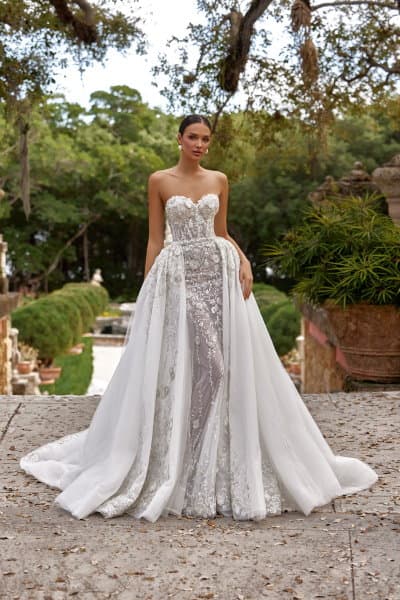
ÉCLAT 2026 is a 65-look collection, and the house describes it as a luminous expression of modern luxury, femininity, and refined strength. Those words could sound like marketing language on another designer's lips; on Mukha's, they read as a precise design brief. Every construction choice in the collection serves that intent.
The silhouettes are clean, architectural where they need to be and softly draped where the body calls for it. The corsets are built with structural intention, the kind that shapes without constricting, that supports without announcing itself. Refined draping moves alongside intricate hand-beaded embellishment, and the combination creates a visual tension that is anything but passive. These are gowns with presence, but a presence that emanates from the woman inside them rather than from the dress itself. Mukha frames that aim without ambiguity: "the gown should reveal the woman, not compete with her."
That philosophy has an almost architectural logic. The gown is not the destination; the woman is. Every seam and embellishment functions as a frame rather than a focal point, directing attention inward rather than absorbing it. In a bridal market crowded with maximalist fantasy, sculptural excess, and volume for its own sake, the restraint embedded in ÉCLAT feels both radical and refreshing.
Starting With the Woman
What separates Mukha's approach from straightforward minimalism is the emotional intelligence behind the construction. She describes recent work as carrying "more light, clarity, and quiet strength," and that phrase functions as both an aesthetic directive and a philosophical one. The hand-beading is intricate, yes, but it is deployed in service of luminosity rather than decoration. The architectural corsets are precise, but they are built to support a body, not to impose a silhouette on one. Beauty in this collection is meant to support a woman, "not merely adorn her."
That distinction matters more than it might initially appear. Bridal fashion has long operated on a model where the gown transforms the wearer, where the dress does the dramatic work and the woman inhabits it. Mukha inverts that dynamic entirely. The wearer is already whole. The gown is her ally, not her author.
For brides who have grown tired of feeling like passengers inside their own wedding dress, that philosophy is a direct address. It is a collection built for women who know who they are, or who are in the process of figuring it out, and who want a gown that meets them where they stand rather than projecting an identity onto them.
What ÉCLAT Looks Like in Practice
Across 65 looks, the collection builds a coherent visual language without rigidity. Architectural corsets ground the more structured pieces, giving them the kind of physical authority that photographs well but also wears well over the course of a long day. Clean silhouettes read modern in a way that will not feel dated in ten years of wedding photographs. The refined draping introduces movement and softness, a counterweight to the structural elements that keeps the collection from feeling severe.
The hand-beaded embellishment is where the quiet strength of the collection becomes most visible. Intricate by description and presumably by execution, beading at this level is one of the most labor-intensive forms of couture craft, the kind of detail that rewards the eye up close without demanding attention from across a room. It is, in its way, a very precise expression of Mukha's design philosophy: depth that reveals itself gradually, rather than announcing itself immediately.
The collection's name, ÉCLAT, translates from French as brilliance, radiance, or a sudden burst of light. It is a choice that aligns precisely with what Mukha says she is chasing: light, clarity, and the kind of quiet strength that glows rather than glares.
The Larger Context
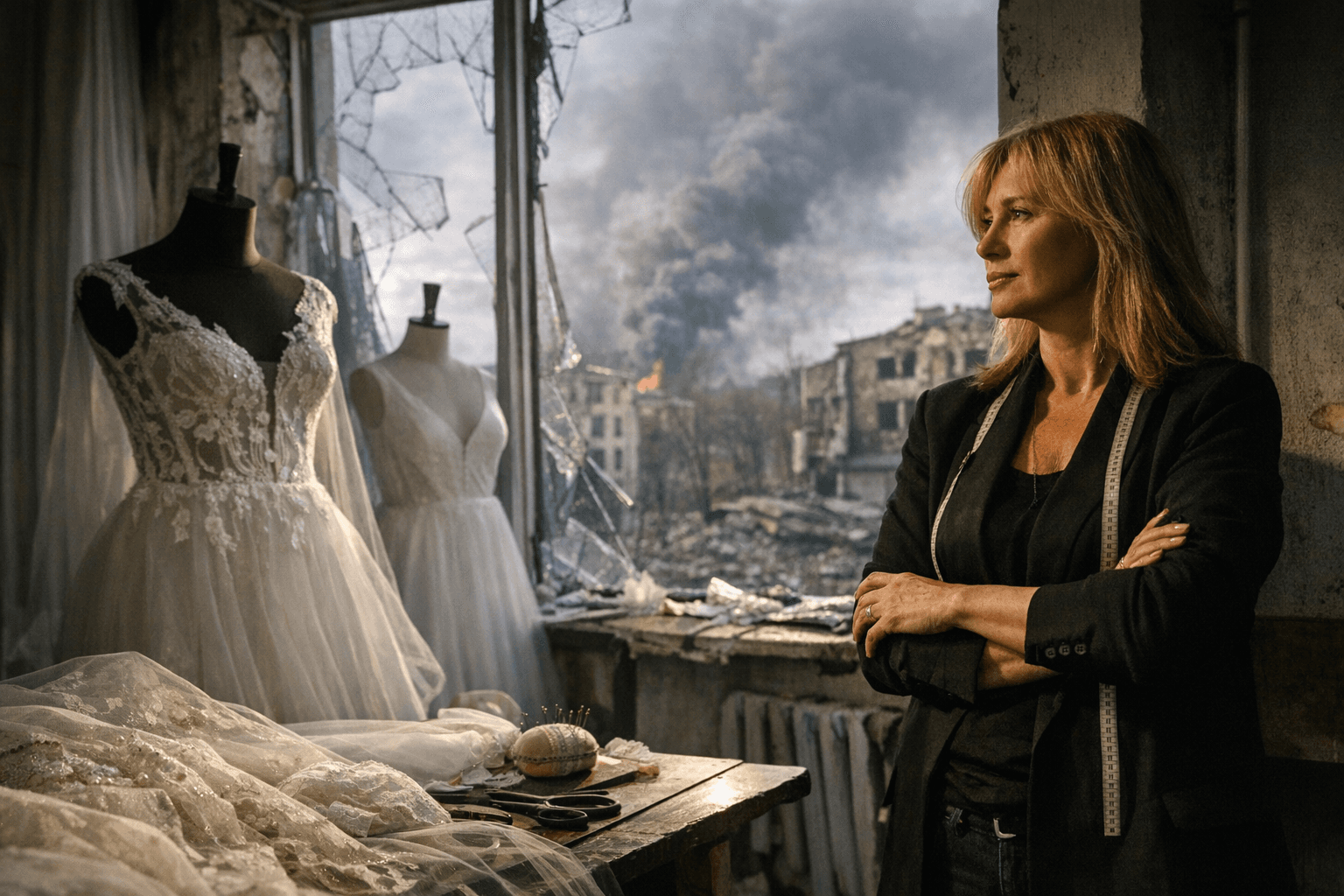
Designing bridal wear in Ukraine during an active period of conflict is not a neutral act. The wedding gown is, culturally, one of the most hopeful garments in existence: it is made to be worn on a day that represents a chosen future. For Mukha, that symbolism has become the literal subject of her work rather than its background assumption. Every architectural corset and hand-beaded seam in ÉCLAT 2026 carries the weight of that context, whether or not the bride wearing it knows the circumstances under which it was designed.
The result is a collection that asks more of bridal fashion than most collections do. Not more volume, not more embellishment, not more spectacle. More meaning. In a category where the temptation to ornament is constant and the pressure to produce fantasy is commercial, that is a significant creative position to hold.
Mukha holds it with evident conviction. Romance, in her current vocabulary, is not about the perfection of the dress. It is, as she puts it, "the courage to believe in the future." ÉCLAT 2026 is what that courage looks like, worn.
Know something we missed? Have a correction or additional information?
Submit a Tip