Yulia Maliuchik Reframes Bridal Fashion as Personal Storytelling
Yulia Maliuchik wants brides to stop dressing for the room and start dressing for themselves. Her two labels are rewriting the rules.
There is a particular kind of fatigue settling over brides who have spent too long scrolling through identical ballgowns, identical cathedral trains, identical moments that look more like a mood board than a marriage. Yulia Maliuchik noticed it before most, and built two labels around the antidote.
Maliuchik, the founder behind The SoulDress and Jemúre Couture, has emerged as one of the more compelling voices in contemporary bridal precisely because she refuses to treat the wedding dress as a costume. Her philosophy, explored at length in Vogue Portugal's Bridal Affair supplement, is disarmingly direct: a wedding dress should function as personal storytelling, not performance. The bride is not dressing for a room full of guests. She is dressing for a chapter of her own life.
Two Labels, One Philosophy
The SoulDress and Jemúre Couture are distinct in their register but united in their foundational conviction. Where bridal fashion has long defaulted to aspirational archetypes, princess silhouettes coded for a specific kind of femininity, Maliuchik's labels operate from a different starting point. The question is not "what does a bride look like?" but "who is this particular woman, and what does she want to feel?"
The SoulDress speaks in softer terms. The name itself signals intent: clothing as something emotionally inhabited rather than simply worn. This is the label for the bride who wants texture over spectacle, who gravitates toward the way a fabric moves rather than the way a silhouette photographs. Jemúre Couture operates at the opposite end of the register, more architecturally ambitious, more technically demanding, the kind of work that sits within the couture tradition without genuflecting to it. Together, the two brands give Maliuchik's boutique an unusual range: a client can arrive with almost any vision and find a genuine point of entry.
The Bridal Industry's Shifting Center of Gravity
What Maliuchik is articulating is not a radical departure from bridal fashion so much as a crystallization of where the most interesting work in the category is already heading. The contemporary bride is better informed than any previous generation: she knows the difference between a bias-cut silk charmeuse and a duchess satin, she has opinions about illusion necklines and plunge backs, and she is increasingly resistant to being told what a wedding should look like. She arrives at a boutique with references, with contradictions, with a specific emotional brief.
This shift has been gradual, but it has accelerated. The pandemic disrupted the wedding industry's machinery so thoroughly that when couples began marrying again, many had already reconsidered the entire premise of the event. Smaller ceremonies demanded more considered clothing. Brides who had delayed by years arrived older, more settled in their own taste, and less interested in the white dress as social signal. The result has been a slow but unmistakable movement toward individuality at the boutique level, even as the mass market continues churning out variations on the same silhouette.
Maliuchik's boutique sits precisely at this intersection. She is not a volume designer. The intimacy of working with individual clients, understanding the emotional architecture of a wedding day, is central to how both labels function. Couture, at its best, has always been this: the application of exceptional craft to a singular human being's needs. Jemúre Couture in particular carries that lineage.
What Personal Storytelling Actually Means in Practice
The phrase "personal storytelling" can feel dangerously close to marketing language, but Maliuchik uses it to describe something quite specific. A bride's story is not necessarily romantic or traditional. It might be irreverent, architectural, sensual, minimal, maximalist, or some unexpected combination. The dress, in her framing, should reflect the actual complexity of the person wearing it rather than smoothing her into a category.
This has practical consequences for how a bridal consultation works at her boutique. Rather than presenting a curated rack and observing what a client reaches for first, the approach is more interrogative. What moments in her wardrobe history has she felt most herself? What does she want to remember about this day in twenty years? These are not questions with obvious answers, and they are not designed to produce obvious dresses.
The SoulDress, as the more accessible of the two labels, often becomes the vehicle for brides who have been told by other boutiques that what they want is too unusual or too simple or too much. There is something quietly radical about a bridal label whose selling point is that it listens.
The Portugal Context
Vogue Portugal's decision to feature Maliuchik in its Bridal Affair supplement is itself a statement about where editorial taste is moving. Portugal has become a meaningful location for European bridal fashion, partly because of its craftsmanship infrastructure and partly because of the increasing number of destination weddings drawing international clients to the country. A supplement dedicated to bridal affairs, published in an English-language format that speaks directly to an international readership, signals that Portuguese bridal designers are no longer being positioned as regional voices. They are being presented as part of a global conversation.
Maliuchik fits that framing. Her work does not read as geographically specific in its aesthetics; it reads as emotionally specific, which travels far more effectively across borders and cultures.
Why This Matters Beyond the Boutique
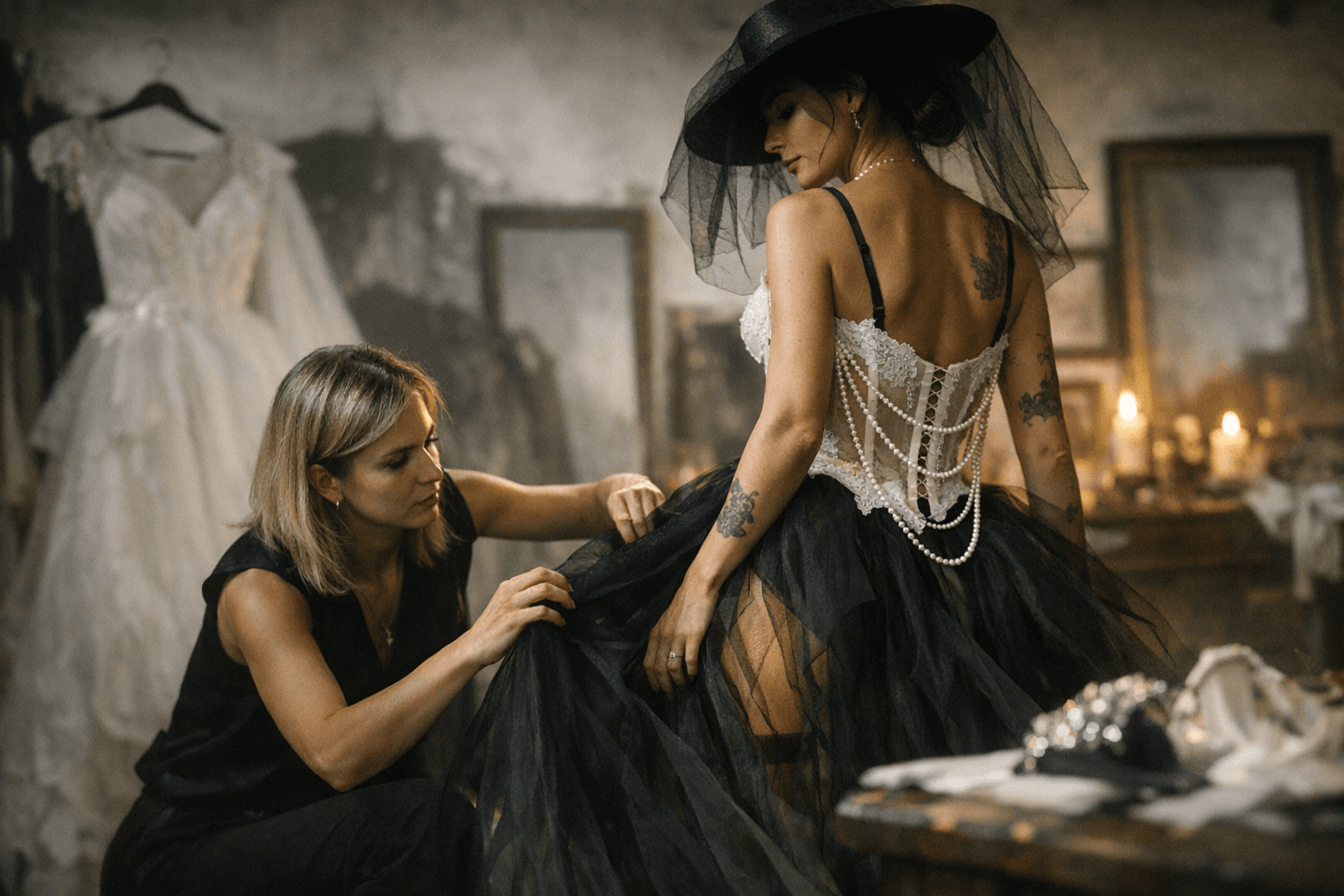
The most interesting thing about Maliuchik's approach is the implicit critique it carries of the bridal industry's dominant mode. Bridal fashion has historically been one of the most conservative corners of the fashion system, slower to absorb cultural shifts, more resistant to the kind of individuality that ready-to-wear embraced decades ago. A bride who wanted to wear black, or wear trousers, or wear something that referenced a subculture rather than a fairy tale, often had to fight for that vision against a well-meaning but narrowly imaginative industry.
What Maliuchik represents, and what her profile in Vogue Portugal makes visible to a wider audience, is a boutique model built on the premise that there is no wrong answer in bridal, only underdeveloped questions. The dress exists to tell a story. The designer's job is to help figure out which one.
That is a deceptively simple idea, but in an industry still largely organized around aspiration and archetypes, it is genuinely disruptive. The brides who find their way to The SoulDress or Jemúre Couture are not looking for the dress. They are looking for their dress, and that distinction, small as it sounds, changes everything about how the work gets made.
Know something we missed? Have a correction or additional information?
Submit a Tip