16 Carefully Chosen Pieces Can Create 256 Unique Outfits for Men
Sixteen pieces of clothing, chosen with intention, can mathematically generate 256 distinct outfits — here's exactly how to build that wardrobe from scratch.
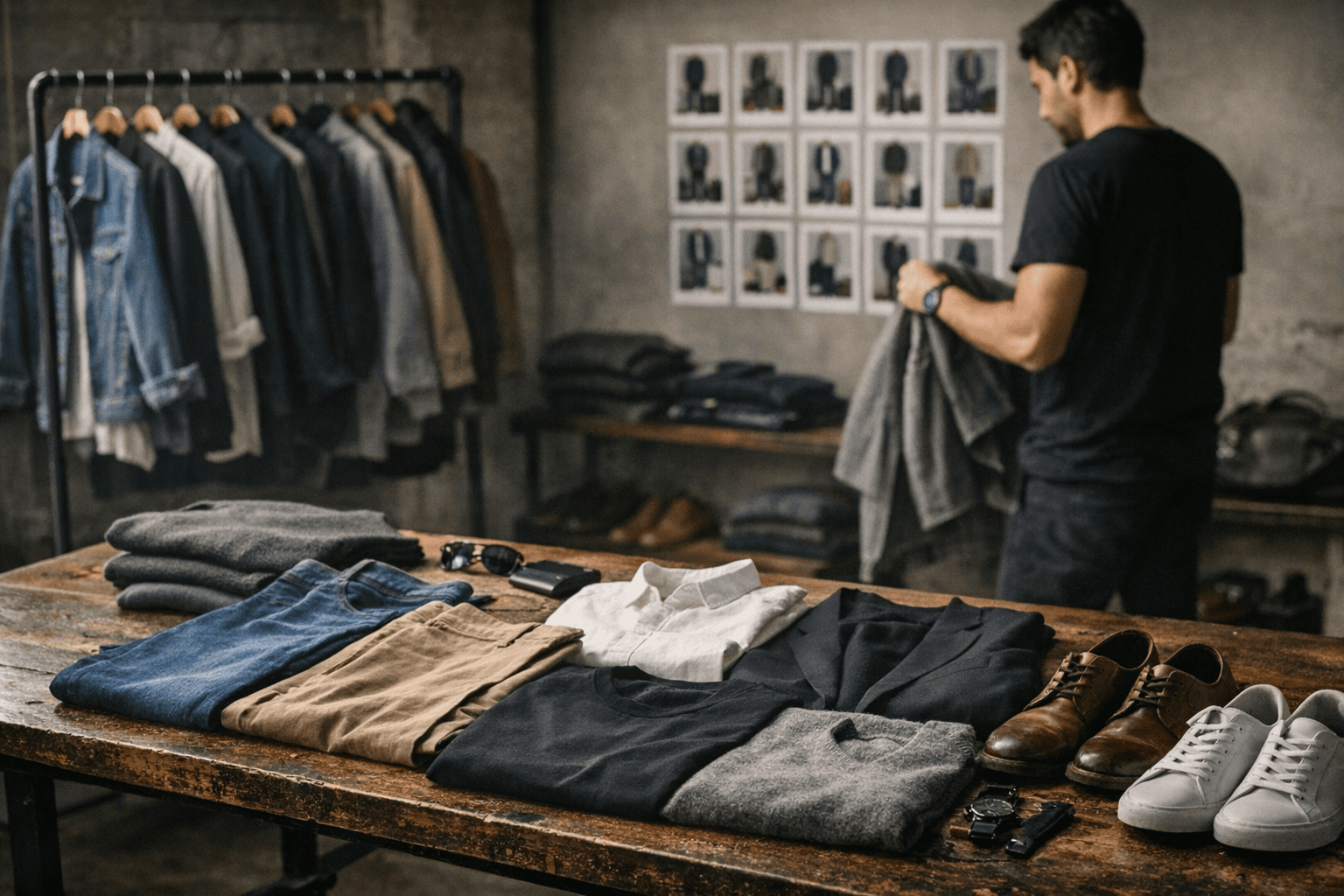
Most men own far more clothing than they need and still face the same defeated stare into a full closet every morning. The interchangeable wardrobe inverts that logic entirely: instead of accumulating pieces that only work in narrow combinations, you build a tight system where every item connects to every other. The math is disarmingly simple. Sixteen pieces that each pair with the others can yield 256 distinct outfits, a figure that means you could dress without repetition for months at a time.
The concept travels under several names. On r/minimalism, one practitioner described it plainly: "It has many names, a minimalist wardrobe, the capsule wardrobe, the interchangeable wardrobe. The idea is simple really, an interchangeable wardrobe is when every piece of clothing in your closet works with nearly every other item." That same poster built a 14-piece version using 7 button-up shirts, 3 pants, 2 sets of shoes, and 2 long-sleeve sweaters, arriving at 120 unique outfits. "For 4 months, you could wear just simply fourteen pieces of clothing, change them around a bit and you're not going to wear the same thing for four months. That's pretty amazing."
The Real Men Real Style framework scales that logic to 16 pieces and 256 outfits, and the method begins not at the store but with a single priority: fit. "To attain a perfect interchangeable wardrobe, the clothes have to fit. And fit well!" As the framework puts it, "quality trumps quantity" and the goal is simple: "fewer clothes, more quality, more outfits."
Before the specific pieces, one structural rule applies to all of them. Each item must function as a foundation piece, meaning it works with nearly everything else in the system. "Forget about glamour when building this part of your closet." Versatility, neutral palettes, and clean construction matter more than any single impressive statement piece. The Reddit practitioner's advice is worth heeding: "Make sure everything is a different color and everything matches." Earth tones are a reliable starting framework precisely because they create natural coherence across every combination.
Here are the 16 pieces that form the architecture of a 256-outfit wardrobe:
1. A well-fitted white dress shirt
The cornerstone of any interchangeable system, a white shirt pairs with every trouser, chino, and casual pant in the wardrobe. Choose a fabric with enough structure to hold a tuck but enough softness to wear open-collared on weekends.
2. A light blue dress shirt
Light blue sits close enough to white on the neutrality spectrum to work with the same range of bottoms, while creating visible differentiation in your rotation. It reads formal under a suit and relaxed tucked into chinos.
3. A navy blue dress shirt
Navy deepens the palette and bridges the gap between your formal shirts and casual layers. Pair it with grey or tan trousers for a look that reads polished without a tie.
4. A grey or chambray casual shirt
This is the piece that earns its keep across smart-casual and weekend contexts. A mid-weight chambray in grey or slate crosses comfortably between a blazer and raw denim.
5. A plaid or subtle pattern button-up
One patterned shirt in a muted tartan or gingham adds visual variety without breaking the system's color logic. Keep the dominant tones within your established palette so it still pairs freely.
6. A neutral-toned casual shirt (tan, olive, or stone)
Earth tones are the Reddit practitioner's explicit recommendation: "I went with earth tones because they match well." A tan or olive casual shirt extends the system into weekend and outdoor contexts without requiring separate wardrobe logic.
7. A seventh shirt in a contrasting but compatible color
The Reddit framework uses seven shirts specifically because seven working days cycle through three pairs of trousers before repeating any combination. "If we label each shirt as 1,2,3,4,5,6,7 and each pair of pants, A,B,C. You would interchange your clothes as such: Mon-1+A, Tue-2+B, Wed-3+C, Thurs-4+A, Fri-5+B and so on." The seventh shirt ensures no two consecutive weeks begin on the same combination.
8. Dark navy or charcoal dress trousers
Dark dress trousers anchor the formal register of the system and pair with all seven shirts. Prioritize a clean straight or tapered cut in a medium-weight wool or wool-blend that holds its shape through a full day.
9. Grey dress trousers or wool trousers
Grey trousers are the most promiscuous piece in menswear: they work under blazers, with crewneck knits, and alongside every shirt color in the rotation. Mid-grey is more versatile than either charcoal or light grey.
10. Khaki or tan chinos
Chinos carry the system from office to weekend. In khaki or tan, they connect directly to the earth-tone shirts and provide visual relief against the darker dress trousers. A slim-straight cut in a wrinkle-resistant cotton keeps them functional across contexts.
11. A navy or charcoal blazer
A single well-cut blazer multiplies the formal reach of every shirt and trouser in the wardrobe. In navy or charcoal, it layers over casual shirts without looking incongruous and over dress shirts without looking underdressed.
12. A V-neck or crewneck sweater in a neutral
This is one of the two long-sleeve layers the Reddit practitioner counts in their 14-piece system. A fine-gauge merino in camel, grey, or navy lays cleanly over a collared shirt and under a blazer, making it a genuinely three-context piece.
13. A second sweater or lightweight knit layer
The second sweater in the Reddit setup exists specifically to extend the combinatorial math. "Add in shoes, sweater or jacket into the mix and you have even more combinations." Choose a contrasting neutral — if the first sweater is grey, the second in camel or navy doubles the layering permutations.
14. Dress shoes in black or dark brown
Men's dress shoes are the base layer of the footwear calculation. A clean Oxford or Derby in black covers formal contexts; dark brown extends into smart-casual pairings with chinos and blazers. The Real Men Real Style framework specifically calls out dress shoes as a distinct section within the system.
15. A casual shoe or clean sneaker in a neutral
The second shoe category shifts the entire wardrobe into a more relaxed register without requiring any change to the tops or bottoms. White, grey, or tan leather sneakers or suede chukkas work across chinos and casual trousers without fighting the color system.
16. A versatile outerwear piece (trench, overcoat, or chore coat)
The outer layer is the piece the Real Men Real Style framework references through its 13-piece one-week plan variant, which suggests the system functions even at reduced counts when a strong outerwear anchor is present. A single tailored overcoat in camel or charcoal covers every combination underneath it and visually unifies the wardrobe in colder months.
The rotation logic, once the 16 pieces are assembled, is straightforward to execute. Work through the shirt-and-trouser combinations first, then layer in the sweaters and blazer, then shift the shoe pairing. Each variable added to the equation multiplies the total rather than simply adding to it, which is how 16 pieces reach 256 distinct looks.
The psychological benefit is underrated. The r/minimalism practitioner who built their version specifically noted the relief of knowing that any combination will work: "You can pick any combination of clothes, and rest assured that the outfit will be stylish and comfortable." For anyone who has ever stood in front of a packed closet feeling genuinely stuck, that frictionless confidence is the system's most practical return on investment.
The wardrobe is not static once built. Minor variations, a new shirt in an adjacent tone, a second pair of trousers in a slightly different cut, can be introduced without disrupting the system's internal logic. "Now that your wardrobe is coming together, you can incorporate some minor variations that will keep your wardrobe different while still interchangeable." The 16-piece version is a starting architecture, not a ceiling.
This article was produced by Prism’s automated news system from verified source data, official records, and press releases, then run through automated quality and moderation checks before publishing. The system is built and supervised by the people who set the standards it runs under. Read our full AI policy.
Did this article answer your question?