Build Your Capsule Wardrobe Around Denim You Already Own
Twelve pieces, 10 outfits, zero new jeans required. Denim is the most underleveraged structural spine in your closet, and here's the blueprint to prove it.
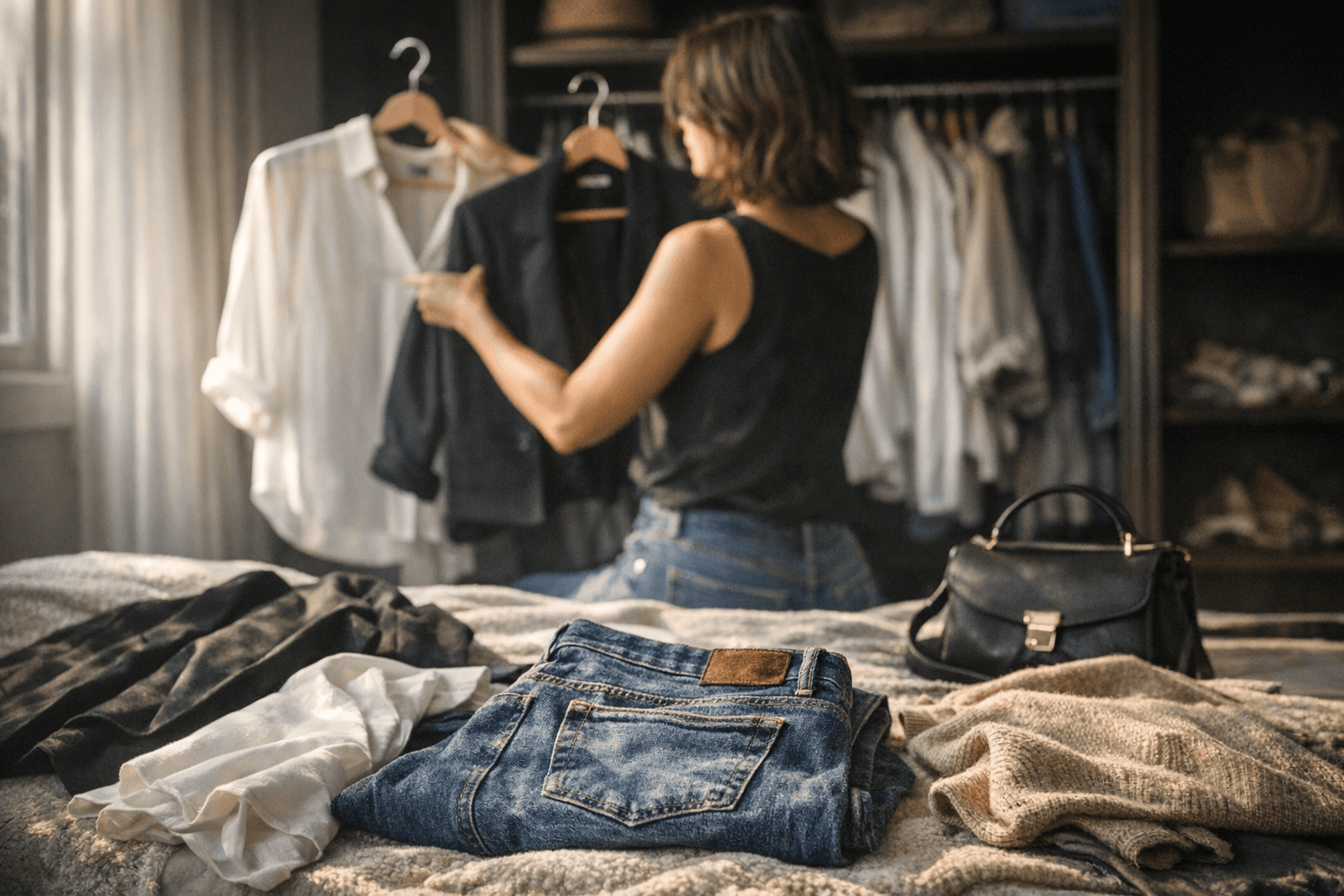
You have four pairs of jeans. Maybe five. And yet most mornings still end with the same defeated conclusion: nothing to wear. The jeans are right there, folded or hanging, accounted for, but without a deliberate supporting cast, each pair just exists in isolation rather than functioning as part of a system. The problem isn't the denim. It's that nobody ever mapped out how to build around it.
That's exactly what a denim-first capsule does: it takes your existing jeans as the given and builds a tight, repeatable outfit system around them. Not a wardrobe overhaul. Not a seasonal haul of 30 new pieces. A 12-to-15 item collection that generates 10 or more distinct outfits and eliminates the decision fatigue that makes a closet full of clothes feel empty.
Before you build, ask yourself three questions. How many days a week do you actually reach for jeans? What are your primary activities, whether that's a daily commute, desk work, errands, or social dinners? And does your climate call for layering most of the year? Your answers determine whether you need a lean 12-piece casual system or a slightly expanded 20-piece build for the person juggling office days with weekend errands.
The Three Denim Essentials
Every denim-first capsule runs on three anchor pieces. These are the spine, doing the most combinatorial work.
- A mid-rise straight jean in a medium or light wash. Your everyday workhorse. The mid-rise sits at the natural waist rather than the hip, creating a balanced silhouette that reads as intentional without veering formal. It shifts register cleanly from a Saturday errand run to a casual Friday desk day with nothing more than a shoe swap.
- A dark-wash straight jean. The piece that pulls double duty. Deep indigo and near-black washes read as elevated and pair convincingly with a structured blazer for a look that holds up in a smart-casual office setting. A Cotton Incorporated consumer survey found that 80 percent of U.S. shoppers prefer denim made from cotton or cotton blends, and it's the denser, higher-cotton fabrications that hold a dark wash longest without fading into an indeterminate middle-blue. Dark-wash jeans in the right cut have a reliable way of making any outfit look more expensive.
- A denim jacket or denim overshirt. Not a third pair of jeans. The jacket keeps the denim-forward logic of the capsule without doubling down on the same silhouette. A classic trucker cut in a lighter or medium wash creates tonal contrast over the dark straight jean. An overshirt worn open layers over a tee or fine-knit for a relaxed but assembled look.
Those three pieces are your spine. Everything else exists to serve them.
Fit and Wash Selection Rules
Before deciding which jeans from your existing collection earn their place, run each pair through two tests.
The fit test: A mid-rise straight should skim, not grip, through the thigh and fall cleanly to the ankle. If you prefer a shorter break, a cropped straight cut ending just above the ankle creates ideal proportion with ankle boots or loafers, letting the footwear read clearly without the hemline cutting the leg awkwardly. The seated test is non-negotiable: sit down, then stand. If the waistband rolls forward or gaps at the back, the rise isn't right for your proportions and no amount of belting corrects it. For most people, a mid-rise lands between 9 and 11 inches from crotch seam to waistband.
The wash test: Evaluate your denim in natural daylight, not store lighting. A true dark wash should be uniform from waistband to hem with no visible fading at the thigh or knee. What to skip: any wash with artificial whiskering at the hip or a heavy sandblasted fade mid-thigh. Both visually shorten the leg line and date the piece within a season or two.
The 10-Outfit Matrix: 13 Pieces, Repeatable Results
The supporting cast around your three denim anchors requires only 10 additional pieces. Here is the complete 13-item list:
Denim spine (3 items): mid-rise straight jean, dark-wash straight jean, denim jacket
Tops (4 items): white fitted tee, white or cream button-down, black turtleneck, fine-knit sweater in oatmeal, camel, or grey
Outerwear (1 item): a structured blazer in black, tan, or camel
Shoes (2 items): white leather sneakers, ankle boots or loafers
Non-denim bottom (1 item): black tailored trousers
Bags (2 items): structured tote, small leather crossbody
From those 13 pieces, here are 10 specific, non-repeating outfits:
1. Mid-rise straight + white tee + denim jacket + white sneakers
2. Dark-wash straight + white button-down + blazer + loafers
3. Mid-rise straight + black turtleneck + blazer + ankle boots
4. Dark-wash straight + fine-knit sweater + ankle boots
5. Mid-rise straight + white tee + blazer + white sneakers
6. Dark-wash straight + black turtleneck + denim jacket + loafers
7. Black trousers + white tee + denim jacket + white sneakers
8. Black trousers + white button-down + blazer + ankle boots
9. Mid-rise straight + fine-knit sweater + denim jacket + loafers
10. Dark-wash straight + white button-down + white sneakers
The math stacks in your favor: 2 jeans plus 3 tops plus a blazer plus 2 shoe options generates 18 or more combinations before you even factor in layering sequences. Ten outfits are a floor, not a ceiling.
The Shopping Checklist: What to Measure Before You Buy
If your current jeans don't pass the fit test and you need to replace a piece, take three measurements before you shop:
- Waist: Measure at the natural waist, roughly one inch above the navel, not at the hip. Brand sizing varies enough that a number alone tells you nothing.
- Hip: Measure at the fullest point, typically 7 to 9 inches below the natural waist. A well-fitting straight jean should allow about two fingers' width of ease.
- Inseam target: For a full-length straight cut, 28 to 30 inches typically hits at the ankle. For a cropped straight, 26 to 27 inches lands at the ideal break above the ankle bone.
In the fitting room, sit, stand, and walk. The waistband should not gap at the back or roll forward. Look for at least 95 to 98 percent cotton in the fabric content; a small amount of elastane, 1 to 3 percent, improves comfort without distorting the silhouette over time.
Cost Per Wear: The Case for Buying Better
A Cotton Incorporated survey found that the average American spends $47 on a pair of jeans and wears them so frequently that cost per wear drops to roughly four cents. Four cents. That's a return almost nothing else in your closet matches.
The formula is simple: price divided by total wears. Drop a hundred dollars on jeans and wear them 100 times and that's a dollar a wear; wear them more, and the cost keeps shrinking. The $40 pair that fades, stretches at the knee, or pills at the inner thigh after 30 washes stops paying down its cost the moment it stops getting worn.
Apply the same logic to the blazer and fine-knit sweater in the matrix above. Both appear in five of the 10 outfits listed. High-contact pieces justify higher spend because the cost per wear on a $200 blazer worn hundreds of times is a fraction of three $60 blazers that fall out of rotation.
The point isn't to spend more. It's to spend where it multiplies. A capsule built on denim you already own, surrounded by a small, intentional supporting cast, doesn't just solve the nothing-to-wear problem. It turns getting dressed into a repeatable skill rather than a daily negotiation with your own closet.
Know something we missed? Have a correction or additional information?
Submit a Tip