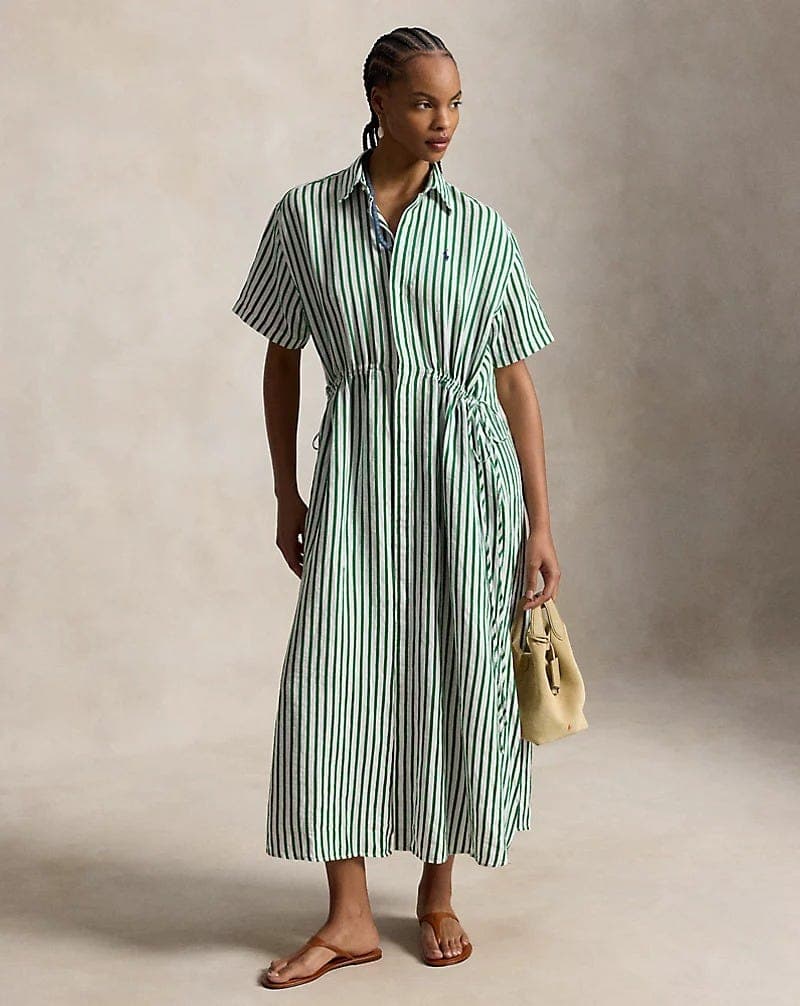
One timeless summer staple can anchor every capsule wardrobe
The smartest summer capsule starts with one great shirt: it works harder than a dress, sandal, or bag and makes every outfit feel intentional.

One well-cut shirt earns more outfit mileage than any other summer staple. A dress solves a look in one step, a sandal finishes it, and a bag carries it, but a shirt changes the shape of everything around it, which is exactly why it belongs at the center of a capsule wardrobe.
Why the shirt does the heavy lifting
In warm weather, the pieces people reach for most are rarely the most dramatic ones. The shirt is the quiet anchor: crisp enough to sharpen easy trousers, relaxed enough to float over shorts, polished enough to temper denim, and useful open as a light layer when the air turns heavy. That versatility matters more than the romance of a one-and-done summer dress, because the best capsule piece is the one that keeps making new outfits out of the same few clothes.
This is where the shirt outpaces the rest of the category. A sandal is necessary, but it only works from the ankle down. A bag can change the mood of an outfit, but not its silhouette. A trouser gives structure, yet it still needs a top to do the actual styling work. A shirt is the rare piece that can play every role at once: topper, base layer, polish point, and the thing that makes a simple look feel considered.
The capsule wardrobe idea was built for this kind of dressing
The modern capsule wardrobe did not begin as a social media shorthand for minimalism. Susie Faux is widely credited with coining the term in the 1970s, and Donna Karan gave the concept one of its clearest blueprints with her 1985 Seven Easy Pieces collection in New York. Karan’s lineup included a bodysuit, tailored jacket, skirt, pants, cashmere sweater, leather jacket, and an evening look, a compact system designed, in her words, to take a woman from day to night and weekday to weekend.
That logic still feels fresh because it solves the same problem most women actually have: too many clothes, not enough combinations. The point was never to build a closet full of identical neutrals; it was to create pieces that could shift roles without losing ease. In that sense, the shirt is the modern heir to Karan’s thinking, because it can be dressed up, stripped back, layered, tucked, tied, or worn loose without needing an entirely new wardrobe around it.

Why a summer capsule feels especially relevant now
The case for fewer, better pieces gets stronger when you look at what happens to clothing after it leaves the closet. The Ellen MacArthur Foundation says more than half of fast fashion is disposed of in under a year. It also says textile-to-textile recycling remains below 1 percent, and more than 80 percent of textile waste is still incinerated, landfilled, or lost to the environment.
That is exactly why the summer capsule is more than a style exercise. It is a practical response to a fashion system built on overproduction and quick disposal, and it gives real weight to the idea of buying only what works repeatedly. A shirt that can carry a season’s worth of outfits is not just convenient; it is the opposite of disposable dressing.
What the other staples do well, and where they fall short
Each staple category matters, but they do different jobs. The dress gives you speed and ease, especially in heat, yet it usually delivers one finished silhouette rather than many possibilities. The trouser brings instant composure, but it depends on the right top to keep it from feeling too severe. The sandal is indispensable in summer, though it functions more like punctuation than a foundation.
The bag is the least likely to anchor a capsule on its own. It can make a look feel more expensive, softer, sharper, or more directional, but it rarely changes the actual architecture of the outfit. That is why the shirt wins the utility test: it is not only part of the look, it is often the part that defines it.
How to make one shirt work all season
The best summer shirt should feel clean in shape and flexible in attitude. Look for a version with enough structure to hold a tuck, but enough ease to wear open over a tank, vest, or swimwear. Cotton poplin feels crisp and bright; a silkier finish reads more polished; an oversized cut can feel modern if the shoulders are balanced and the sleeves have a little weight.
- Half-tucked with tailored shorts for the easiest daytime uniform
- Open over a vest and straight trousers when you want a softer layer
- Buttoned to the top with a simple skirt for a sharper, more city-minded feel
- Knotted at the waist over a dress to make one piece behave like two
Style it in ways that earn repeat wear:
The shirt is also the smartest place to spend a little more, because the return is in frequency, not novelty. A piece that holds its shape after repeated wear, washes cleanly, and pairs with almost everything you already own will do more for your wardrobe than a trend buy that only works once.
The real capsule lesson
Who What Wear has made the case that readers are not replacing entire wardrobes, but refreshing them with a few staples, and that is the right instinct for summer dressing. Trends will keep moving, but the pieces that anchor real life are the ones that survive heat, packing, commuting, dinners, and the long stretch between laundry days.
If one item deserves the center of the capsule, it is the shirt. It has the rare ability to make every other piece look more intentional, and that is what a great summer wardrobe really needs.
This article was produced by Prism’s automated news system from verified source data, official records, and press releases, then run through automated quality and moderation checks before publishing. The system is built and supervised by the people who set the standards it runs under. Read our full AI policy.
Did this article answer your question?