The Capsule Wardrobe — Timeless Guide & Essentials
Your wardrobe is probably full and still feels empty. Build a capsule that solves that: 30-37 pieces, infinite combinations, zero decision fatigue.
The Problem Most Wardrobes Have
The gap between a closet stuffed with clothes and actually having something to wear is where most people live permanently. The average person reaches for the same handful of pieces while the rest hang untouched, collecting guilt alongside dust. A capsule wardrobe is the fix: a deliberately edited set of pieces, typically between 30 and 40 per season, where everything works together and nothing is wasted.
The philosophy is older than most people realize. London-based wardrobe consultant Susie Faux introduced the concept in the 1970s at her boutique aptly named "Wardrobe," arguing that a small selection of interchangeable, well-made garments beats a closet full of impulse buys every time. It was Donna Karan who pushed the idea into mainstream consciousness in 1985 with her "Seven Easy Pieces" collection: a bodysuit, tailored jacket, skirt, trousers, cashmere sweater, leather jacket, and evening dress. Seven pieces designed to carry a working woman through any day, any meeting, any occasion. The number has since expanded, but the logic holds.
The Ground Rules
Before you buy anything or edit anything out, internalize the three rules that make a capsule actually function:
- Every piece must coordinate with at least three others in your wardrobe. If it only pairs with one thing, it's a costume, not a capsule piece.
- Build your foundation in neutrals first. Black, white, navy, camel, and grey form the backbone. They mix freely, they photograph well, and they age gracefully.
- Add one or two accent pieces per season, not more. An accent is where your personality enters: a rust-colored blazer, a cobalt knit, a printed midi skirt. One or two accents energize a neutral base; five or six turn it into visual noise.
These aren't aesthetic preferences. They're structural rules. A wardrobe that follows them will generate significantly more outfit combinations from fewer pieces. Ten coordinated pieces alone can yield roughly 30 distinct outfit combinations. That math is why capsule dressing feels effortless once the architecture is right.
Building Your Color Palette
Color is the engine of a functional capsule, and it deserves more deliberate attention than most people give it. Research suggests color accounts for up to 90% of a person's gut reaction in visual contexts, including clothing. That instant read matters, which is why scattering random colors through a closet creates an anxious, nothing-goes feeling even when the closet is full.
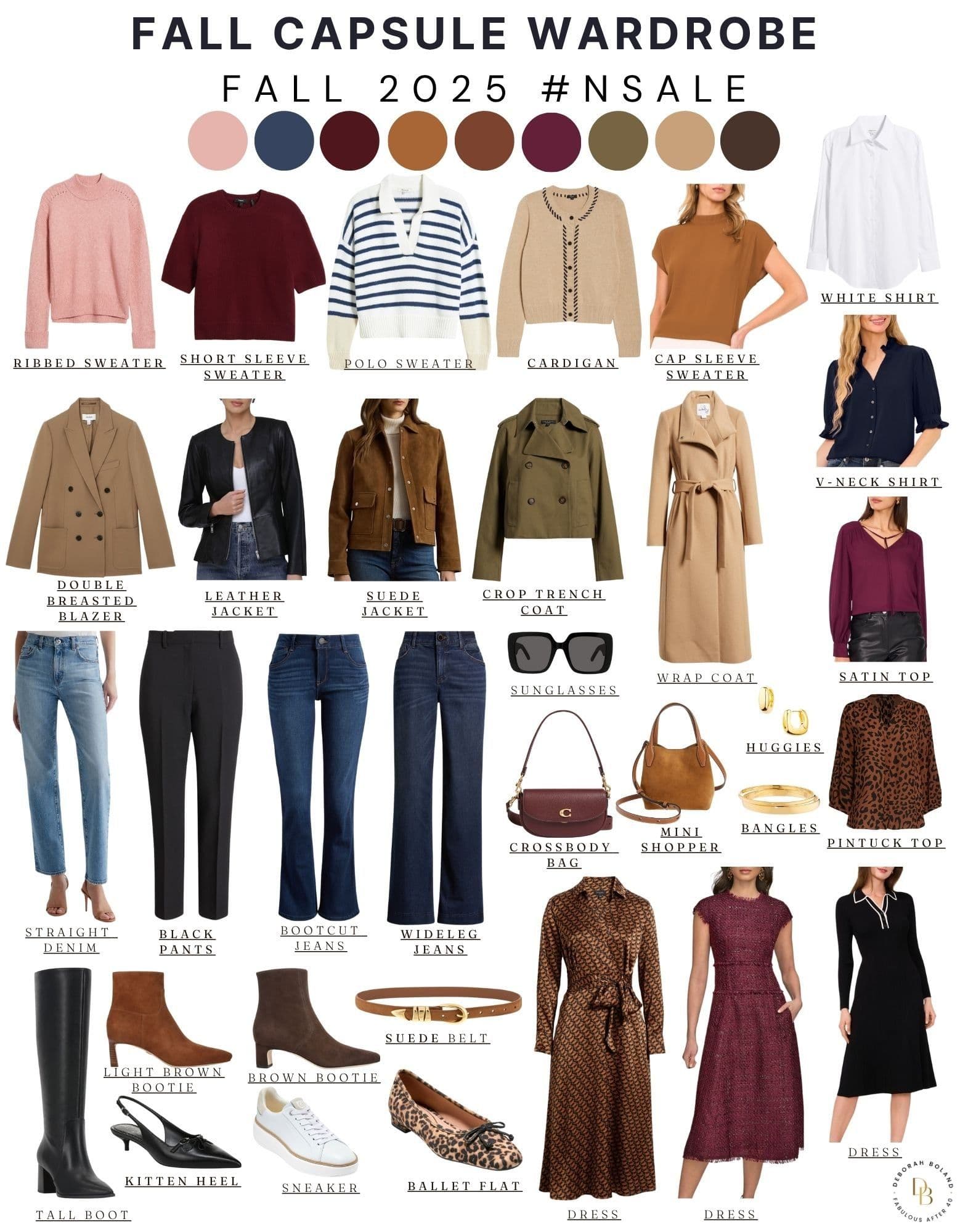
Most well-built capsules operate on 4-6 core neutrals as the base layer. From there, you identify one or two main colors you actually wear repeatedly, then a tight group of accent shades for personality. The discipline is in resisting the pull of a beautiful color that doesn't connect back to your neutral foundation. If a burgundy skirt can't be worn with at least three pieces you already own, it belongs to someone else's capsule.
Navy and black remain the two most reliable base colors in capsule building. Black pairs with virtually everything and reads as sharp or relaxed depending on what surrounds it. Navy carries the same versatility with slightly more warmth. Brown and camel are increasingly favored as a softer, earthier alternative to the black-and-white axis, particularly for autumn and winter builds.
Outfit Formula Frameworks
A capsule only delivers on its promise if you have a few reliable outfit formulas you can execute without thinking. These aren't rigid uniforms; they're starting points that eliminate decision fatigue on ordinary mornings.
The classic three-part formula: a neutral base (trousers or a skirt), a mid-layer (knitwear, a shirt, or a fitted turtleneck), and an outer layer (a structured blazer or coat). Vary the proportions and textures within that formula and the same three roles can produce weeks of distinct looks.
The two-piece shortcut: a well-cut trouser paired with a tucked statement top or a dress worn alone. This is where your one or two accent pieces earn their place. A camel trouser and a cobalt silk blouse require no other work; the contrast does everything.
For weekends and casual contexts: a clean denim base (dark-wash straight leg is the most versatile cut), a quality white or striped tee, and a single layer over the top, whether that's an overshirt, a bomber, or a longline cardigan.
The One-Month Capsule Checklist
Think of building your capsule the way you'd pack for a one-month trip. You're not preparing for every possible scenario; you're preparing for your actual life. A practical 37-piece framework breaks down as follows:
- 15 tops (a mix of basics, knits, button-downs, and one or two statement pieces)
- 9 bottoms (trousers, jeans, skirts in your core neutral palette)
- 4 layers (one structured blazer, one casual jacket, one transitional coat, one lightweight overshirt)
- 4 shoes (a clean sneaker, a flat or low heel, a boot, a sandal or loafer depending on climate)
- 2 dresses (one casual, one that works for a dinner or event)
- 3 wildcard pieces (the accent items, the seasonal swap, the piece that makes the capsule feel like yours)
The 37-piece count aligns with what stylists and wardrobe editors consistently recommend as the sweet spot for weekday and weekend coverage without forcing heavy laundry cycles. The more restrictive Project 333, developed by writer Courtney Carver in 2010, takes it further: 33 pieces including outerwear and accessories for a full three-month season. It's a useful reset for anyone who wants to pressure-test what they actually reach for.
Seasonal Swap Guidance
A capsule wardrobe doesn't require a full rebuild every three months. The core neutral foundation stays. What rotates is the weight, texture, and a handful of seasonal-specific pieces.
In spring, swap heavy wool knits for cotton and linen layers. Pull out the transitional trench or a lighter-weight blazer. In summer, the capsule contracts: fewer layers, more focus on clean basics and breathable fabrics. In autumn, reintroduce texture through cashmere, boiled wool, and heavier denim. Winter is when the coat earns its keep as the most visible piece in your rotation, which makes it worth investing in seriously.
Store off-season pieces separately, whether that's a vacuum-sealed bag for knitwear or a separate rail for summer linens. The capsule should feel live and current, not crowded with pieces from two climates at once.
Cost Per Wear and the Repair vs. Replace Decision
The cost-per-wear formula is the clearest argument for buying quality over quantity, and it's simple: divide the total cost of an item by the number of times you wear it. A $200 wool coat worn 100 times over three years costs $2 per wear. A $60 fast-fashion version worn 10 times before it pills beyond dignity costs $6 per wear, and went to landfill faster. The more expensive piece was cheaper.
Apply the same logic to the repair vs. replace decision. When a capsule piece shows wear, the question isn't whether to bother fixing it; it's whether the cost of repair is justified by the number of additional wears it will deliver. A cobbler resoling a leather boot for $40 on a boot you paid $300 for and wear three times a week is an obvious yes. A $15 fast-fashion shirt that split at the seam after six months is a different calculation, and ideally the kind of piece that doesn't enter a well-built capsule in the first place.
Sustainable Shopping and Secondhand Sourcing
The sustainability case for capsule wardrobes is significant: 87% of fashion produced globally ends up in a landfill or incinerator within a year of purchase. Less than 1% of clothing is actually recycled. Building a capsule forces the opposite behavior: fewer purchases, higher quality, longer ownership cycles.
Secondhand sourcing is one of the most effective ways to build a capsule without the full financial barrier of buying everything new. Vintage and consignment stores consistently carry the kind of neutral, well-made basics that capsule wardrobes require: trench coats, wool blazers, Levi's 501s, silk blouses. Brands like Eileen Fisher have moved further, operating their own buy-back and resale programs so garments re-enter circulation rather than waste streams.
When buying new, prioritize brands that publish material information and have verifiable sustainability claims. Organic cotton, responsibly sourced wool, and recycled synthetics are increasingly available at accessible price points. The principle holds regardless of budget: buy the best quality you can afford, wear it as many times as possible, and treat repair as a default rather than a last resort.
A capsule wardrobe, done right, isn't a minimalist exercise in deprivation. It's a maximum-efficiency system where every piece pulls its weight, every outfit assembles itself, and the closet finally starts working for you instead of against you.
This article was produced by Prism’s automated news system from verified source data, official records, and press releases, then run through automated quality and moderation checks before publishing. The system is built and supervised by the people who set the standards it runs under. Read our full AI policy.
Did this article answer your question?