Ashley Olsen’s Paris black tailoring redefines quiet luxury for heatwave dressing
Ashley Olsen’s black tailoring in a Paris heatwave shows quiet luxury has gone harder, with discipline and precision replacing beige softness.

Ashley Olsen just made the new quiet-luxury dress code brutally clear: it is no longer about melting into soft neutrals, it is about looking composed enough to ignore the weather. In a Paris heatwave that pushed forecasters toward 40C and sent France into emergency measures, her all-black tailoring read less like minimalism and more like authority with a pulse.
Quiet luxury has hardened
For years, the quiet-luxury conversation was coded in cream cashmere, camel coats, and the kind of softness that suggested money without trying too hard. Ashley Olsen’s Paris look pushes that language forward. Black tailoring keeps the same Olsen polish, but it sharpens the silhouette and strips out the cozy part of the equation, which is exactly why it feels current.
That shift matters because the old-money mood in 2026 is not standing still. The look is moving away from comfort-coded understatement and toward something more directional, more city-bred, and a little more severe. It is still discreet, but now the discretion comes with discipline.
Why Paris made the look hit harder
The setting did half the work. Who What Wear UK ran the story on June 21, 2026, right as Paris sat inside a major late-June heatwave. Forecasters were warning that the city could climb above 40C for the first time on a June day, and by June 22 Paris had logged its hottest June night on record at 24.2C. France was already under maximum-alert warnings, with school closures and restrictions on some public alcohol consumption disrupting daily life.
Against that backdrop, Olsen’s black tailoring was more than a style choice. It became a visual flex, the kind of look that refuses to wilt even when the city does. Heatwave dressing usually tilts toward linen, pale cotton, and anything that breathes; Olsen went the other way, and that refusal is what gives the outfit its charge.
The Olsen code still runs the room
This is not a random celebrity street-style moment. Mary-Kate and Ashley Olsen founded The Row in 2005, and the brand’s own positioning still sits on timeless ready-to-wear, handbags, clothes, and accessories. That pedigree matters because the sisters have spent two decades turning understatement into a language of its own, one built on monochrome, privacy, and a very specific kind of polish.
The Row’s Paris chapter deepens the effect. The brand opened a Paris store at 1 rue du Mont Thabor, and the sisters have repeatedly used Paris as a stage for their label. Their presentations have long been described as intimate and non-spectacular, which is basically the anti-runway version of quiet power: no fireworks, no noise, no begging for attention.
What black tailoring says now
Black tailoring used to read as classic, even safe. In this moment, it reads as strategic. It signals control, taste, and a refusal to be softened by trend-cycle prettiness, especially when the weather practically demands surrender. That is why Olsen’s look lands as a stronger old-money signal than the usual beige uniform.
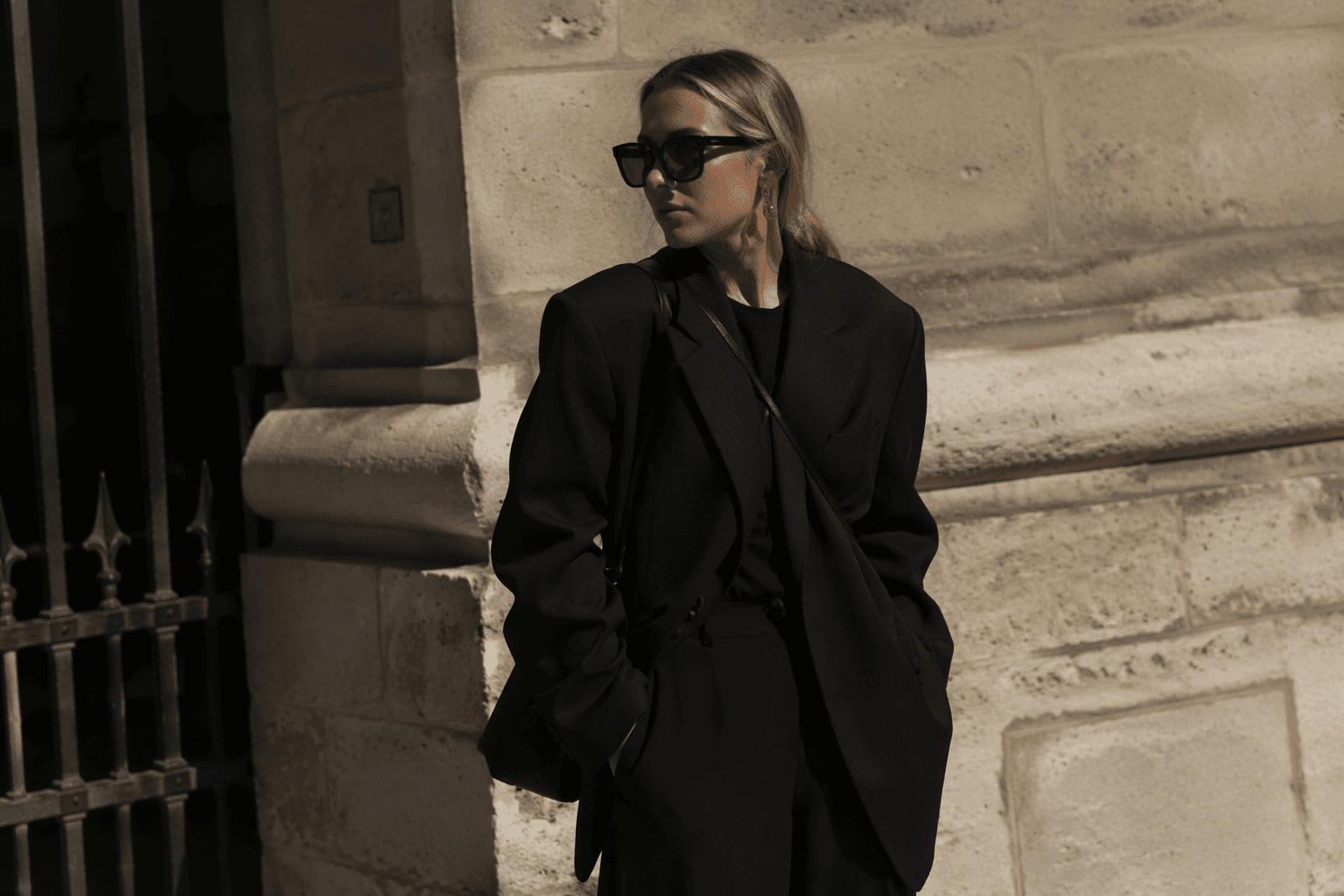
The new elite code is not about looking expensive in a generic way. It is about looking exact. Sharp shoulders, clean lines, and a darker palette turn quiet luxury into something more authoritative, almost architectural. The message is simple: ease is no longer the only luxury. Precision is.
How to wear the new quiet luxury uniform
If you want the Olsen version of old money style now, think less plush and more edited. The point is not to chase stiffness for its own sake, but to use structure the way previous seasons used softness: as the signal.
- Choose tailoring with a severe edge, not a relaxed drape. A strong jacket or a crisp trouser line does more work than a loose, breezy set.
- Keep the palette restrained, but let black lead. It is the fastest way to move quiet luxury away from linen cliché and toward modern authority.
- Focus on finish. The Row has always sold the idea that clothes are about construction as much as appearance, and that is where the look feels richest.
- Let the silhouette do the talking. When the clothes are this pared back, proportion and cut become the whole story.
- Treat understatement as intent, not absence. Olsen’s look works because it feels chosen, not accidental.
Why this version of old money feels more believable
The old-money aesthetic has always depended on restraint, but restraint has changed. The soft, neutral version suggested comfort and leisure; this newer version suggests a woman who moves through a city, keeps her cool, and does not need weather-appropriate dressing to prove she understands fashion. Ashley Olsen in Paris makes that case without saying a word.
That is why the image sticks. In a summer where Paris was dealing with record-breaking heat, emergency warnings, and everyday disruption, black tailoring became a statement of control. Quiet luxury is still here, but it has shed its softness and tightened into something far more exacting.
This article was produced by Prism’s automated news system from verified source data, official records, and press releases, then run through automated quality and moderation checks before publishing. The system is built and supervised by the people who set the standards it runs under. Read our full AI policy.
Did this article answer your question?