Before You Buy: The Smart Shopper's Guide to Quiet Luxury Essentials
Stop impulse-buying "quiet luxury" labels and start buying smarter: cashmere, tailoring, and accessories have tells that separate real investment pieces from expensive impostors.

Quiet luxury has a counterfeiting problem, and it has nothing to do with knockoffs. The real issue is that the aesthetic's rise has flooded the market with pieces that look the part, photograph beautifully, and fall apart or date themselves within two seasons. Before you spend seriously, whether on a new Loro Piana sweater or a pre-owned Brioni suit, you need a framework that goes beyond brand recognition. This is that framework.
Cashmere: What the label won't tell you
The single most important number in cashmere is micron count, not the country of origin or the brand's heritage narrative. Fiber diameter is measured in microns, and anything below 16 microns qualifies as Grade A cashmere; the finest pieces, typically from Mongolian or Scottish mills, come in at 14 to 15 microns. You will almost never find this figure on a hangtag, which is precisely why you need to know to ask for it.
Beyond fiber quality, construction tells you everything. Hold a cashmere piece up to a light source and check the knit density. A quality sweater should be dense enough that light barely passes through. Pill-resistance correlates directly with ply: two-ply cashmere, where two strands are twisted together before knitting, holds its structure far longer than single-ply alternatives, which look beautiful on a hanger but deteriorate within a single winter of regular wear.
On the pre-owned market, condition grading language varies wildly between platforms. A piece listed as "excellent" on one resale site may show significant pilling at the underarms and cuffs. When buying secondhand cashmere, request close-up photographs of the elbow patches, cuffs, and under-sleeve seams; these are the first points of wear. A gently used Scottish-mill sweater from a brand like N.Peal or Johnstons of Elgin will outlast a brand-new fast-luxury alternative purchased at full retail.
Tailored suiting: the architecture of a good investment
A suit is architecture before it is clothing, and the bones determine everything. The first distinction to understand is canvas construction: full-canvas, half-canvas, and fused. In a full-canvas suit, a layer of horsehair canvas runs the full length of the jacket, hand-stitched to the outer fabric, which allows the garment to mold to your body over years of wear. Fused suits, where the interfacing is glued to the fabric, look crisp in the shop and bubble at the chest after three or four dry-cleaning cycles. Half-canvas is a legitimate middle ground used by excellent makers including Canali and some Corneliani lines, floating canvas through the chest and lapel where structure matters most.
To identify construction without cutting into a garment, pinch the lapel fabric between your fingers and gently separate it from the lining. In a canvassed jacket, you will feel three distinct layers. In a fused jacket, the two layers move as a single stiff unit.
On the pre-owned market, suiting represents extraordinary value. A full-canvas Brioni or Kiton suit at auction or on a platform like 1stDibs can be acquired for a fraction of its original cost, often in the range of 15 to 25 percent of retail, in sizes and colors that would require a 12-to-18-month bespoke order if purchased new. The caveat: always factor in alteration costs before purchasing. A suit that requires significant re-cutting at the shoulders is rarely worth the expense; a suit that needs only waist suppression and trouser tapering is a genuine find.
Fabric matters as much as construction. Super numbers (Super 110s, 130s, 150s) indicate the fineness of the wool fiber, but they are not a simple hierarchy of quality. A Super 130s cloth from a reputable mill like Loro Piana, Ermenegildo Zegna, or Scabal will outperform a Super 160s from an unknown origin because the finer the fiber, the more vulnerable the cloth is to wear and snagging. For a working wardrobe suit, a well-milled Super 120s or 130s in a tight plain weave is the practical choice. Reserve the featherweight high-super cloths for a second or third suit worn for specific occasions.
Accessories: where quiet luxury is most easily faked and most easily authenticated
The old-money accessory wardrobe is built on restraint and material integrity, not logo density. The categories worth real investment are narrow: shoes, leather goods, and a watch or two.
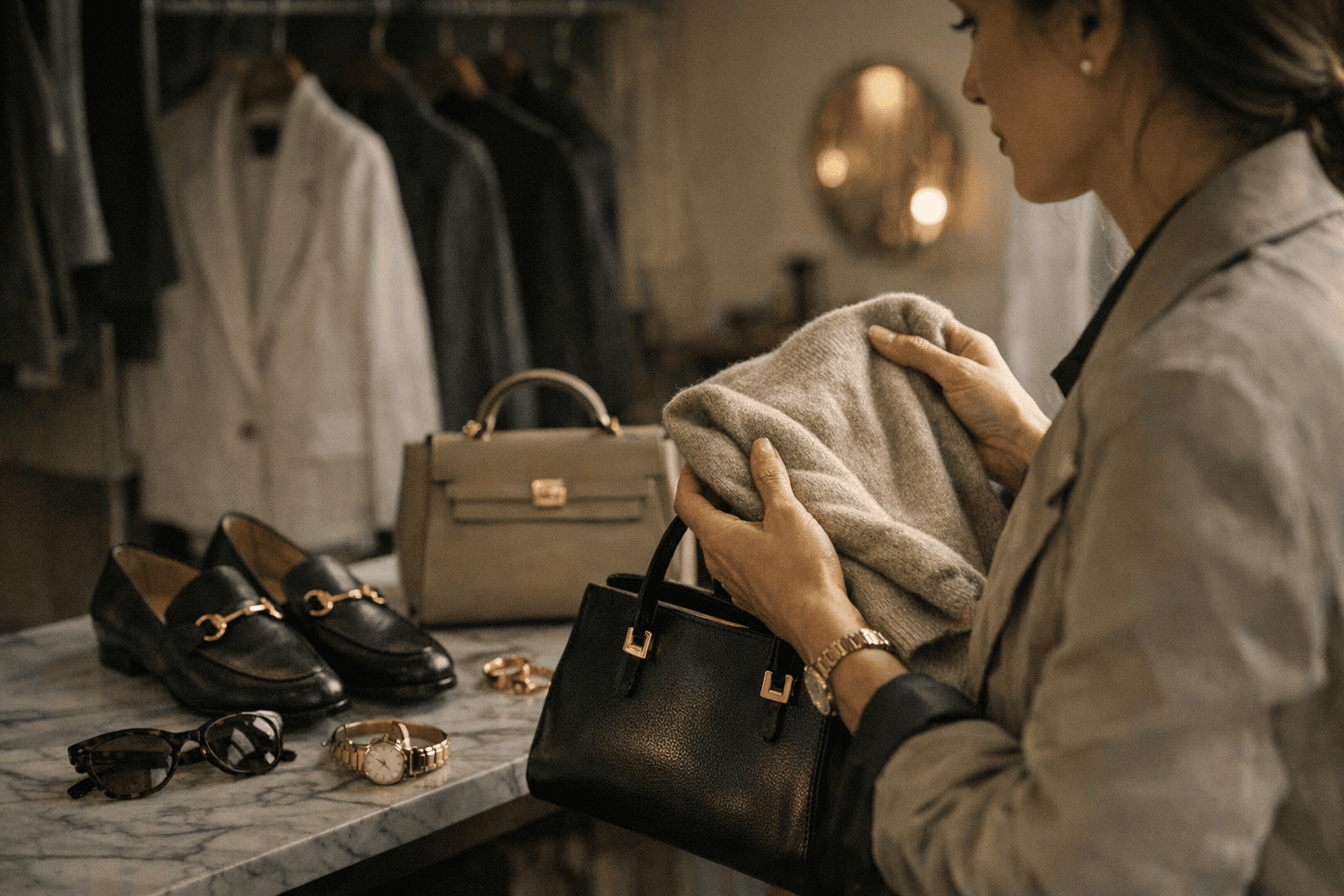
For shoes, the construction method is the buying criterion. A Goodyear-welted shoe, where the upper, welt, and sole are stitched together in a continuous seam, can be resoled multiple times over decades. Blake-stitched shoes are lighter and more flexible but offer one or two resoles before the construction is compromised. A pair of Goodyear-welted shoes from Carmina, Edward Green, or Crockett and Jones at the mid-tier investment level will outlast any cemented or bonded construction at any price point. The welt is visible as a thin strip of leather running around the perimeter of the sole; if you cannot see it, the shoe is almost certainly cemented.
Leather goods require the same material interrogation. Full-grain leather, which retains the natural surface of the hide and develops a patina over time, is categorically different from corrected-grain leather, which is sanded smooth to hide imperfections and then embossed with a uniform texture. Full-grain ages into itself; corrected-grain merely ages. On a bag or belt, the easiest test is the cut edge: full-grain leather goods from quality makers will have burnished or painted edges that are clean and tight; lesser goods reveal a fibrous, suede-like interior when you look at the cut edge closely.
A word on watches: the quiet luxury register in horology is not Audemars Piguet Royal Oak (which, despite its exceptional engineering, has become a status signal, the opposite of the understated). The old-money watch is a dress watch with a clean dial: a JLC Reverso, a Patek Philippe Calatrava, or a vintage Rolex Datejust in steel. Pre-owned is not just acceptable here, it is often preferable, because the secondary market prices these pieces transparently and a well-serviced watch carries documented history.
The pre-owned calculus
Every category above has a pre-owned sweet spot worth understanding. The platforms are not equal: 1stDibs and The RealReal offer authentication services but charge buyer premiums that compress your value gain. Vestiaire Collective's direct seller model can yield better pricing but requires more due diligence on your part. For suiting and accessories specifically, specialist dealers who focus on a single category, estate sale houses, and brand-specific resellers often carry better-conditioned stock than generalist luxury resale platforms.
The depreciation curve is not uniform across categories. Cashmere depreciates steeply with condition; a pilled sweater has almost no resale value regardless of its origins. Tailoring in a classic cut holds value well because the market for it is consistent. Goodyear-welted shoes in a conservative Oxford or Derby last appreciate in wearable condition because the supply of well-maintained examples is genuinely limited.
The before-you-buy checklist
Before any quiet luxury purchase, new or pre-owned, run through these points:
- Cashmere: confirm ply count, request fiber origin if possible, inspect cuffs and underarms for pilling, verify that the fabric weight feels substantial rather than drapey
- Suiting: pinch-test the lapel for canvas, verify cloth mill if possible, calculate alteration costs before committing, avoid shoulders that require structural recutting
- Shoes: look for the visible welt, confirm resoling history on pre-owned pairs, choose a conservative last that will read correctly in 20 years
- Leather goods: check cut edges for full-grain construction, assess hardware quality by weight and finish consistency, avoid pieces where stitching is glued rather than sewn through
- Watches: buy from a seller who provides service history, prioritize a clean dial over complications you will not use, think twice before any piece whose primary appeal is its current cultural moment
The real definition of quiet luxury is not spending less; it is spending in a way that compounds. A well-chosen piece does not just serve you this season. It covers decades, often outlasting the trends that made it feel necessary in the first place.
This article was produced by Prism’s automated news system from verified source data, official records, and press releases, then run through automated quality and moderation checks before publishing. The system is built and supervised by the people who set the standards it runs under. Read our full AI policy.
Did this article answer your question?