Cannes red carpet leans into Princess Diana and Jane Birkin homages
Cannes is dressing like prestige has a pedigree again, with Diana, Birkin, and archive references doing the heavy lifting on the red carpet.
Heritage is the new status language
Cannes has always understood glamour as a performance of taste, but this year the signal was especially clear: the red carpet favored recognizable inheritance over novelty. Harper’s Bazaar’s Cannes roundup centered on Princess Diana, Jane Birkin, and Demi Moore, a trio that says everything about where prestige fashion is headed now, toward looks that feel inherited, legible, and socially fluent. When the Festival de Cannes calls its red carpet “la montée des marches,” it is already telling you this is not just entrance dressing. It is ritual, hierarchy, and image-making all at once.
The 79th Cannes Film Festival ran from May 12 to 23, 2026, with the Croisette and the Palais des Festivals et des Congrès again serving as the most closely watched backdrop in fashion. Harper’s Bazaar has called Cannes “the most glamorous red carpet of the year,” and that description matters because glamour here is not about excess for its own sake. It is about who can wear history well enough to look expensive, settled, and certain. In a fatigued fashion culture, that kind of recognizability now reads as authority.
Why old-money dressing is winning again
Old-money style is never really about money alone. It is about codes that have been collected, repeated, and refined until they seem to belong to a lineage rather than a season. Cannes made that point forcefully this year, because the strongest looks did not chase shock value. They borrowed from the archive, from royal memory, and from the kind of polished silhouettes that already carry cultural capital.
That is why the homage trend feels bigger than nostalgia. It reflects a market in which decorative but disciplined references outperform experimental spectacle as a prestige signal. A gown that echoes Diana or Birkin does more than flatter the wearer. It says the wearer understands the language of legacy, and that she can step into a story already approved by fashion history.
What to wear if you want the same effect
- Choose a silhouette that looks archived, not costume-like.
- Favor clean drape, soft structure, and visible craftsmanship.
- Keep the reference recognizable enough to read instantly, but restrained enough to feel elegant.
- Let one historical signal do the work instead of piling on several.
The best old-money dressing does not shout. It implies access, taste, and confidence through proportion, fabric, and a sense of restraint. Cannes rewarded exactly that.
Princess Diana’s shadow, and why it still sells
The most direct example came from Anastasia Andrushkevich, whose Cannes tribute recreated Princess Diana’s 1987 baby-blue look. The original was a Catherine Walker gown, a detail that matters because Catherine Walker is part of the royal-fashion canon, not just a dressmaker’s label. Andrushkevich wore the flowing baby blue gown at the 2026 premiere of Fjord, turning one of the most famous royal red-carpet images into a contemporary Cannes moment.
The dress had already acquired market value beyond its emotional charge. Reporting noted that Diana’s original gown was auctioned for $137,500, a figure that underscores how royal archive pieces now function like blue-chip assets. That price is not just about fabric or condition. It is about provenance, memory, and the fact that certain looks become culturally liquid when they are attached to an icon who defined elegance for a generation.
Diana remains so potent because her style sits at the intersection of accessibility and aspiration. The baby-blue gown is formal, but it is not stiff. It is soft enough to feel human, polished enough to feel consequential, and familiar enough to be instantly legible on a modern carpet that thrives on image recognition.
Jane Birkin and the appeal of studied ease
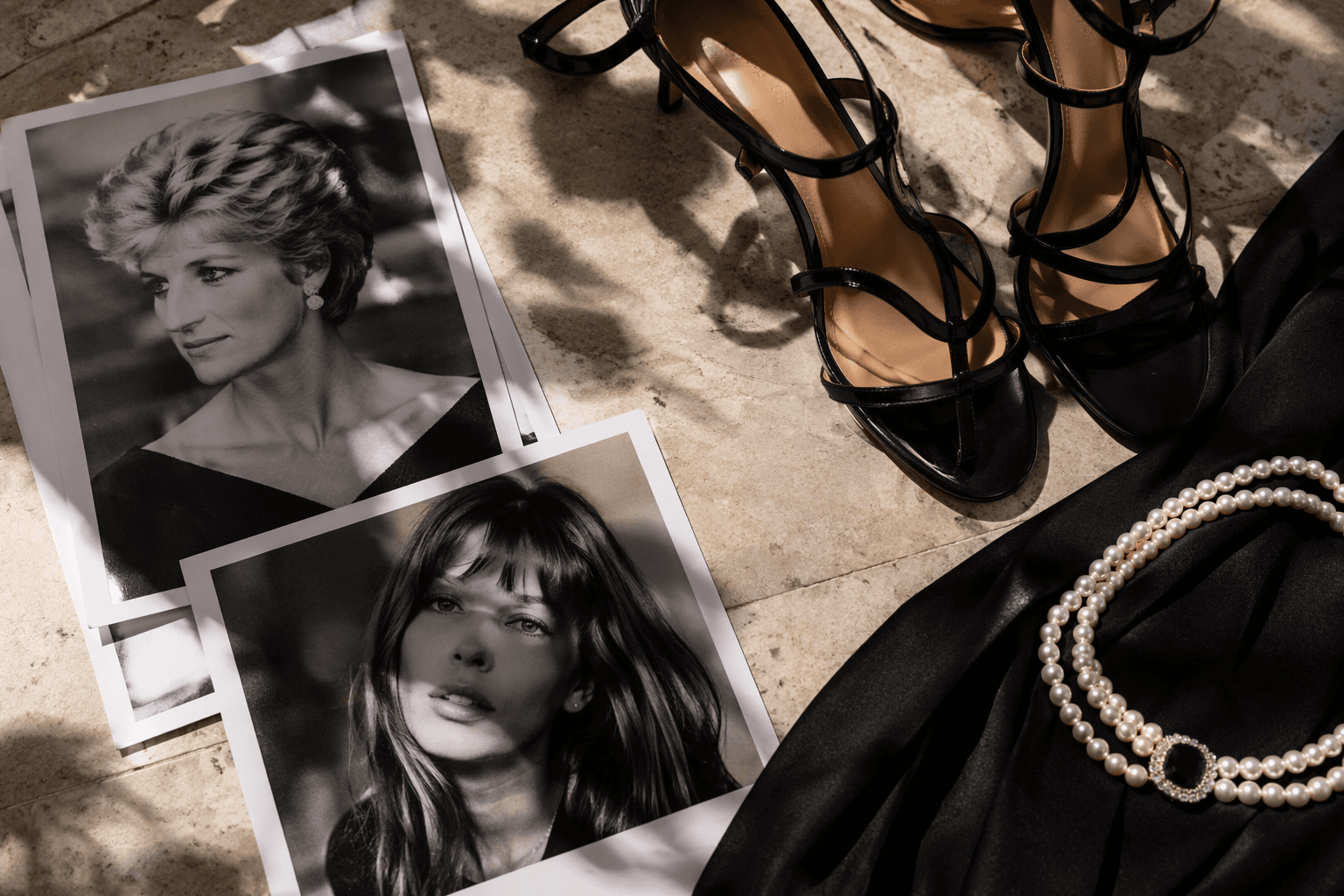
Bella Hadid’s Cannes appearance pushed the same idea in a different direction. Harper’s Bazaar identified her look as a custom Schiaparelli dress inspired by Jane Birkin, which is a smart choice because Birkin’s influence has never been about perfection. It is about ease that still reads as intentional, the kind of lived-in chic that feels unforced even when it is highly constructed.
Schiaparelli gives that reference a sharper frame. The house is known for surrealism, drama, and exacting finish, so pairing Birkin’s relaxed legend with Schiaparelli’s couture rigor creates an especially modern old-money equation: effortless on the surface, engineered underneath. That balance is exactly why this kind of homage performs so well now. It gives the audience something familiar to decode, while still satisfying the appetite for craftsmanship.
What matters is not imitation. It is translation. Birkin’s appeal lies in the way she made insouciance look enviable, and a custom Schiaparelli version turns that attitude into red-carpet capital. The message is clear: ease is only persuasive when it has structure behind it.
Demi Moore and the return of self-referencing glamour
Demi Moore’s presence in Harper’s Bazaar’s Cannes coverage added another layer to the story. Her fashion choices were framed as part of a broader festival narrative of heritage-conscious dressing, but Moore’s version of homage is more personal than royal or archival. She referenced her own earlier screen-era style, which is a reminder that legacy does not have to come from a museum or a princess’s wardrobe. Sometimes it comes from your own image history.
That kind of self-reference is especially powerful at Cannes, where stars are expected to arrive as both their current selves and as embodiments of a long public mythology. Moore’s approach suggests that prestige today often lies in continuity. The market rewards women who can make their past feel curated rather than dated, and that is a very old-money instinct at its core. Nothing looks more expensive than knowing your own iconography.
What Cannes is telling the market now
The broader lesson is that fashion has moved from novelty-chasing toward codes that feel inherited. Cannes is one of the world’s most closely watched style stages every May, and this year it showed how quickly the center of gravity can shift when audiences tire of spectacle. Decorative maximalism, archival glamour, and historical reference are not opposites of modernity. They are modernity’s current premium language.
For readers building an old-money wardrobe, the takeaway is simple: reach for pieces that suggest continuity, not invention for its own sake. Look for fabrics with a quiet sheen, gowns that skim rather than cling, tailoring that suggests discipline, and references that feel selective rather than obvious. The goal is not to dress like a reenactment. It is to wear something that implies you already belong to the room.
Cannes proved that prestige still depends on memory. The strongest looks this year did not try to outrun the past. They made it look freshly expensive.
This article was produced by Prism’s automated news system from verified source data, official records, and press releases, then run through automated quality and moderation checks before publishing. The system is built and supervised by the people who set the standards it runs under. Read our full AI policy.
Did this article answer your question?