Cartier, Tiffany and Dior lead summer 2026 bold jewelry trend
Summer jewelry is turning louder, but the smartest pieces still read old money when they favor heritage houses, polished gold, and collectible stones.
The new old-money signal is not quiet, it is controlled
Summer 2026 jewelry is not leaning into discretion so much as discipline. WWD calls the season “all about the bold and playful,” with “color and whimsy” and “escapist glamour” setting the tone, but the look that matters for old-money dressing is more specific: heritage-branded pieces with strong house signatures, polished finishes, and a sense that they will be worn for years, not one weekend. That is the difference between merely expensive and actually investment-looking.
The shift lands at an interesting moment. Bain & Company says the global personal luxury goods market reached €364 billion in 2024 and is forecast to ease to €358 billion in 2025, a 2 percent decline, even as jewelry remains one of the stronger categories. In other words, the mood may be changing, but fine jewelry still carries weight. When the broader market softens, recognizable craftsmanship and brand codes become even more valuable, because they promise permanence in a season that is suddenly allergic to restraint.
What reads old money now
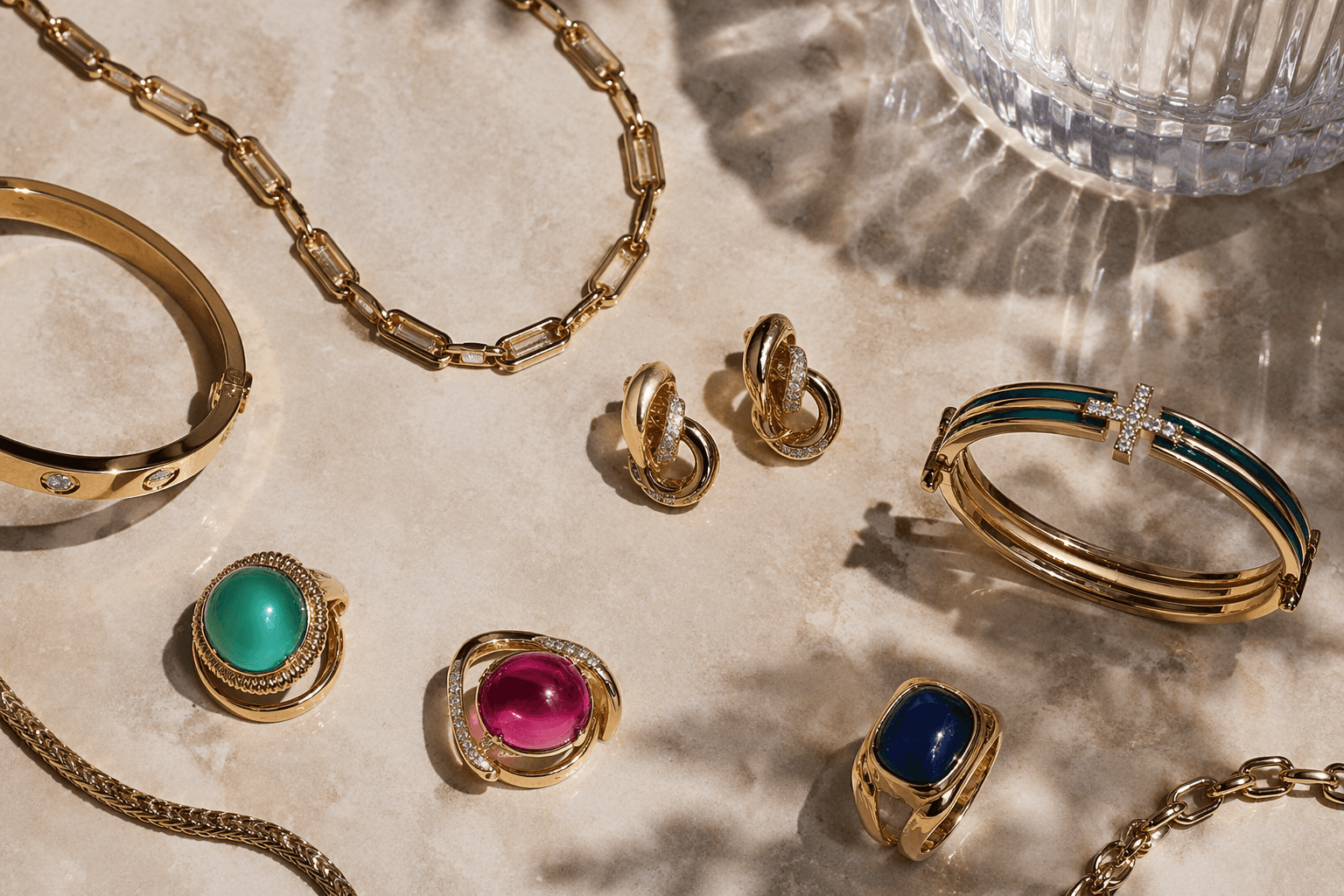
Old-money jewelry for summer is not about piling on sparkle until it looks loud. It is about pieces that feel inherited, even when they are new: rope motifs, polished gold, discreet diamonds, collectible colored stones, and silhouettes that sit cleanly with linen, crisp tailoring, and a repeat wardrobe. The best pieces do not announce wealth by volume alone. They signal taste through recognizable forms, subtle construction, and the kind of polish that looks natural with a white shirt and a tan.
That is why the current wave of bolder jewelry still has to be filtered carefully. A vivid gemstone ring can feel polished and aristocratic if the setting is refined and the shape is architectural. A heavy logo piece, by contrast, can look like a flex without a pedigree. The code is simple: choose jewelry that looks like it belongs in a family archive, not just a shopping cart.
Cartier, Tiffany and Dior set the tone
Cartier remains the cleanest shorthand for this shift because the maison’s appeal has always been built on recognizable shapes and precious stones rather than gimmickry. On its official site, Cartier continues to frame its high jewelry around “latest creations,” unique stones, and recurring themes. That combination matters now: it keeps the pieces fresh without stripping away the house identity that makes them feel collected rather than merely purchased.
Tiffany is pushing in a bolder direction while staying firmly inside the fine-jewelry frame. The Blue Book 2026 collection is titled *Hidden Garden*, designed by Nathalie Verdeille and The Tiffany Design Studio, and it is presented as a showcase for “the world’s finest diamonds and extraordinary colored gemstones.” That pairing of diamonds with colored stones is exactly where the season’s smartest glamour lives. It gives you impact without sacrificing refinement, especially when the stones are cut and set with enough precision to hold their own beside tailoring.
Dior brings a different kind of polish, one that feels more editorial and more coded. The house says its jewelry collections celebrate Christian Dior’s symbols and the savoir-faire of its ateliers, while Jonathan Anderson’s Spring-Summer 2026 work reinterprets archive pieces for now and refreshes the house codes. That matters because the most compelling old-money jewelry rarely looks raw or experimental. It looks like history, edited for the present. Dior’s approach turns that into a visible language: archive references, house symbols, and a finish that reads refined rather than ornate.
The houses to watch if you want color without losing polish
Chanel’s fine-jewelry offering stays grounded in the classics, with rings, bracelets, necklaces and earrings as the core categories. That may sound straightforward, but it is exactly why Chanel works in this conversation. The brand’s jewelry tends to feel disciplined even when the design is decorative, which makes it easy to wear with summer suiting, silk separates, and the kind of restrained dress that would swallow a trend-driven statement piece.
Louis Vuitton takes a more explicitly contemporary route, but its Color Blossom line still offers a useful range for readers who want recognizable luxury with a visible pulse of color. On the house’s fine-jewelry shop, the line includes earrings starting around $1,870 and a long necklace priced at $53,500. That spread tells you everything about the market right now: there is room for entry-level luxury, but also for high-ticket pieces that behave like collectibles. If you want the old-money effect, the higher-end pieces matter less for their price alone than for their proportion, finish, and the way they hold their shape against simple summer clothes.
Why Kiki McDonough suddenly feels essential again
If the French maisons define the polished side of the story, Kiki McDonough gives it a distinctly British accent. WWD singled her out as London’s queen of color, and the timing is apt. In April 2026, she received a royal warrant from Queen Camilla, a recognition that reinforces the brand’s place in the upper reaches of British jewelry culture. McDonough founded her London-based label in 1985, and the V&A credits her as one of the first women to make a name for herself in British luxury jewelry.
The real significance, though, is stylistic. The museum says she helped introduce colorful gemstones to the British jewelry scene outside the traditional big three gems. That detail feels newly relevant because summer 2026 is rewarding exactly that kind of discipline with personality. Her pieces offer color, but not chaos. They have the social ease that makes a gem ring look right at breakfast and again at dinner, which is precisely how old-money jewelry should behave.
How to wear the trend without losing the code
The smartest way into this mood is to think in terms of balance, not abundance. One polished gold cuff can do more than three competing bracelets. A rope pendant works because it has texture and movement without looking fussy. Diamond-and-gold earrings stay elegant when they sit close to the face and reflect light rather than scatter it. Even when the season leans bold, the silhouette should stay composed.
- Choose pieces with visible craftsmanship, especially smooth edges, precise settings, and balanced proportions.
- Favor houses with a clear signature, since recognizable design language is what makes jewelry read inherited rather than impulsive.
- Let color do the work when the outfit is simple, especially with linen, white tailoring, or a clean summer dress.
- Skip anything that looks overdesigned, overly logoed, or dependent on novelty to feel current.
A useful filter:
Summer’s most convincing old-money jewelry is not trying to disappear. It is trying to last. The houses leading this moment understand that restraint and spectacle are no longer opposites; the best pieces combine both, so a bracelet gleams against a cuff, a gemstone flashes under sunlight, and the whole look still feels as if it has been in the family for decades.
This article was produced by Prism’s automated news system from verified source data, official records, and press releases, then run through automated quality and moderation checks before publishing. The system is built and supervised by the people who set the standards it runs under. Read our full AI policy.
Did this article answer your question?