Chanel’s Hollywood trip helped define fashion’s bond with film
Chanel went to Hollywood to dress stars, and ended up teaching film how to sell restraint. That sleek, non-flashy code still shapes old-money style today.
The prestige formula starts with restraint
Chanel did not arrive in Hollywood to compete with spectacle. She arrived to make restraint look expensive. That is the real lesson of her 1931 trip to Los Angeles: fashion discovered that cinema could turn a clean line, a soft shoulder, and a disciplined palette into aspiration more potent than ornament.
Samuel Goldwyn had been courting Chanel for more than three years before he finally brought her west, and the incentive was as commercial as it was cultural. A reported million-dollar contract hovered over the deal, which tells you how seriously Hollywood understood the value of her name. Chanel left for Hollywood in February 1931, and by the time she was photographed in Los Angeles in March, the collaboration had already started to become part of fashion lore.
How Chanel translated Paris polish for the screen
The house’s own history places Chanel in Hollywood to dress actresses at United Artists, where the studio created a private salon in its wardrobe department just for her. That detail matters. It shows how quickly film production was willing to reorganize itself around fashion’s authority, even before costume design became the prestige industry it is now.
Her first screen looks were not the feathered, sequined fantasies Hollywood often favored. WWD notes that Chanel’s early creations for the camera included black pajamas and a beige wool sports suit worn by Barbara Weeks in *Palmy Days*. Those choices were radical in their understatement. They carried the sharpness of daywear, the kind of clothes that read as composed rather than decorative, and that is exactly why they still feel familiar in the visual language of old-money dressing.
Why Hollywood needed Chanel, even when it did not fully know it
Chanel’s collaboration with Hollywood was commercially disappointing, but that is not the same as being insignificant. Later scholarship has treated the episode as historically important because it marked an early attempt to use high fashion to draw female film audiences, a strategy that would become standard across studio culture. In other words, the partnership helped reveal that what women wore on screen could be just as persuasive as the plot.
At the time, though, Chanel’s pared-back elegance could clash with the dominant idea of movie glamour. Hollywood was still deeply committed to the shine of fantasy, and her severe polish was sometimes considered too minimal for the screen. Yet that tension is precisely what gives the story its staying power: she introduced a different kind of luxury, one based on poise, not excess.
The images that fixed the moment in fashion history
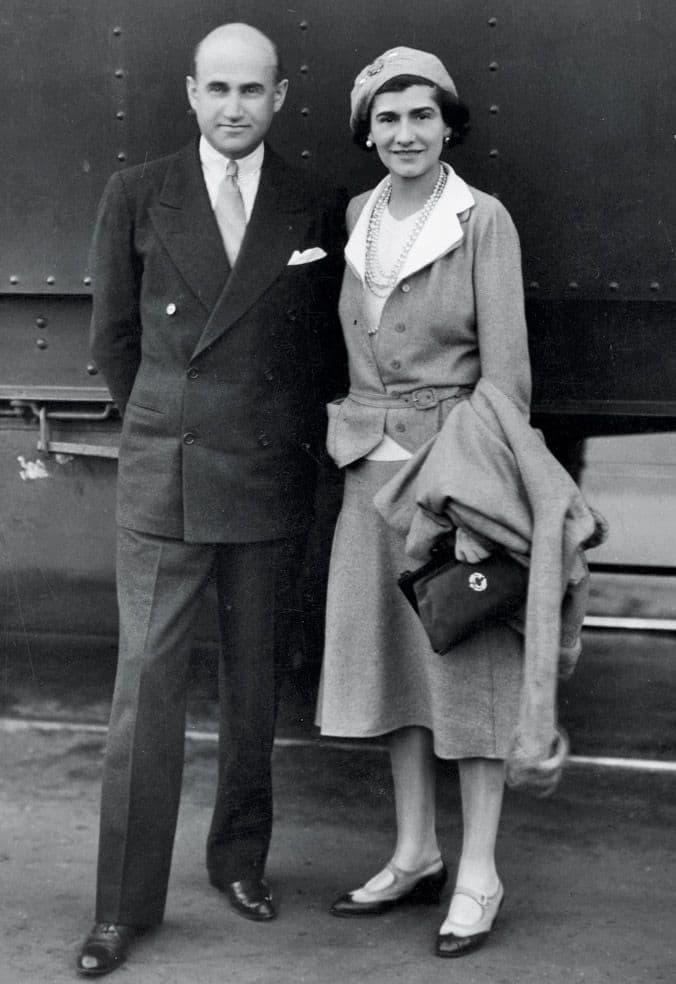
Archival photographs from UCLA Library Digital Collections and Calisphere document Chanel with Goldwyn in Los Angeles in March 1931, standing in front of a passenger train car in one image and appearing in another that Calisphere links to a Los Angeles Times story from March 18, 1931, titled “Style Creator Tells How To Become Chic.” Those pictures do more than prove she was there. They freeze the moment when fashion and film were learning to speak the same visual language.
That language was built on clarity. Chanel’s presence beside Goldwyn, the train-car setting, the newspaper coverage, and the studio wardrobe salon all point to a new kind of cultural exchange, one in which fashion was no longer only a Parisian system of dress. It was becoming a cinematic tool, capable of making understatement feel public, glamorous, and worth copying.
Why this still matters to old-money style
If modern old-money dressing has a uniform, Chanel helped write it. The formula is recognizable: clean lines, calm colors, expensive fabrics that do not need to shout, and silhouettes that suggest ease without ever looking careless. It is the opposite of costume jewelry logic and the opposite of trend-chasing flash; the clothes signal money, but also judgment.
That is why Chanel’s Hollywood episode still resonates. She showed that a luxury image does not have to sparkle to be powerful. A beige wool suit, a pair of black pajamas, and the discipline to resist excess can read as more aspirational than anything covered in decoration, especially when film gives those clothes a face, a body, and a story.
The lasting bond between fashion and film
Chanel’s own brand later framed Hollywood as part of its long relationship with cinema, and that framing makes sense. Her work for *Tonight or Never* in 1931 and *The Greeks Had a Word for Them* in 1932 extended the experiment, proving that the house understood film not just as a platform, but as a multiplier of style. Once an audience sees a certain kind of elegance under studio lights, it stops being private taste and starts becoming cultural shorthand.
That is the real origin story here. Chanel did not simply costume actresses; she helped establish fashion’s bond with film as a prestige engine, one that could take restraint, polish, and self-control and turn them into desire. The result is still visible every time modern luxury leans quiet, every time old money is styled as nonchalant rather than loud, and every time a perfectly cut suit says more than any amount of sparkle ever could.
This article was produced by Prism’s automated news system from verified source data, official records, and press releases, then run through automated quality and moderation checks before publishing. The system is built and supervised by the people who set the standards it runs under. Read our full AI policy.
Did this article answer your question?