Emilia Wickstead’s resort 2027 softens old money dressing with romance
Emilia Wickstead’s resort 2027 collection swaps stern polish for soft romance, using florals and painterly color to refresh old-money dressing. A royal commission gives the shift real social cachet.
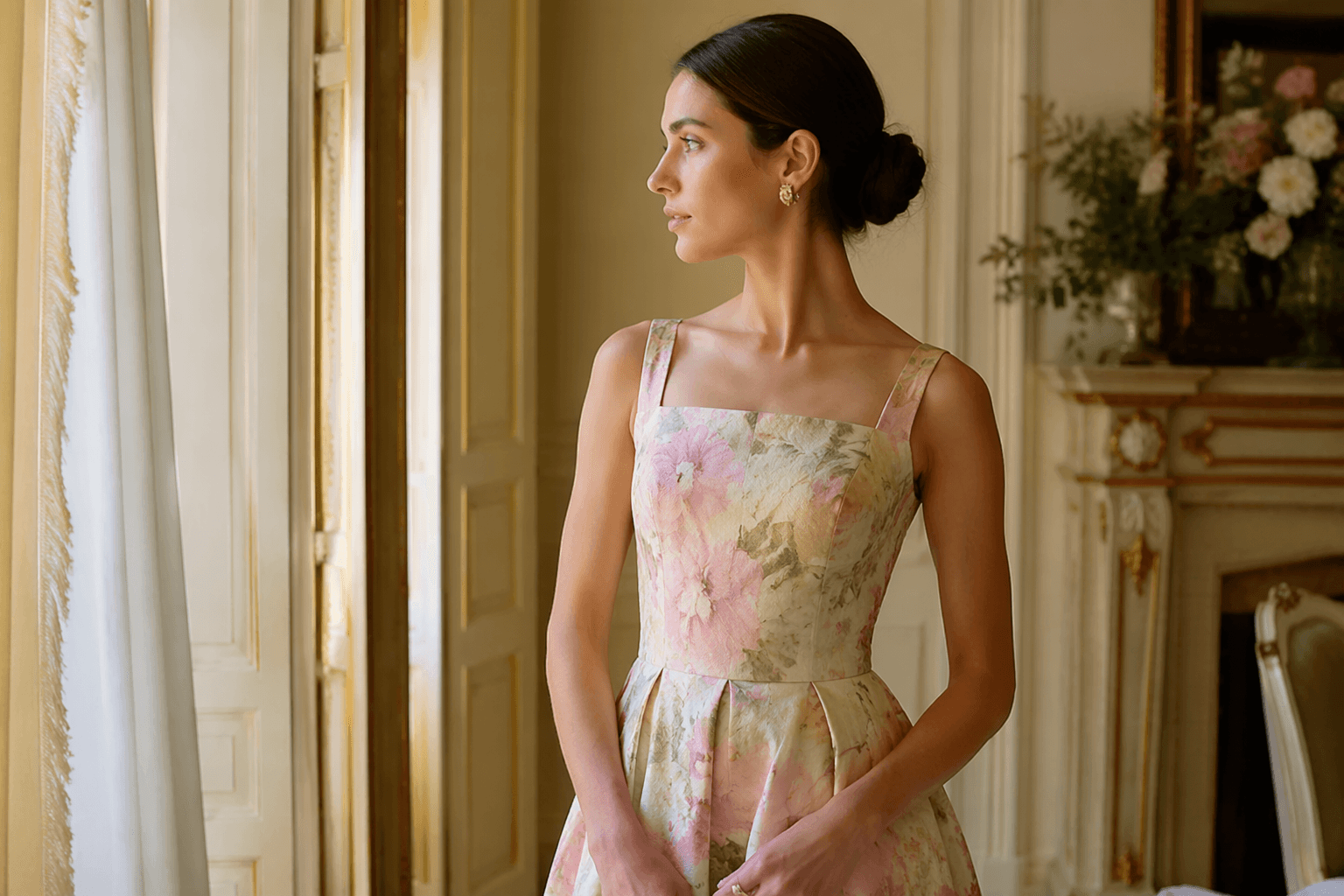
Emilia Wickstead’s resort 2027 collection takes one of fashion’s most familiar codes, restrained wealth, and gives it a gentler pulse. The mood is polished but not stiff, with floral occasionwear and elegant separates that feel inherited rather than loudly acquired, the sort of clothes that signal status by ease, not noise.
The collection’s title, Soft Focus, says exactly where Wickstead is headed. She is not abandoning tailoring or ceremony; she is blurring them, rounding the edges so the silhouette feels more painterly, more intimate, and easier to live in outside the rarefied world of a formal calendar.
The new code: ceremony with daylight in it
What makes this collection interesting is not that it is luxurious, but that it redefines what luxury looks like when the old-money mood loosens its collar. Wickstead leans into floral occasion dressing, but the florals are not sugary or overworked. They sit alongside separates designed to move from a luncheon to an evening garden party, which is exactly where modern old-money style has been drifting: less costume, more continuity.
That matters because the old-money look has often been reduced to a narrow formula, navy, cream, camel, pearls, crisp shirts, and the occasional horsey blazer. Wickstead’s version widens the palette and softens the structure. It keeps the polish, but replaces hardness with tactility and romance, which makes the clothes feel less like a uniform and more like a life.
Why Helen Frankenthaler changes the mood
Wickstead’s reference to Helen Frankenthaler gives the collection its most intelligent twist. Frankenthaler, who worked for six decades and helped redefine abstract painting, is closely associated with the soak-stain technique, in which diluted color seeps into raw canvas and creates washes that feel luminous rather than heavy. That idea maps neatly onto Wickstead’s “Soft Focus” language: color not as decoration, but as atmosphere.
The designer’s mood board reportedly drew on archival images of Frankenthaler in her New York studio, and that context sharpens the collection’s direction. Instead of treating art as a mood-board cliché, Wickstead uses it to loosen the severity of occasion dressing. The result feels less like a literal floral print story and more like fabric that has absorbed light, memory, and movement.
The royal commission gives the collection its social signal
The other half of the story is royal, and it is a useful one. Wickstead recently designed Harriet Sperling’s wedding dress for Peter Phillips, Queen Elizabeth II’s grandson, for their June 6, 2026 wedding at All Saints Church in Kemble, Gloucestershire. Sperling wore a custom Emilia Wickstead gown with a column silhouette, lace details, long lace sleeves, a high neckline, and a dramatic veil.
That commission matters because it reinforces Wickstead’s place in the world of high-society dressing, where discretion counts as much as glamour. Her clothes already live in a space between formal authority and modern femininity, and the wedding dress only deepens that association. In old-money terms, this is not flash, it is pedigree.
For readers, the practical takeaway is clear: if you want the Wickstead version of the look, favor clothes that suggest occasion without screaming occasion. A long column shape, a clean neckline, a lace detail at the sleeve or hem, and a fabric that holds structure without looking rigid will always read more expensive than anything over-embellished.
What Wickstead is actually updating
Wickstead’s own brand language is useful here because it explains why this collection feels like a refinement rather than a reinvention. The label describes itself as known for modern silhouettes, strong use of color, and a mix of traditional and contemporary techniques. That is precisely what resort 2027 appears to be doing: keeping the house’s disciplined lines while letting the color breathe and the finish soften.
Founded in 2008, after Wickstead studied at Central Saint Martins and graduated in 2007, the brand has always sat in an interesting lane. It is polished enough for formal wardrobes, but youthful enough to avoid becoming trapped in one generation’s idea of chic. That balance now looks especially relevant, because old-money style is no longer just about restraint. It is about appearing deeply considered, slightly romantic, and quietly individual.
How to wear the Wickstead version of old money now
If you want to translate this collection into real life, think in terms of contrast. Pair a fluid floral dress with a shoe that is refined rather than precious. Choose a tailored separate, then soften it with a blouse that has a bit of sheen, a scarf-like tie, or a painterly print. The point is not to look costumed for a country house weekend; it is to look as if you have inherited the sense of ease.
A few rules sharpen the effect:
- Choose florals that feel washed or diffused, not bright and hypergraphic.
- Keep the silhouette controlled, then allow one element, sleeve, skirt, or neckline, to drift romantic.
- Favor fabrics that hold shape but still move, so the clothes feel ceremonial without stiffness.
- Let color do the work where embellishment might feel too obvious.
- Skip anything that looks aggressively trend-driven; this look lives on subtlety.
That is where Wickstead is smartest. She is not chasing decorative excess for its own sake. She is showing how polish can be softened until it feels more personal, more modern, and more believable on a real body in a real life.
Why this shift matters now
Old-money style has been through a long phase of minimalism, stealth wealth, and muted certainty. Wickstead’s resort 2027 collection suggests a new turn, one in which romance and color are no longer read as frivolous, but as signs of confidence. The message is subtle but persuasive: if you already know the codes, you can afford to loosen them.
That is why the collection lands so well. It keeps the authority of ceremonial dressing, borrows the painterly intelligence of Frankenthaler, and folds in the social polish of a royal commission. The result is a fresher kind of status dressing, softer, more feminine, and a lot less interested in being obvious.
This article was produced by Prism’s automated news system from verified source data, official records, and press releases, then run through automated quality and moderation checks before publishing. The system is built and supervised by the people who set the standards it runs under. Read our full AI policy.
Did this article answer your question?