Frédéric Arnault Charts Loro Piana's Future, Balancing Growth With Quiet Luxury
Frédéric Arnault inherits a €10 billion brand built on silence. His first moves signal whether Loro Piana's quiet luxury DNA survives ambition.
A €10 Billion Inheritance Built on Cashmere and Discretion
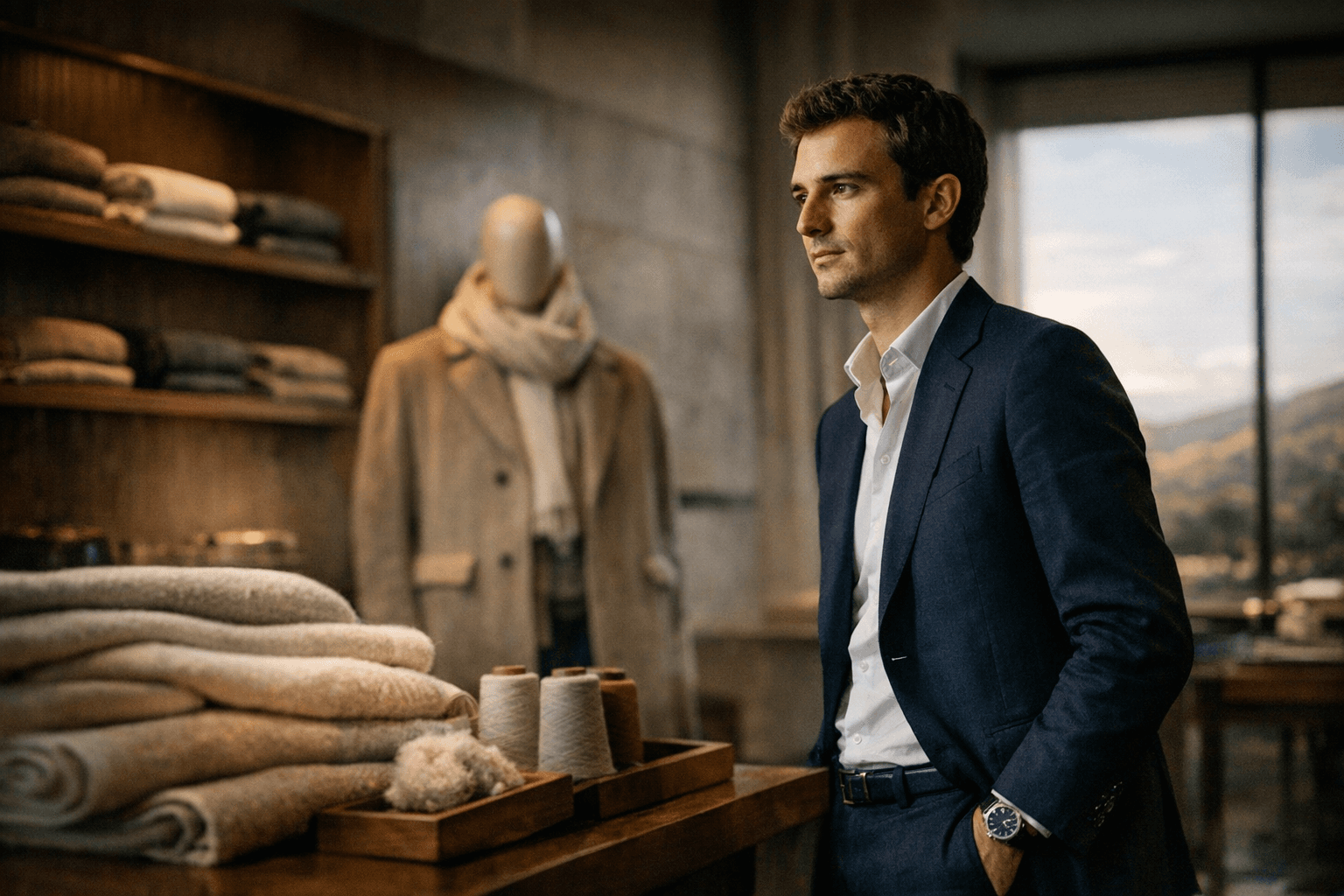
There is a particular kind of power that comes from a brand that does not need to announce itself. In a world saturated with fleeting trends and loud logos, Loro Piana stands as a testament to the enduring power of craftsmanship, quality, and understated elegance: more than a brand, it's a legacy built on an unwavering commitment to the finest raw materials on earth. That legacy now belongs, operationally, to a 29-year-old with a background in computational mathematics, electronic payments, and connected watchmaking.
Frédéric Arnault was appointed CEO of Loro Piana as of June 10, 2025. His mandate, as inherited from the brand's extraordinary decade under LVMH stewardship, is not simply to run an Italian textile house. It is to answer one of fashion's most fascinating strategic paradoxes: how do you grow a brand whose identity depends on never feeling like it is trying to grow?
The Man Behind the Appointment
Arnault studied computational and applied mathematics at the École Polytechnique, a prestigious university known for its science and technology programs. Before joining LVMH, he interned at McKinsey & Company and Facebook, both of which helped shape his approach to the luxury business. After successfully driving the transformation of TAG Heuer, where he spent six years, initially focusing on product and marketing until his appointment as CEO in 2020, Frédéric led the Watch Maisons, including the acquisition of l'Épée 1839. He also played a key role in developing the global partnership between LVMH and Formula 1.
His move from watches to luxury apparel comes amid a broader executive overhaul at the French conglomerate. But the specifics of what he built at TAG Heuer are instructive. Even though the Connected Watch collection has moved away from the limelight in recent years, there is no denying the dynamism and vibrant energy he injected into the division. More importantly, wherever he goes, he brings those strategic insights with him. At Loro Piana, those insights will need to be recalibrated entirely: where TAG Heuer leaned into technology and sports spectacle, Loro Piana's entire value proposition rests on the quiet, the slow, and the rare.
The Brand He Is Inheriting
The numbers are extraordinary by any measure. LVMH acquired Loro Piana, the Italian fashion house specializing in cashmere, vicuña, and extra-fine wool, for €2 billion in 2013. It is currently worth around €10 billion, Bernard Arnault said during a results presentation. Loro Piana has been among the strong performers at LVMH despite the pullback in high-end spending, and it is among the brands with the greatest momentum within the luxury sector, Bank of America analysts noted.
Loro Piana, a relatively understated brand within LVMH, does not have a creative director, fashion shows, or flashy collaborations, yet it has seen remarkable growth in recent years. Industry sources place its annual revenue at approximately €2.5 billion, making it LVMH's third-largest brand in the fashion and leather goods division, following Louis Vuitton and Dior.
That positioning without the conventional architecture of luxury performance — no runway, no star designer, no logo arms race — is precisely what makes the brand so unusual and so difficult to replicate. There is no star designer behind Loro Piana's ready-to-wear collections. The company has kept a low profile in its hiring strategy, opting for a Chief Product Officer rather than an Artistic Director, and collaborating seasonally with stylists.
The Foundation Frédéric Inherits: Bertrand's Blueprint
To understand the challenge facing Arnault, it helps to understand what his predecessor Damien Bertrand built. Under his tenure, "Loro Piana reconnected with its entrepreneurial DNA to introduce unique new fabrics, develop a fast-growing leather goods business and modernise its image," LVMH said.
Key to Bertrand's strategy has been the launch of leather goods, the brand's fastest growing category, as well as the introduction of seasonal themes and a "more modern" silhouette. Loro Piana finally launched a long-awaited handbag range, the Bale, named after the pillow-shaped wool bundle that is the start of the supply chain. This is not a minor category extension. Some argue that Loro Piana has the potential to become the Hermès of the LVMH fashion division. However, unlike Hermès, it lacks a signature handbag — a defining product that fuels desirability and resale value. The Bale was designed, explicitly or not, to begin closing that gap.
Bertrand also pushed back hard against the "quiet luxury" label that the cultural moment attached to the brand. His position was unambiguous: "Loro Piana existed before quiet luxury and will exist afterwards; there are a lot of things about the brand that are not quiet at all." Bertrand says he took his first two years "to rework completely the silhouette," making it "more modern and more harmonised between men and women." That helped drive the brand among younger consumers; the average age of its clientele dropped to between 35 and 40 years old.
The Growth Paradox at the Heart of Loro Piana
Bernard Arnault himself has articulated the central tension with a candor unusual for a luxury group chairman. He praised the family's ability to source "exceptional products" and added during one results presentation: "Loro Piana continues to perform well. We have only one problem: we need to slow down growth and maintain product quality as soon as things start to get a little out of hand."
That admission is the most precise diagnosis of the brand's strategic condition anyone has yet offered. Loro Piana's identity is inseparable from scarcity, material supremacy, and the particular social signal of not being everywhere. Channel conflict, overexposure, and supply shocks can erode intangible equity. The company sets clear limits on distribution breadth and volume to protect perceived rarity, with production limits on icons preventing ubiquity and protecting pricing.
The pricing itself reflects this positioning without apology. Loro Piana cashmere sweaters start at around €1,000 while handbags begin at €1,900. Some of its coats exceed €10,000, firmly placing the brand in the ultra-luxury tier. Yet the brand's allure is not built on price shock but on material legitimacy. The first thing you notice when visiting Loro Piana's main factories in Roccapietra and Quarona, both in Piedmont, is how similar they are to a watch manufacturer or a jewellery workshop: quality control requiring painstaking attention from seasoned artisans, hi-tech machines that detect the tiniest imperfections in a skein of yarn.
Geographic Expansion: The American Question
One of the clearest frontiers for Arnault to navigate is geographic. The brand's recent moves in the United States signal both the opportunity and the risk. Loro Piana has officially planted its flag in the American Southwest with a new flagship at Scottsdale Fashion Square — and the opening is more than a retail expansion; it is a calculated colonization of the country's fastest-growing ultra-high-net-worth enclave. Utilizing the brand's signature Carabottino wood and walls upholstered in silk and raffia, the space rejects the frenetic energy of a traditional shopping mall, mimicking instead the private quarters of a European industrialist. The layout, featuring designated lounge zones and convertible private shopping rooms, acknowledges that privacy is the ultimate commodity.
This is Loro Piana's expansion grammar: not flagships in every airport terminal, but precisely chosen destinations where the store itself functions as a statement of cultural alignment. Conservative store growth favors high-productivity sites and renovations over blanket openings. It is a discipline Arnault will need to honor while the group's broader growth ambitions exert pressure in the opposite direction.
Succession Optics and the Arnault Architecture
Frédéric's appointment cannot be fully separated from the wider question of succession at LVMH. LVMH boss Bernard Arnault is putting in place a series of operations to prepare his succession. Although Bernard has no plans to retire anytime soon, his children are being groomed with key leadership roles at LVMH, and four of the five children have a seat on the company's board. Each sibling's posting now reads like a piece of a larger organizational chessboard: Delphine at Dior, Alexandre at Tiffany's, and now Frédéric at Loro Piana.
With his appointment as head of Loro Piana, Frédéric Arnault takes the reins of an expanding label with a twofold objective: to accelerate growth and maintain the brand's timeless identity and its expertise of excellence. What gives that brief particular sharpness is how unforgiving the brand's DNA is. Loro Piana is the luxury world's closest thing to a platonic ideal of quality without noise. It has thrived precisely because it never felt like a project. The moment it does, the game changes entirely.
What Comes Next
Estimates point to a potential path above €3.2 to €3.5 billion by 2026, assuming mid-teens growth and stable currency conditions. Whether Frédéric Arnault reaches that figure while keeping the brand's codes intact will define his early tenure more clearly than any individual product launch or store opening.
Loro Piana's appearance in "Succession" brought renewed attention to the brand's role in portraying quiet wealth. The show's costume designers chose Loro Piana to dress characters like Kendall Roy, understanding that individuals of extreme wealth often opt for quality and comfort over flashy logos. That kind of cultural resonance is not engineered — it accrues. Protecting it, while simultaneously expanding into Scottsdale, building out a leather goods category, and modernizing the silhouette for a client now averaging 35 to 40 years old, is the precise tension Arnault must hold.
He arrives with a track record built on product iconography, disciplined brand evolution, and the confidence to move fast without appearing to hurry. At TAG Heuer, that meant a Steve Jobs-style launch presentation and a decade-long Formula 1 partnership. At Loro Piana, the same instincts will need to find expression in a language made entirely of vicuña, baby cashmere, and the kind of restraint that, done correctly, costs a great deal more than it shows.
This article was produced by Prism’s automated news system from verified source data, official records, and press releases, then run through automated quality and moderation checks before publishing. The system is built and supervised by the people who set the standards it runs under. Read our full AI policy.
Did this article answer your question?