French luxury brands turn to the U.S. as China cools
As China cools, French luxury houses are chasing a more legacy-minded American buyer through flagships, private clienteling, and wealth beyond the coasts.
The smartest French luxury houses are no longer treating New York and Los Angeles as the whole American map. As China softens, the money worth courting looks more conservative, more heritage-driven, and increasingly likely to surface in wealthy secondary markets, where a discreet handbag, a precise blazer, or a properly cut coat still signals status more cleanly than a flash of logos.
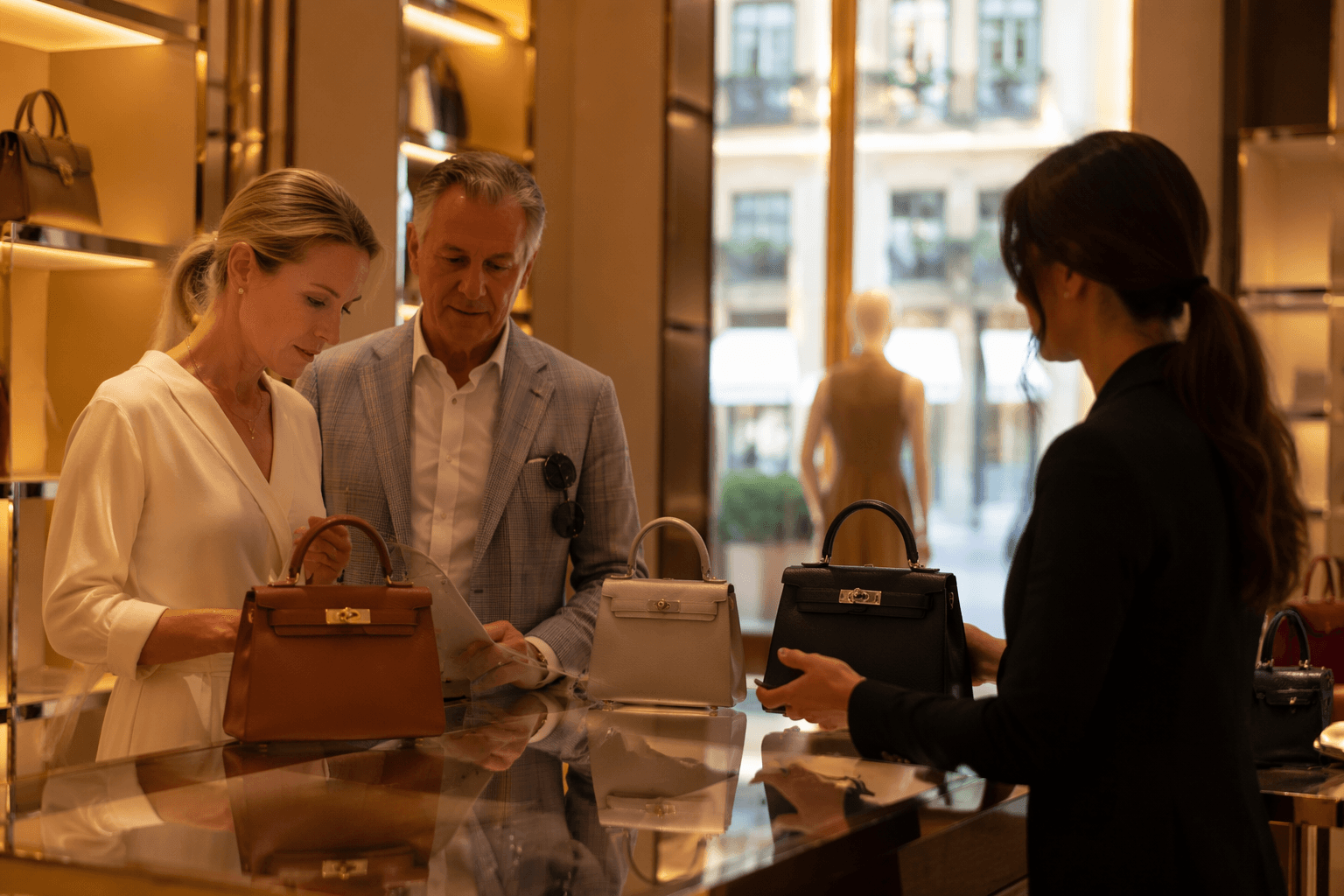
That shift says almost everything about the new American luxury customer. This is not the buyer chasing novelty for novelty’s sake. It is a client who reads craftsmanship as authority, prefers longevity to noise, and wants the retail experience to feel private, measured, and almost old-world, even when the purchase happens in a modern American city.
Why French luxury is leaning harder into the U.S.
The pull toward the United States is partly arithmetic and partly aesthetic. Bain & Company says mainland China’s luxury market fell 18% to 20% in 2024 and is expected to stay flat in 2025, while Morgan Stanley puts Chinese, American, and European consumers at about 75% of total luxury spending. J.P. Morgan added in October 2025 that the U.S. remains a bright spot, even as tourist spending in Europe softens and consumer tastes shift across Asia.
For French houses, that means the U.S. is not just a fallback market. It is where the next wave of discreet spending may come from, especially among buyers who see luxury as part of a family ledger rather than a passing trend cycle. The retail strategy that follows is less about spectacle and more about presence: flagships, intimate salons, and the kind of clienteling that rewards repeat relationships over one-time foot traffic.
The real opportunity is beyond New York and Los Angeles
The most revealing part of the pivot is where the brands are looking next. WWD notes that French labels are moving deeper into affluent tertiary markets, and Michael Prendergast of Alvarez & Marsal said those markets are “starting to pop up out of necessity,” pointing to Westport, Connecticut, as one example. That is the old-money story in retail form: wealth that may not announce itself loudly, but still expects access, service, and excellent merchandise.
JLL’s figures show why this matters. New U.S. luxury retail openings totaled 146,888 square feet in the first quarter of 2025, and new luxury retail square footage in the first half of 2025 rose 65.1% versus the same period in 2024. In other words, the appetite for luxury retail space has not disappeared, it has become more geographically distributed, and French brands are following the money into places where legacy wealth often prefers privacy to fanfare.
This is also where the American luxury customer feels newly legible. The buyer in a place like Westport, or in other similar pockets of concentrated affluence, often looks for polished restraint rather than runway drama. That makes the old-money vocabulary especially valuable now: well-weighted wool, soft but structured leather, quiet tailoring, and the sort of polished finish that reads as inherited taste.
The numbers are forcing the issue
The pressure on French luxury groups is visible in their own results. Reuters reported that LVMH warned investors in May 2025 that demand remained soft, especially in China, after missing first-quarter revenue estimates, and that it was taking a cautious view on second-quarter trends. Kering’s second quarter was even more bruising, with revenue down 15% and Gucci sales falling 25% year over year, a reminder that heritage alone does not shield a brand from regional volatility.
LVMH’s scale underscores why the U.S. matters so much in this recalibration. The group reported 2025 revenue of €80.8 billion and a retail network of more than 6,280 stores worldwide. When a company that large shifts attention toward the U.S., it is not making a symbolic gesture. It is protecting a core engine of growth and looking for markets where luxury still has room to stretch.
That broader calculation also explains why the conversation around American luxury has become more conservative in tone. The customer that French brands want now is not necessarily looking for the loudest object in the room. She or he wants the piece that will still make sense five years from now, at a charity dinner, a winter wedding, or a private club lunch. In old-money terms, that is the difference between buying fashion and buying social continuity.
A transatlantic heritage story, not just a sales strategy
There is cultural history behind the commercial shift, and Comité Colbert is making that case directly. From May 26 to 31, 2026, the French luxury association is presenting “Hidden Treasures, 250 Years of Franco-American Luxury Stories” at The Shed in Hudson Yards, with more than 65 French luxury maisons and cultural institutions involved. The exhibition frames the current U.S. push not as a sudden pivot, but as a reactivation of a long Franco-American relationship that has shaped taste for generations.
That matters because old-money fashion has always been about lineage as much as product. French houses thrive when they can position themselves as custodians of craft, not just sellers of seasonal goods. An exhibition like this gives the present moment a deeper register: the U.S. is not merely absorbing French luxury, it is participating in a transatlantic luxury language that still values inheritance, art, and the quiet authority of names that have lasted.
What this means for the next phase of old-money dressing
The next phase of old-money fashion in the U.S. will likely be defined less by obvious coast-to-coast glamour and more by how brands build intimacy around the customer. Flagships will matter, but so will the private room behind them. The winning brands will be the ones that understand how to serve a buyer who wants polish without performance, and who treats luxury as a durable part of personal identity.
That is why the shift away from China is not simply a story about weakness elsewhere. It is a map of where luxury still feels socially useful, and the map increasingly points to the U.S., where discretion, legacy, and well-placed wealth still have enough force to shape the market.
This article was produced by Prism’s automated news system from verified source data, official records, and press releases, then run through automated quality and moderation checks before publishing. The system is built and supervised by the people who set the standards it runs under. Read our full AI policy.
Did this article answer your question?