French luxury’s old-money power, from Hermès to LVMH’s global reach
French luxury keeps old-money status by pairing centuries of craft with hard commercial scale, especially in the U.S. market and beauty exports.

The old-money code is built, not borrowed
French luxury still owns the old-money imagination because it looks like inheritance and behaves like infrastructure. Hermès can point to 1837 and call itself “contemporary artisans since 1837,” while LVMH operates like a global machine, with €80.8 billion in 2025 revenue, €17.8 billion in profit from recurring operations and €11.3 billion in operating free cash flow. That combination of heritage and scale is the real power: the polished saddle stitching, the disciplined tailoring, the controlled distribution, the sense that these houses do not chase status so much as define it.
What makes that signal so durable is that French luxury does not rely on nostalgia alone. It turns craftsmanship into an export model, and export volume into cultural authority. In old-money dressing, that means a silk scarf, a structured coat or a monogrammed travel piece reads as lineage because the industry behind it has the size, the reach and the longevity to make tradition feel commercially inevitable.
Why France still sets the status grammar
Comité Colbert, created in 1954 at the initiative of Jean-Jacques Guerlain, was designed to bind craft and prestige into something closer to national strategy than a private club. The group now says it unites 14 métiers, and its membership spans 96 Maisons, 17 cultural institutions and 6 European members, all of them framed as custodians of savoir-faire. That breadth matters because old-money style is not just about a logo or a dress code. It is about systems that make beauty feel authenticated by history.
The association’s own self-description gives the scale of the French advantage: a quarter of the world’s luxury brands are French, they generate an average of 86% of their turnover through exports, and they directly and indirectly employ more than one million people. Those numbers explain why French luxury feels less like a trend cycle and more like a permanent class structure. When a market is built to send most of its value abroad, it learns how to translate Frenchness into desirability everywhere, especially in places that treat European taste as shorthand for social proof.
Hermès and the power of continuity
Hermès is the clearest lesson in how heritage becomes commercial gravity. A house that dates its history to 1837 does not need to shout its pedigree; the archive is already embedded in the object. That matters in the old-money wardrobe, where the most convincing pieces are often the least eager to perform, a lacquered Kelly, a sharp-shouldered blazer, a scarf with enough silk body to hold a knot.
This is where French luxury separates itself from generic “quiet luxury.” Quiet luxury can drift into anonymity; French luxury gives understatement a lineage. Hermès keeps the language of craftsmanship alive, but it also keeps it aspirational. The message is not that wealth should disappear. It is that wealth should look inherited, orderly and a little hard to access.

LVMH proves old money can scale like modern capital
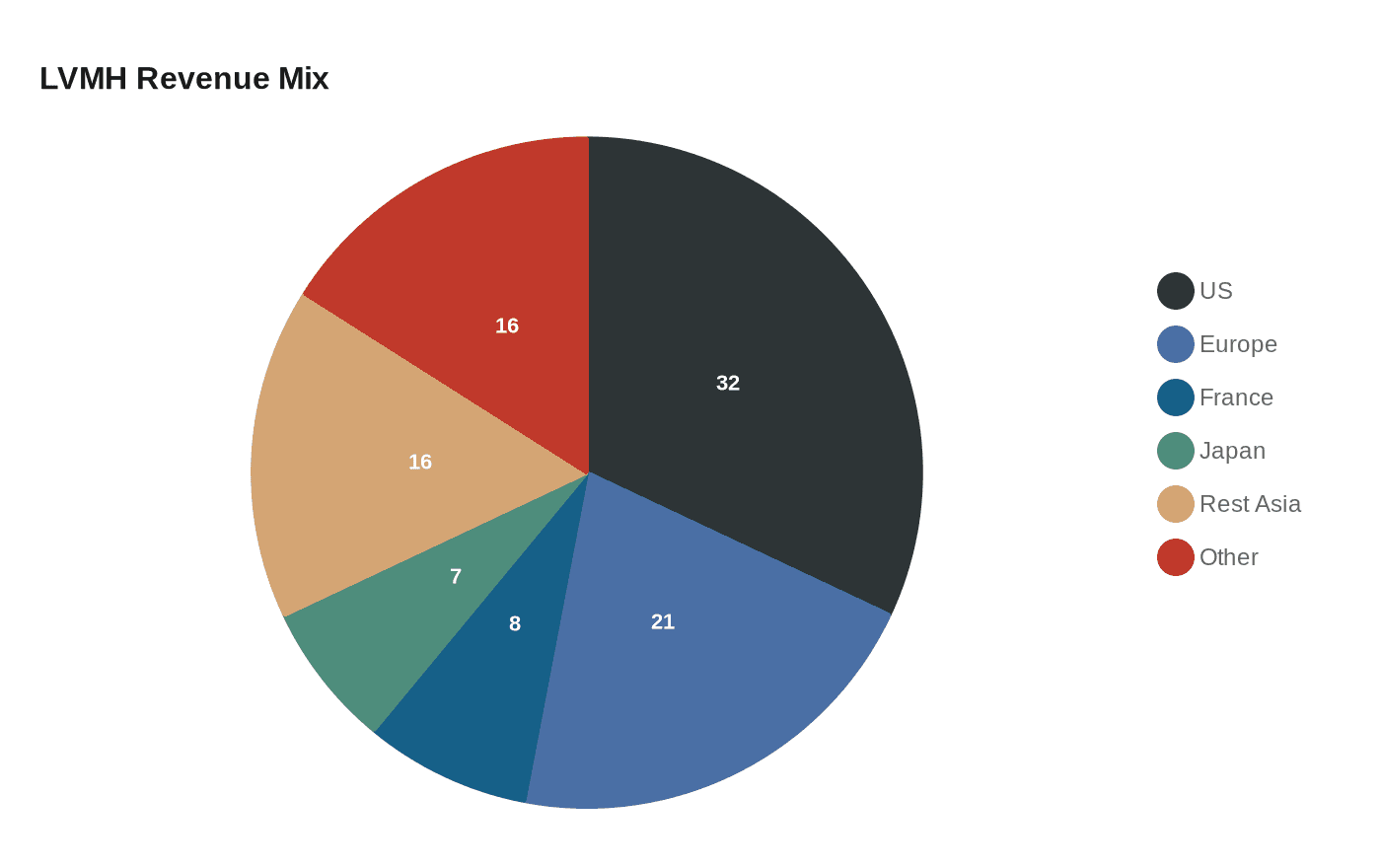
If Hermès supplies the romance, LVMH supplies the proof that romance can be industrialized without losing prestige. The group says it now gathers 75 brands and operates more than 6,280 stores worldwide, a retail footprint that makes French luxury feel omnipresent without feeling common. In 2025, the United States accounted for 32% of revenue by region of delivery, far ahead of Europe at 21%, France at 8%, Japan at 7%, Rest of Asia at 16% and Other markets at 16%.
That U.S. concentration is one of the most important numbers in the whole story. Old-money status may be coded in Parisian taste, but it is monetized in American demand, where French houses remain the trusted dialect of expensive discretion. The American shopper is not only buying product. They are buying the permission structure that French luxury has spent decades perfecting: the idea that a bag, a fragrance or a trunk signals discernment rather than display.
Versailles still haunts the runway imagination
The symbolic roots of that power reach back to the Palace of Versailles. Its official history says the fashion gala of 28 November 1973 was widely perceived in France and the United States as a competition between French and American designers, staged to raise restoration funds. That episode remains one of fashion’s clearest prestige myths because it turned clothes into cultural diplomacy. French style was no longer just beautiful. It became a national argument about taste, authority and who gets to define elegance.
That transatlantic tension still animates the category today. The French Embassy’s 2024 economic report says bilateral goods and services trade reached $153 billion in 2023, and French and American companies had invested close to $500 billion in each other’s economies. Fashion and beauty sit inside that relationship as more than decorative exports. They are proof that French luxury is woven into American affluence at the level of habit, gift-giving and self-presentation.
Beauty is the quiet engine behind the aura
The French luxury story becomes even stronger in beauty, where the category is both highly visible and deeply habitual. French cosmetics exports reached a record €22.5 billion in 2024, and exports of essential oils, perfumes, cosmetics and toiletries from France to the United States were valued at US$3.22 billion in the same year. That is not a side note. It is the fragrance cloud around the whole category, the invisible layer that lets French luxury enter bathrooms, dressing tables and carry-on bags long before it enters a wardrobe.
Beauty is where French luxury often wins by repetition rather than spectacle. A fragrance, a cream or a lipstick can be more socially durable than a seasonal look, and that durability is exactly what old-money taste rewards. It suggests routine, memory and quiet command.
The next version of heritage is technological
The newest French-luxury message is not about abandoning tradition. It is about updating its machinery. A September 2025 Bain & Company and Comité Colbert report found that 85% of luxury CEOs consider technology important to strategy, 8% call it critical, and the average luxury house devotes 3.1% of revenue to technology. Sixty percent plan to increase technology budgets by at least 5% over the next two to three years.
That matters because the most convincing old-money houses now have to look old while operating like highly tuned global businesses. Digital clienteling, data, omnichannel retail and product traceability do not destroy the aura. They protect it. In the French model, technology is not meant to shout. It is meant to make scarcity smoother, service more precise and the brand universe harder to dilute.
The handoff at Comité Colbert and the symbolism of New York
The leadership change at Comité Colbert underscores that continuity here is strategic, not static. Hélène Poulit-Duquesne, CEO of Boucheron, has been elected to succeed Laurent Boillot as chair, with the transition set for June 2026. Even the succession reads as a statement about the future of French luxury: heritage is being handed forward by operators who understand both craft and corporate scale.
That same instinct shapes Comité Colbert’s May 2026 exhibition, Hidden Treasures: 250 Years of Franco-American Luxury Stories, at The Shed in New York from May 26 to 31. More than 65 French luxury houses and cultural institutions are involved, and the show is built around previously unseen American archives. It is a fitting stage for the category’s central truth: French luxury does not simply sell old-money fantasy. It exports the institutions, the rituals and the historical confidence that make that fantasy feel real, especially in the United States, where its prestige still converts cleanly into power.
This article was produced by Prism’s automated news system from verified source data, official records, and press releases, then run through automated quality and moderation checks before publishing. The system is built and supervised by the people who set the standards it runs under. Read our full AI policy.
Did this article answer your question?