Hermès Birkin Resale Market Softens, Putting Scarcity Strategy at Risk
The Birkin's mystique may be cracking: resale prices for Hermès's most coveted bags have softened, threatening the scarcity strategy that built their legend.

The Birkin's value proposition has always rested on a single, carefully constructed premise: you cannot simply buy one. Hermès has spent decades engineering desire through its client-allocation system, the so-called "Hermès game," in which purchase history, boutique relationships, and accumulated spend determine who is offered a Birkin or Kelly and when. That architecture of controlled scarcity is now showing structural strain, as resale prices for both bags have begun to soften in a way that challenges the foundational logic of the entire system.
Business of Fashion flagged the shift in its High Margin newsletter, the publication's dedicated lens on luxury's financial mechanics. The analysis centered on what happens when the resale market, long the external validator of Hermès's scarcity strategy, stops performing its assigned role. For years, secondary market premiums above retail served as proof of concept: the "Hermès game" worked because the demand it manufactured was real and durable. A softening resale market suggests that durability is no longer guaranteed.
The strategic risk here is specific and consequential. Hermès does not discount. It does not hold sales. Its entire pricing architecture depends on the perception that a Birkin bought at retail is immediately worth more the moment it leaves the boutique. If resale values compress toward retail, or worse, dip below it, the calculus changes for the client who spent years cultivating a boutique relationship and building a purchase history in ancillary categories, scarves, homeware, riding equipment, to eventually be offered a bag. The return on that investment, financial and social, diminishes.
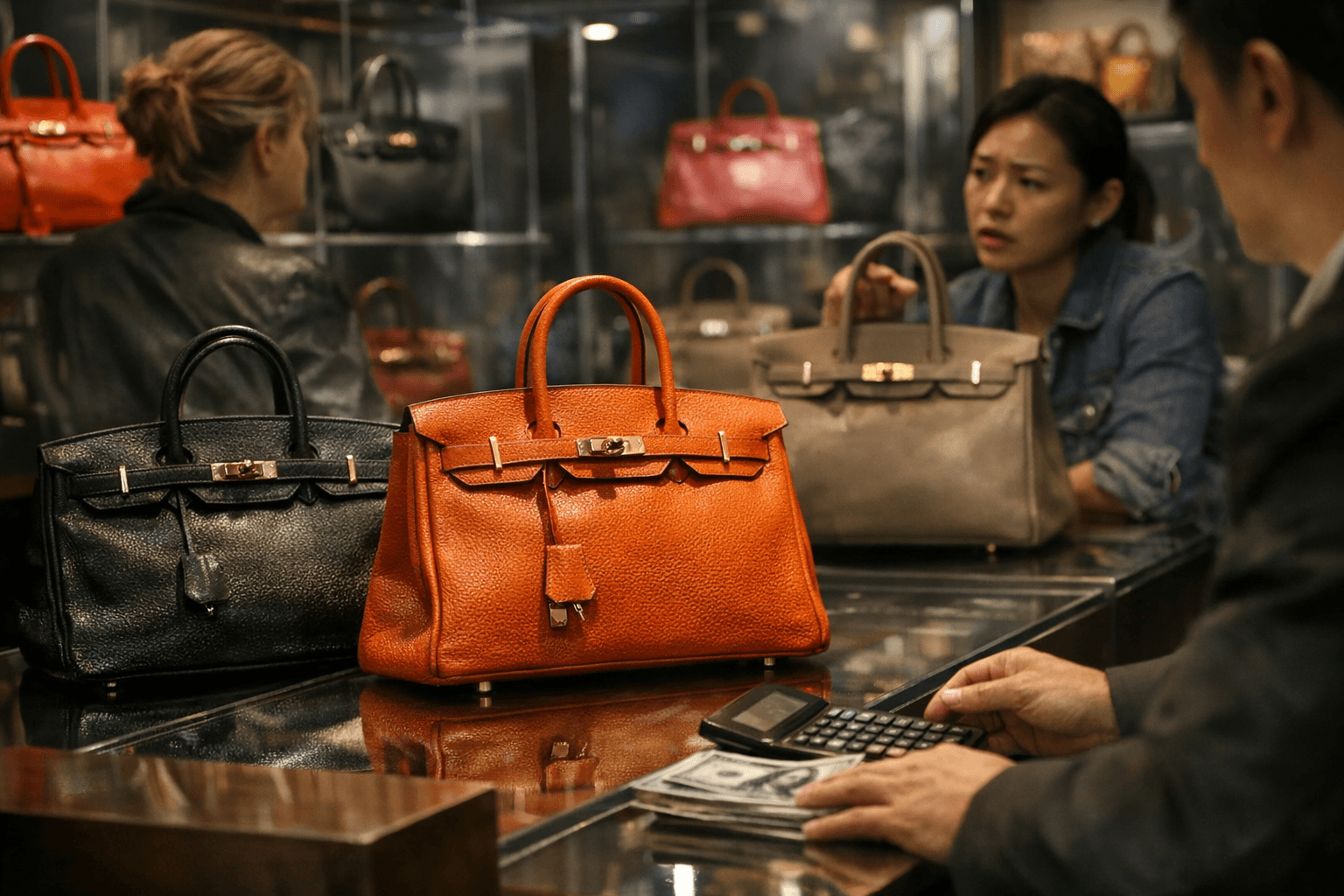
The Kelly faces the same exposure. Both bags have functioned less as fashion objects than as alternative assets, a status reinforced by auction results and the broader financialization of luxury goods over the past decade. That framing attracted a category of buyer whose loyalty is to the investment thesis, not to the house. A sustained resale correction would likely accelerate their exit, removing a segment of demand that helped sustain the secondary market premiums Hermès's strategy depends on.
What the Business of Fashion analysis ultimately surfaces is a feedback loop that Hermès has benefited from enormously but does not fully control. The scarcity is manufactured inside the boutique; the premium is produced outside it. If the external market begins telling a different story, the internal system faces a credibility problem that no amount of allocation management can fully resolve.
This article was produced by Prism’s automated news system from verified source data, official records, and press releases, then run through automated quality and moderation checks before publishing. The system is built and supervised by the people who set the standards it runs under. Read our full AI policy.
Did this article answer your question?