How to Buy, Care For, and Keep a Cashmere Sweater Forever
The one cashmere sweater worth owning costs less than you think and more than you expect — here is exactly how to find it, evaluate it in-store, and keep it for decades.
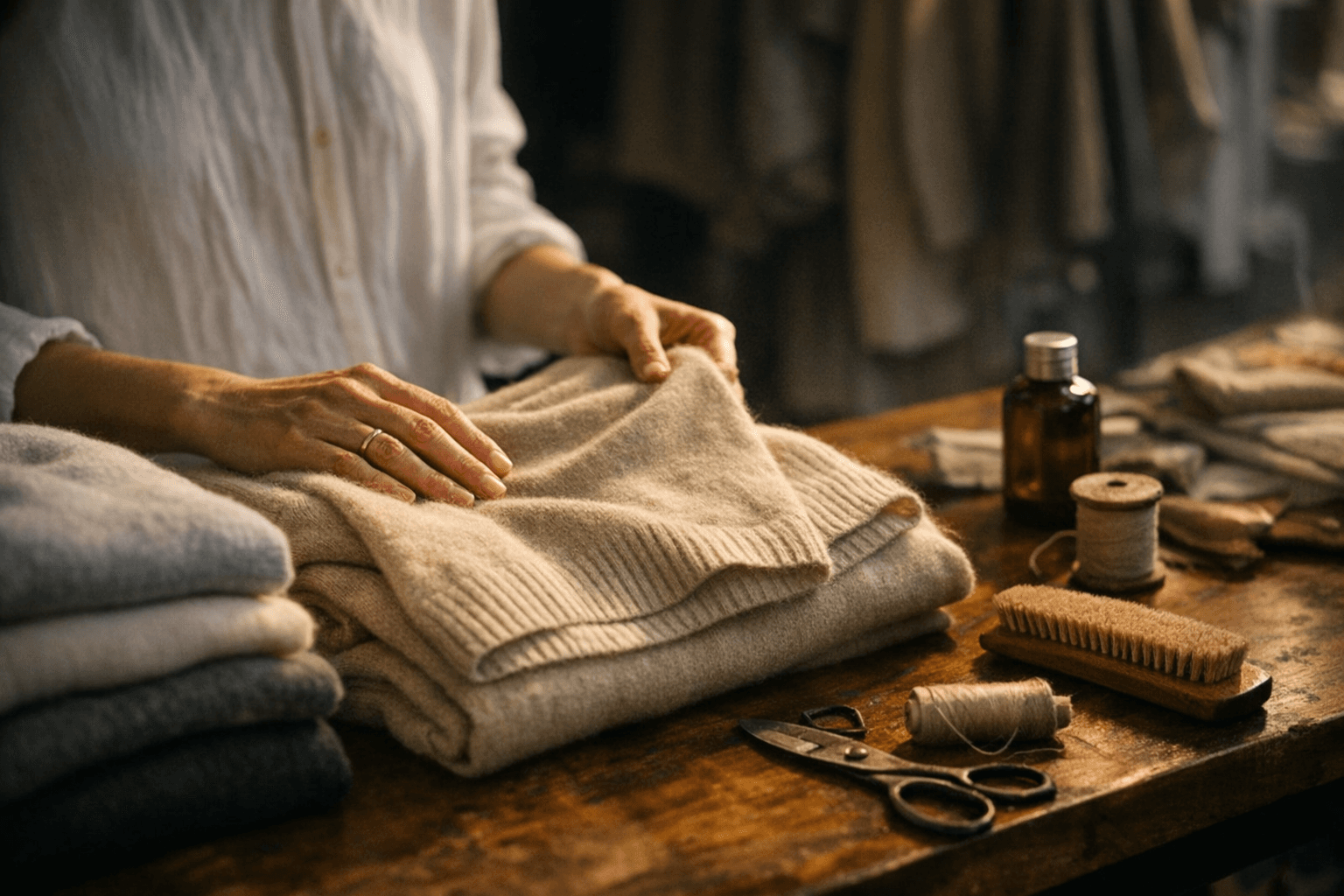
Carolyn Bessette Kennedy didn't need a logo to signal money. A perfectly fitted cashmere crewneck tucked into narrow trousers did everything a power suit could and more. That sweater, that silhouette, is still the core vocabulary of old-money dressing — and yet it remains the piece most people get wrong, either buying too cheap and replacing it constantly, or spending heirloom prices without knowing what they're actually paying for. This guide is a decision tree. Walk through it before you buy, and you'll leave with one sweater you'll wear for twenty years.
Step One: Evaluate the Fiber Before You Read a Label
The word "cashmere" on a tag tells you almost nothing. What matters is the grade of the fiber inside, and you can assess it without a lab.
Cashmere grades run A through C, defined primarily by fiber diameter measured in microns. Grade A fibers measure around 14 microns, meaning they are exceptionally fine, silky against the skin, and durable enough that they soften further with every wash rather than degrading. Grade A cashmere is the most expensive of all cashmere, because it is the thinnest, longest, and most durable, with a diameter of 14 microns and a length of around 36mm. Grade C, the lowest grade, has fibers up to 25-30 microns thick; these fibers are coarser and often shorter, making Grade C more prone to pilling and stretching out since the hairs are shorter and weaker.
In-store, you have two reliable physical tests:
- The touch test: Run the fabric against the inside of your wrist, not your palm. Your palm is calloused; your inner wrist will register any roughness or prickle immediately. Grade A cashmere feels like cooled butter. Grade C feels vaguely woolly.
- The stretch test: Gently stretch the item out then let go and watch how quickly it springs back to its original shape. High-quality cashmere will return to normal; lower grades will either stay stretched out or take far longer to revert. You can also look through the cashmere while you stretch it: a lower-grade sweater will look thin and more susceptible to holes than cashmere of better quality.
- The light test: Hold the fabric up to the light. High-quality cashmere looks even and smooth. Lower-quality cashmere may have thick spots or uneven color.
Step Two: Decode Ply and Gauge
Once the fiber passes your touch and stretch tests, decode the construction numbers. These two metrics, ply and gauge, determine whether the sweater is right for your use case — not whether it's "better" in some abstract sense.
A 2-ply yarn uses two strands twisted together; 4-ply uses four. 2-ply is lightweight, breathable, and ideal for layering and year-round wear. A 4-ply sweater is noticeably denser, warmer, and carries more visual weight — better as a standalone piece in colder months. Higher plies such as 4-ply add additional warmth and weight, but do not indicate additional quality. Higher ply counts also tend to be more expensive, as they require more yarn to make.
Gauge, meanwhile, is about knit tightness. Gauge refers to the number of stitches or rows per inch and is a measure of how tightly the item is knitted. Cashmere items commonly knit in 7 gauge are scarves and wraps, while sweaters and blankets are often knit in 12 gauge. For a layering sweater that will go under blazers or over shirts, a 12-gauge, 2-ply construction in Grade A fiber is the single most versatile specification you can buy.
Step Three: Inspect the Construction
A sweater spun from Grade A fiber can still be poorly made. Check these three things before committing:
- Shoulder seams: Pick up the sweater and feel where the sleeve meets the body. A linked seam (where each stitch is joined individually) lies flat and nearly invisible. A sewn or overlocked seam creates a visible ridge that digs into the shoulder and weakens over time. Linked seams are the mark of a properly finished garment.
- Ribbing tension: The cuffs and hem should snap back after you stretch them. Ribbing that immediately goes slack has been knitted at too low a gauge or with insufficient ply count for the weight of the body. It will look tired after a season.
- Stitch density: Run your thumb across the body fabric in a small circle. Dense, even stitches resist pilling and hold their shape through repeated washing. If the weave shifts under slight pressure, the garment will begin to look worn before it actually is.
Step Four: Choose Your Price Tier Honestly
There are three realistic tiers, and all three can deliver a sweater worth keeping.
Everyday accessible ($80-$200): Brands like Naadam and Quince have built their reputations on Mongolian Grade A cashmere at accessible prices. These sweaters perform well for the first two to three years with proper care. Expect to de-pill them more regularly than a mid-market piece.
Mid-market ($300-$700): This is where construction quality catches up with fiber quality. Scottish mills such as Johnstons of Elgin knit at full gauge with linked seams; their sweaters wear differently from fast-fashion cashmere because the stitching holds through a decade of washing. Falconeri, operating out of Italy, occupies a similar position. At this tier, the cost-per-wear calculation tips firmly in your favor.
Heirloom ($1,200 and above): Loro Piana sweaters feel featherlight and silky, and a Grade A piece, if well cared for, tends to maintain its smooth look and shape over time. Brunello Cucinelli mixes Italian skill with ethical production; their relaxed styles start at $1,200, and Loro Piana's pieces start at $1,500. At this level you are paying for fiber sourcing (Loro Piana controls its own Mongolian and Peruvian supply chain), finishing detail, and a guarantee of Grade A fiber throughout. These sweaters are genuinely worth the investment if you will wear them at least forty times a year.
Step Five: Choose the One Color
If this is your forever sweater, the color decision matters as much as the fiber. The old-money palette has three credible answers: camel, navy, and oatmeal/ivory.
Camel is the most editorial — it photographs beautifully, reads as warm against most skin tones, and layers under a navy or charcoal overcoat with zero effort. Navy is the most versatile for layering under jackets, because it reads as a neutral while still providing contrast. Oatmeal or natural ivory is the quietest option and arguably the most intellectually honest expression of the fabric itself, letting the texture read rather than the color.
For a single-sweater wardrobe slot, camel earns the most wear-per-occasion. It is the color Carolyn Bessette Kennedy returned to instinctively and the one that still looks authoritative without effort.
The Maintenance Protocol (screenshot this)
A cashmere sweater is not fragile; it just requires the right habits. The following protocol will extend the life of any sweater, regardless of tier.
Washing frequency: Wash after five to seven wears, not after every wear. Over-washing breaks down the fiber structure. New cashmere has the highest concentration of loose surface fibers it will ever have; the first three to five wears typically generate the most visible pilling, but removing pills promptly after early wears will allow the garment to stabilize significantly.
How to wash: Hand wash in cool water with a pH-neutral or wool-specific detergent — baby shampoo works. Gently squeeze extra water from the sweater without twisting; you can compress it into a ball and squeeze, or roll the cashmere in a towel to absorb excess water. If machine-washing, use a mesh laundry bag to reduce friction and agitation inside the machine, and select the lowest water temperature and spin setting.
Drying: Lay flat on a dry towel and reshape while damp. Never hang a wet cashmere sweater; the weight of the water will permanently distort the shoulders. Never use a tumble dryer.
De-pilling: Use a cashmere comb or a fabric shaver on the lowest setting, always working in one direction across the fabric. Address pills while they are small — once they mat together, the fiber has already degraded at that point.
Storage: Always wash cashmere before storing for the season; a worn garment carries body oils and residue even if it looks clean, and these attract moths. Fold neatly in cotton bags with natural moth repellents. Cedar blocks and dried lavender sachets are both effective and don't leave a chemical residue on the fiber. Refresh cedar blocks with fine sandpaper each season. Never store cashmere in plastic, which traps humidity and encourages mildew.
Moth prevention: Moths are attracted to body oils, not the fiber itself — which is why the pre-storage wash is non-negotiable. For active infestations, freezing the garment for 72 hours in a sealed bag kills eggs without chemical exposure.
Repair vs. Replace: The Threshold
The rule of thumb is simple: if the damage is localized (a single moth hole, a pulled thread, a small snag), repair it. Reweaving services exist in most major cities and can invisibly close a hole up to approximately the size of a coin for $50-$150 depending on complexity. That cost is worth absorbing on any sweater over $300.
Replace when pilling covers more than 30 percent of the body fabric, when the ribbing has permanently relaxed past recovery, or when a seam failure has caused the fabric itself (not just the seam) to pull apart. A sweater that has reached this point has fulfilled its service life honestly; there is no shame in retiring it. The economics of cashmere only work when you stop trying to resurrect a dead piece and instead reinvest with sharper criteria than you used the first time.
The sweater you buy with this framework will not be your cheapest. It will, almost certainly, be the last one you need to buy.
This article was produced by Prism’s automated news system from verified source data, official records, and press releases, then run through automated quality and moderation checks before publishing. The system is built and supervised by the people who set the standards it runs under. Read our full AI policy.
Did this article answer your question?