Lee Radziwill's Restrained Jewellery Defines the Quiet Luxury Ideal
Giorgio Armani described Lee Radziwill's style as "reducing, not adding." Her jewellery box proves it, and five rules from it still work today.
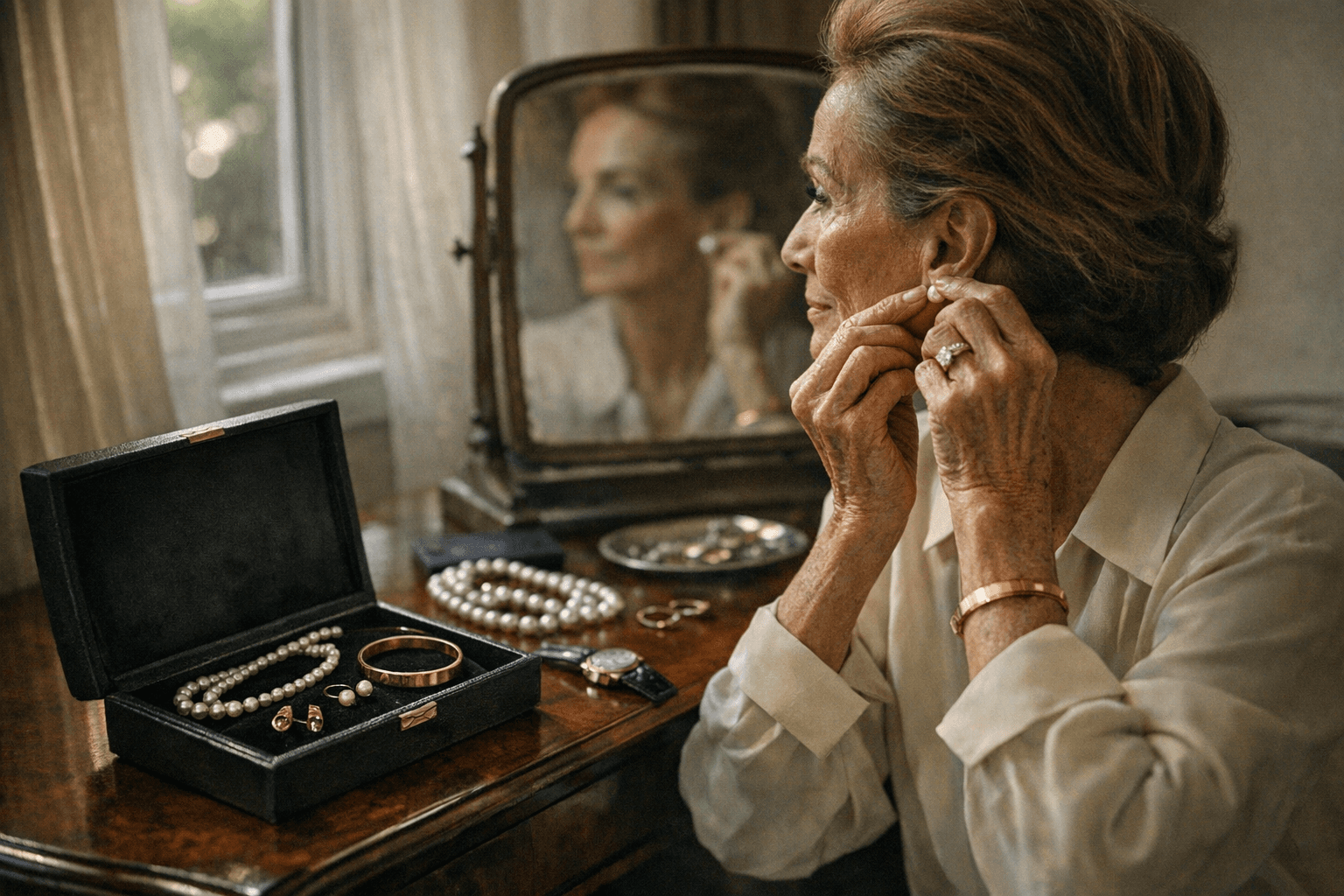
When Christie's auctioned Lee Radziwill's estate in October 2019, 158 of 168 lots sold, raising $1.26 million. The numbers were impressive. The lesson was more so. Among the pieces that went under the hammer were two nearly identical pairs of Dior earrings, a cluster diamond brooch priced in the low thousands, and mismatched cultured pearl earrings estimated at $5,625. Nothing in the collection screamed. Everything spoke.
That is still the most useful thing about Lee Radziwill's approach to jewellery: it is a system, not an archive. Her pieces were not trophies or investments to lock away. As jewelry expert Ivanova told NaturalDiamonds.com, "She wasn't buying jewelry to lock away or treat like a trophy. She was wearing it in real life, to dinners, to conversations, to everyday moments." Extracted from the context of mid-century socialite life, five of her core principles translate directly into a modern wardrobe.
Rule 1: Proportion Is the Whole Conversation
Radziwill's favorite pearl earrings were not delicate. The mismatched grey and white cultured pearls measured 14.90 and 15.20 mm respectively, mounted in 18-karat gold. That is not a subtle earring. But it is a proportional one: substantial enough to anchor a bare neck or a sleek updo, restrained enough never to compete with a neckline or a collar.
The rule here is not to go small. It is to go considered. The ear is a fixed point, and the jewellery you anchor there controls the entire upper-body composition. Choose a scale that reads from across a room but reads as one thing.
- Entry point ($80-$200): Chunky freshwater pearl studs from Mejuri or Missoma, where 12mm pearls sit at roughly $85-$120.
- Mid-range ($400-$900): South Sea pearl drop earrings in 14-karat gold from Brilliant Earth, which carries cultured pearl earrings from around $450.
- Investment ($2,000+): Mikimoto's 8-9mm Akoya pearl earrings in 18-karat gold, starting near $2,000, are the category benchmark.
Rule 2: Mix Metals, But Only Through Repetition
Radziwill owned not one but two pairs of Dior's 'Coquine' diamond hoops: one set in white gold, one in yellow gold. Both were designed identically, each a hoop suspending bezel-set circular-cut diamonds in 18-karat gold. The name "Coquine," which translates roughly to "mischievous," gives the earrings, as one expert noted in the NaturalDiamonds.com feature, "a bit of personality beneath their classic appearance." But the real lesson is in the duplication: she did not mix metals by wearing both at once. She mixed metals by owning the same design in both, wearing each deliberately. Her collection also included Hermès enamel bangles in gilt and silvered metal alongside 18-karat gold fine jewellery, with clear separation of purpose.
The modern application: anchor your collection in one metal, then introduce a second through a single repeated form. A yellow gold signet and a white gold tennis bracelet, worn on different days, not stacked together.
- Entry point ($150-$350): Catbird's 14-karat yellow gold and white gold stacking rings allow you to build both sides of a metal mix for under $200 each.
- Mid-range ($600-$1,200): Vrai's bezel-set diamond hoops in 14-karat yellow or white gold sit around $700 and echo the Coquine logic precisely.
- Investment ($3,000+): A Cartier Love ring in yellow gold alongside a Cartier Étincelle band in white gold is the category standard for intentional metal duality.
Rule 3: The Day-to-Evening Swap Is One Piece, Not a Transformation
Radziwill's vintage diamond brooch, a circular-cut diamond cluster mounted in white gold and dating to around the 1950s, is a lesson in dual function. It is not a cocktail piece or a daytime piece. It is both, depending only on what it is pinning. An expert quoted in the NaturalDiamonds.com feature captured this precisely: "Done well, there is something appealing about jewelry that looks elegant enough for an evening but can also be worn every day."
The swap is not about changing your jewellery at 6pm. It is about buying pieces that do not need to be swapped at all. A diamond cluster brooch on a blazer lapel at noon, on a silk blouse at dinner: same piece, total transformation. This is what makes a brooch worth buying over a trendy pendant.
- Entry point ($120-$250): Vintage crystal-and-silver cluster brooches from Etsy or 1stDibs' under-$250 category offer authentic mid-century proportion without the fine-jewellery price.
- Mid-range ($500-$1,500): Smaller diamond cluster brooches from estate dealers on Worthy or I Do Now I Don't frequently appear in the $800-$1,200 range.
- Investment ($4,000+): A new or vintage cluster diamond brooch from Graff or a Cartier archive piece, where the circular-cut style Radziwill favored now commands significant premiums.
Rule 4: One Statement at a Time, Always
Giorgio Armani, one of her closest designer allies, said it plainly: "She expresses her personal style through reducing, not adding." Fashion and jewelry designer Jelena Kulić elaborated further for NaturalDiamonds.com: "For Radziwill, jewelry was not about excess but about balance and refinement. She believed that a few carefully chosen pieces could elevate an entire look."
In practice, Radziwill's jewellery archive reveals a pattern: her fine pieces were worn singly. The Taffin amethyst and tsavorite garnet ring, inscribed "Lee with love, Hamilton" and mounted in 18-karat yellow gold, is a bold stone. It is not a piece you pair with chandelier earrings. The spinel and garnet single-line rings, each set with either pink, red, or green stones in 18-karat gold, are quieter. But neither type needed accompaniment.
The practical rule: if a piece has a story, let it have the floor. The one-statement discipline is not about minimalism for its own sake. It is about audibility. A room full of people speaking at the same volume is noise. One voice, clearly chosen, carries.
- Entry point ($100-$300): A single Mejuri or Able gemstone cocktail ring worn alone on the right hand.
- Mid-range ($400-$1,500): Pippa Small's rough-set sapphire or tourmaline rings, typically $500-$1,200, embody exactly the coloured-stone-as-single-statement logic.
- Investment ($5,000+): The Taffin aesthetic itself, by Paris-based designer James de Givenchy, is available new from roughly $5,000 for stone rings and up.
Rule 5: Craft Over Logo, Always
André Leon Talley told the New York Times that Radziwill once said she had never owned an Hermès bag or silk scarf in her life, "Everyone else carried them, so to her they were common." This was not thrift. It was something closer to snobbery about obviousness. Her Chanel costume jewellery, including faux-pearl necklaces and rhinestone clip earrings from the house, was worn because the craft was right, not because the label was visible. Her Kenneth Jay Lane button earrings, the blue rhinestone domes that were listed among her frequent favourites, cost a fraction of her Dior fine jewellery. She wore them anyway, because they looked correct.
The implication for a modern wardrobe is freeing: logo-free craft at any price point is valid, provided the proportion and quality of finish are honest. A well-cast brass earring with the right scale beats a recognizable-logo piece worn at the wrong moment every time.
- Entry point ($30-$150): Kenneth Jay Lane's own archive-inspired pieces, still available through KJL.com and Neiman Marcus for $50-$150, are a direct lineage.
- Mid-range ($200-$600): Wolf & Badger and Moda Operandi carry independent designers whose craft-first, no-logo pieces sit at $200-$600.
- Investment ($1,000+): Sophie Bille Brahe's 14-karat gold and pearl pieces, priced from around $900 to $2,500, represent the clearest contemporary translation of Radziwill's "quality you recognize, brand you don't broadcast" principle.
Applying the Playbook
The five rules are not a capsule wardrobe formula. They are a decision filter. Before adding a piece: Does the scale work at the correct proportion for the face and neckline? Is the metal deliberate, or just whatever was available? Can this earring, ring, or brooch move from a Monday to a Friday night with the same outfit change that changes the clothes? Is it the only statement being made right now? And does it earn its place through craft, not brand recognition?
Radziwill herself spent decades refining this edit. When her full estate was auctioned, the jewellery lots told the story more efficiently than any biography: a woman who bought well once, wore it repeatedly, and never felt the need to buy the same thing in a louder version.
This article was produced by Prism’s automated news system from verified source data, official records, and press releases, then run through automated quality and moderation checks before publishing. The system is built and supervised by the people who set the standards it runs under. Read our full AI policy.
Did this article answer your question?