Nita Ambani’s Banarasi suit celebrates handwoven luxury and heritage craftsmanship
Nita Ambani's Banarasi Butidar suit proves the strongest luxury signal is textile knowledge. Katan silk, Kadwa weave, and GI-protected Banarasi craft turn heritage into authority.

The real signal is in the weave
Nita Ambani’s Banarasi Butidar suit reads less like an outfit and more like an argument for what luxury means now. In a fashion culture still addicted to visible branding, the strongest signal here is the kind you have to know how to read: Katan silk, the Kadwa technique, and a design in which every motif was individually woven by hand. That is the difference between dressing expensively and dressing with discernment.
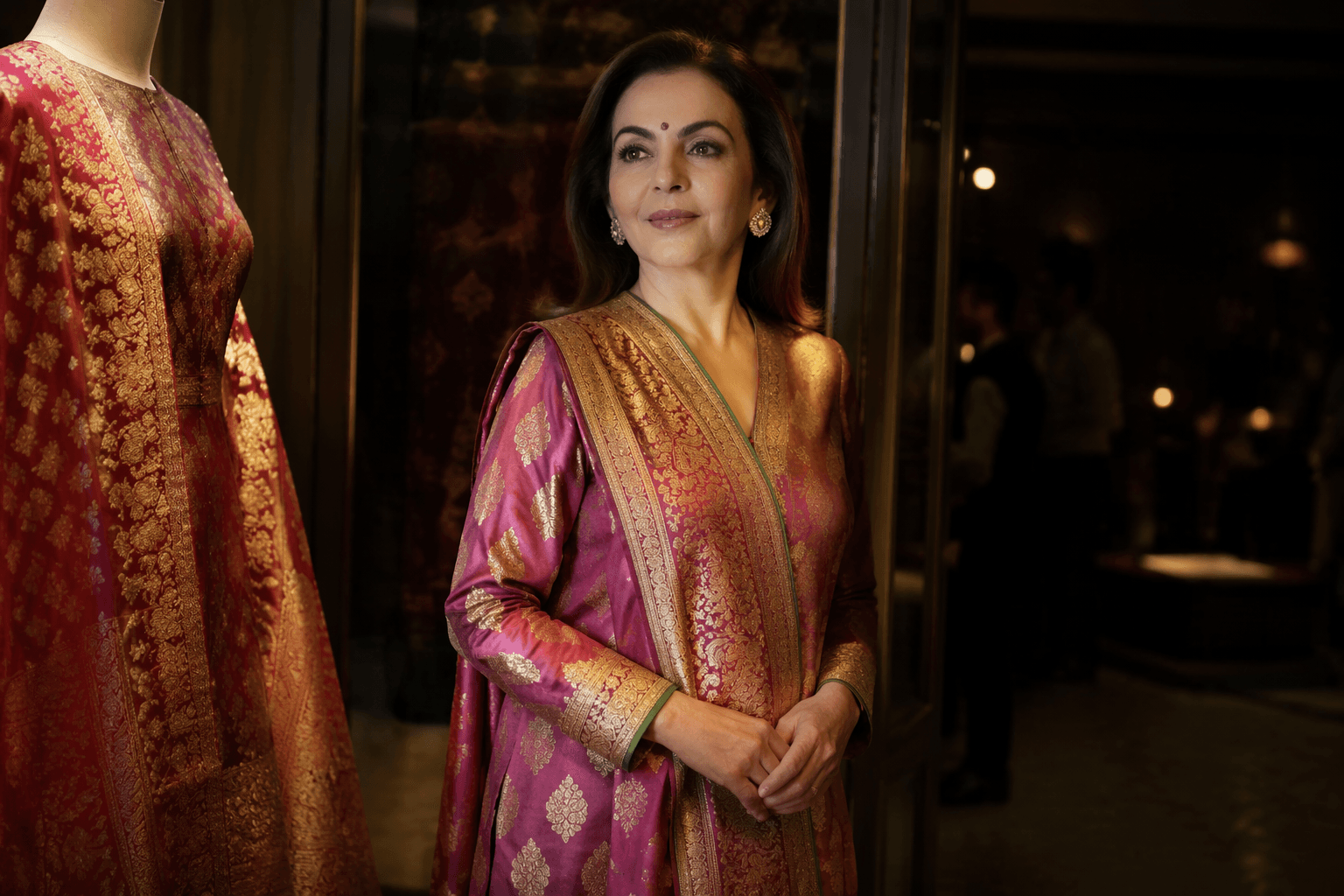
At the special celebration she hosted at the Swadesh flagship store, as founder and chairperson of the Reliance Foundation, the look also became a public tribute to India’s master artists and artisans. News18 framed the ensemble as a statement in favor of indigenous crafts, sustainability, cultural preservation, and ethical fashion, and that framing matters because it places craftsmanship, not consumer spectacle, at the center of the story.
Why Banarasi still carries authority
Banarasi textiles have a kind of social gravity that cannot be manufactured overnight. The Banaras Brocades and Sarees designation is GI registered, with a certificate date of 04/09/2009, and the protected weaving belt stretches across Varanasi, Mirzapur, Chandauli, Bhadohi, Jaunpur, and Azamgarh. That legal protection is not a technical footnote. It anchors the cloth to a defined geography, a set of methods, and a living lineage of labor.
Varanasi deepens that sense of rootedness. UNESCO describes it as one of the world’s oldest continuously inhabited cities, with continuous habitation since at least 1200 BCE. That kind of continuity explains why Banarasi textiles feel inseparable from place and memory. They are not just ornate fabrics. They are cultural documents, carrying the prestige of a city that has been woven into history for millennia.
Katan silk, Kadwa work, and the beauty of labor
The fabric itself does much of the speaking. News18 says the suit was crafted in luxurious Katan silk, a choice that suggests density, sheen, and structure rather than anything flimsy or merely decorative. Katan has presence. It holds its shape with authority, catches light without losing depth, and gives the motifs a surface worthy of close inspection.
Then comes the Kadwa technique, which is where the real textile literacy begins. In Kadwa weaving, each motif is individually woven rather than simply laid down as a repeat, and that labor shows up in the finished cloth as precision you can feel even before you understand it. In this Butidar design, master artisans Haji Nafees Ahmad and Naseem Ahmad individually wove each motif, turning the suit into a demonstration of skill rather than scale.
That is why the piece resonates so powerfully in old-money style conversations. A logo can announce spending, but a handwoven Banarasi announces knowledge. It says the wearer understands why a weave matters, why the hand of the maker matters, and why true luxury often looks more measured than flashy.
Heritage dressing as cultural fluency
What makes this look feel especially current is that it does not treat tradition as costume. News18 positions Nita Ambani’s choice as part of a consistent patronage of Indian handwoven textiles, and that continuity gives the outfit more weight than a one-night style moment ever could. It reads as a wardrobe philosophy built on patronage, preservation, and respect for craft.
That philosophy aligns closely with how government tourism material describes Banaras brocades and sarees: heirloom textiles passed down through families, with every step, from selecting the finest silk to weaving each motif by hand, reflecting commitment to excellence and precision. Heirloom value is the key phrase here. Old-money dressing has always favored things that outlast trend cycles, and Banarasi weaving belongs in that world because it carries both durability and memory in its construction.
The sustainability argument is part of the same logic. Handwoven textiles support artisan communities, preserve regional knowledge, and resist the disposable churn of fast fashion. In an era when sustainability is often flattened into marketing language, a Banarasi Butidar suit makes the point materially. It is labor you can see, craft you can trace, and heritage you can wear.
What this means for the modern old-money wardrobe
The move from quiet luxury to heritage luxury is not really a move away from restraint. It is a move toward deeper knowledge. The most polished wardrobes have always depended on people who could tell the difference between surface polish and actual quality, and Banarasi craft rewards exactly that kind of eye.
Nita Ambani’s suit captures that shift with unusual clarity. It does not rely on a loud brand name or a trend-led silhouette to communicate authority. Instead, it asks the viewer to notice the Katan silk, the Kadwa technique, the GI-protected Banarasi lineage, the named artisans, and the centuries of place that give the cloth its weight.
That is the new old-money code: not more display, but better reading. The most persuasive luxury today is the kind that knows where it came from, who made it, and why that work still deserves admiration.
This article was produced by Prism’s automated news system from verified source data, official records, and press releases, then run through automated quality and moderation checks before publishing. The system is built and supervised by the people who set the standards it runs under. Read our full AI policy.
Did this article answer your question?