Old Money Spring Staples, A Favorite Trench Coat and Quiet-Luxury Basics
A great trench, polished accessories, and repeat-wear basics make old money style feel less costume, more closet.
The trench is the anchor
Hanna Flanagan’s wardrobe edit for The Cut reads like a blueprint for quiet confidence: start with a trench coat that does the heavy lifting, then build around pieces you can wear on repeat. That is the real appeal of old money style. It has no spectacle, no provocation, just a crisp silhouette and the kind of restraint that makes a closet feel edited rather than crowded.
Burberry gives that idea its most convincing uniform. Thomas Burberry invented gabardine in 1879, a breathable, weather-resistant fabric that made the trench practical before it ever became polished. The house still describes its heritage trench coats as made in Yorkshire with the details that matter most: a belt, epaulettes, and the signature check lining. Burberry is marking its 170th anniversary in 2026, which only sharpens the point. This is a coat with a real lineage, not a marketing fantasy.
Why this look reads as old money
The phrase old money style has taken over the space that quiet luxury occupied a few seasons ago, and CNBC made the shift explicit on April 2, 2024. The look is built from expensive materials, muted tones, and classic dressing rather than logos. That formula works because it is legible in everyday life. You can see it in the weight of the cloth, the steadiness of the palette, and the way the clothes sit on the body without insisting on attention.
Fashion commentator Sonya Glyn and Thomaï Serdari, who teaches at New York University Stern School of Business, both linked the aesthetic’s staying power to a more practical mood. Post-pandemic inequality made overt display feel out of step, and fast-fashion fatigue pushed shoppers toward higher-quality pieces that last longer. CNBC also pointed to secondhand shopping as the smartest budget entry point, which is exactly how this style should be approached: not as a fantasy of wealth, but as a disciplined way of dressing better.
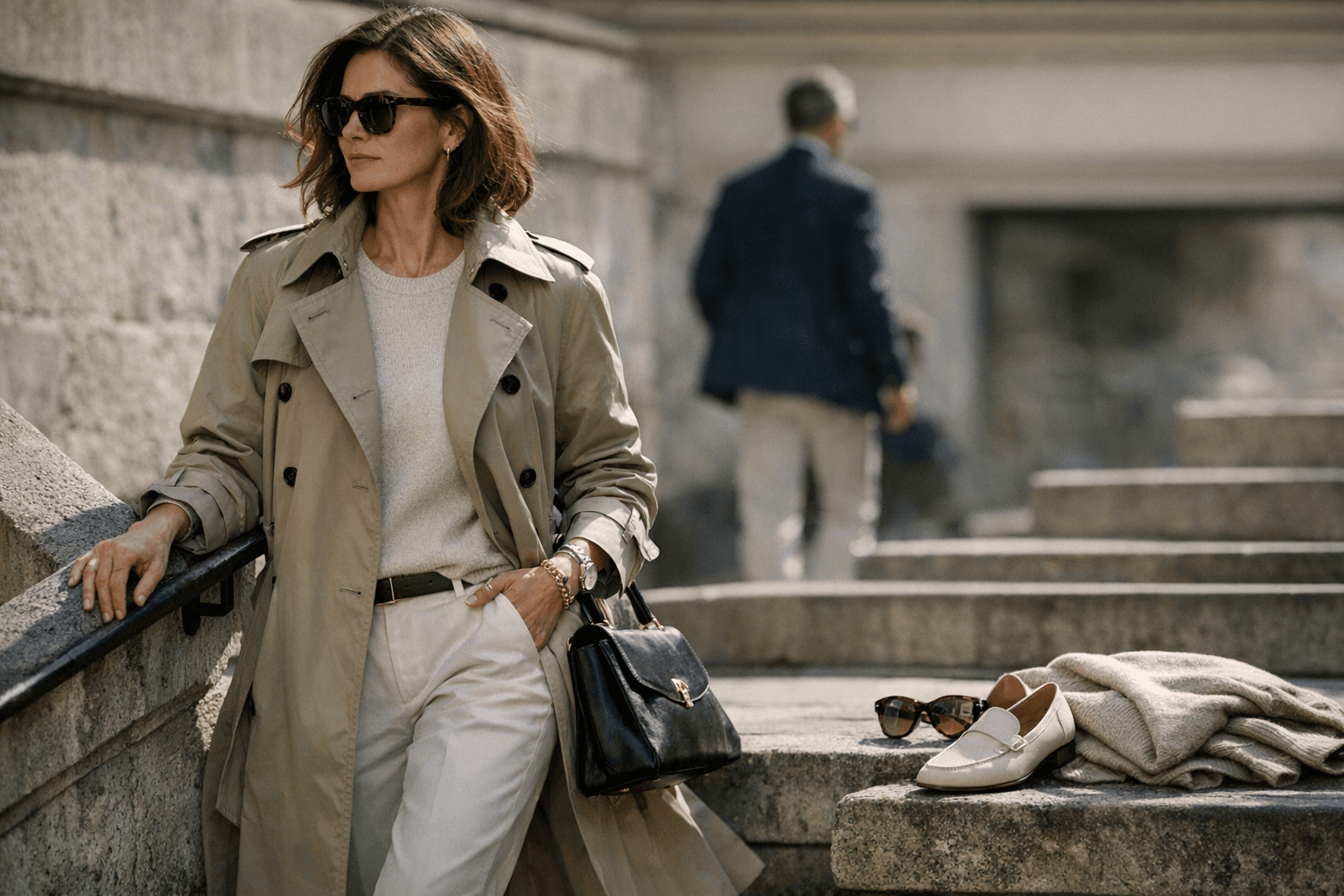
A trench coat captures that lesson better than almost anything else because it is useful first and elegant second. Look for fabric that holds its shape, a shoulder that feels clean rather than oversized, and a belt that defines the waist without fuss. The best version should skim the body, not swallow it, and the best color is usually one that can move quietly through the rest of your wardrobe.
- Choose gabardine or another tightly woven cloth that feels substantial in drizzle and wind.
- Favor camel, stone, navy, black, or khaki over anything overly saturated.
- Keep the detailing traditional: belt, epaulettes, clean lapels, and a lining that feels intentional.
- Buy for repeat wear. A trench only earns its place if you can wear it with denim, tailoring, and dresses all spring.
Accessories do the quiet work
The accessories in an old money wardrobe should look polished, useful, and slightly inevitable. A structured leather tote, slim sunglasses, a belt that sits flat, and shoes with a neat profile do more than any status bag ever could. The point is not to look stripped down. It is to look composed, as if every piece has been considered for its role in the outfit.
That is why the viral Burberry bag conversation mattered in the first place. The Cut linked the quiet-luxury conversation in 2023 to Succession and the “ludicrously capacious” Burberry bag, and the lesson still holds: oversized conspicuousness can be funny, but it is not the same as style. The smarter accessory story is smaller, sharper, and more repeatable. Think less about proving taste and more about making the rest of the wardrobe look expensive by association.
- One polished bag that can handle daily use.
- One pair of sunglasses that looks classic rather than trendy.
- One belt or watch that adds structure without shouting.
- One shoe that can move from errands to dinner without changing the mood of the outfit.
The best accessory formula for this season is simple:
The staples that make the coat feel believable
Old money style falls apart when the coat is good but everything under it looks temporary. The real blueprint is built from most-worn basics that can survive a long spring: crisp shirting, clean tailoring, simple knits, and trousers that hang properly. These are not the items that generate a reaction in a fitting room. They are the pieces that quietly earn their place because they work with everything else.
That is where the edit’s logic becomes useful. If the trench is the headline, the rest of the wardrobe should feel like disciplined supporting cast. A cashmere sweater in a muted shade, a sharp white shirt, a straight-leg trouser, and one pair of good flats will do more for this look than a pile of trend-forward pieces ever could. The goal is not variety for its own sake. It is repetition with polish.
Burberry’s own history makes this especially clear. The coat was designed to endure rough weather, and Sotheby’s places its story in the larger arc of the brand’s founding in 1856 and the early use of gabardine by explorers and military officers. That practical origin explains why the trench still reads as authoritative. It was built for use, then adopted by style figures for the same reason it works now: it solves the weather problem while sharpening the silhouette.
Why the aesthetic still has commercial pull
The market keeps rewarding this kind of dressing. 1stDibs’ 2025 Luxury E-Commerce Report said shoppers were showing renewed interest in heritage-driven and legacy-brand items, which fits a broader appetite for clothes that feel inherited rather than disposable. A separate 2025 luxury-market briefing put physical stores at 81 percent of personal luxury goods sales in 2025 and valued the market at $1.5 trillion, a striking reminder that tactile quality still matters. People are still responding to fabric, finish, and fit in person, where good clothes reveal themselves fastest.
AP reported in July 2024 that TikTok has shortened the shelf life of trends and reshaped how people engage with fashion, which only makes old money style more attractive. When everything else moves too quickly, the trench, the muted palette, and the reliable basics feel like common sense. W magazine showed just how durable the silhouette remains in March 2026, noting recent wearers like Teyana Taylor, Lila Moss, and A$AP Rocky, while also placing the coat in a lineage that includes Humphrey Bogart, Katharine Hepburn, Catherine Deneuve, and Meryl Streep. Few garments move so easily from wartime utility to modern cool.
That is the real lesson of the season. Old money style works when the clothes look expensive because they are well made, not because they are loud. A trench with proper structure, accessories that earn their keep, and basics you will actually wear again is enough to create the kind of understated confidence that never goes out of rotation.
This article was produced by Prism’s automated news system from verified source data, official records, and press releases, then run through automated quality and moderation checks before publishing. The system is built and supervised by the people who set the standards it runs under. Read our full AI policy.
Did this article answer your question?