Paul Smith revives the suit with relaxed, playful tailoring
Paul Smith’s Milan show makes the suit feel human again, trading corporate stiffness for dusty color, fluid cloth and boxier ease that fits how luxury is dressed now.
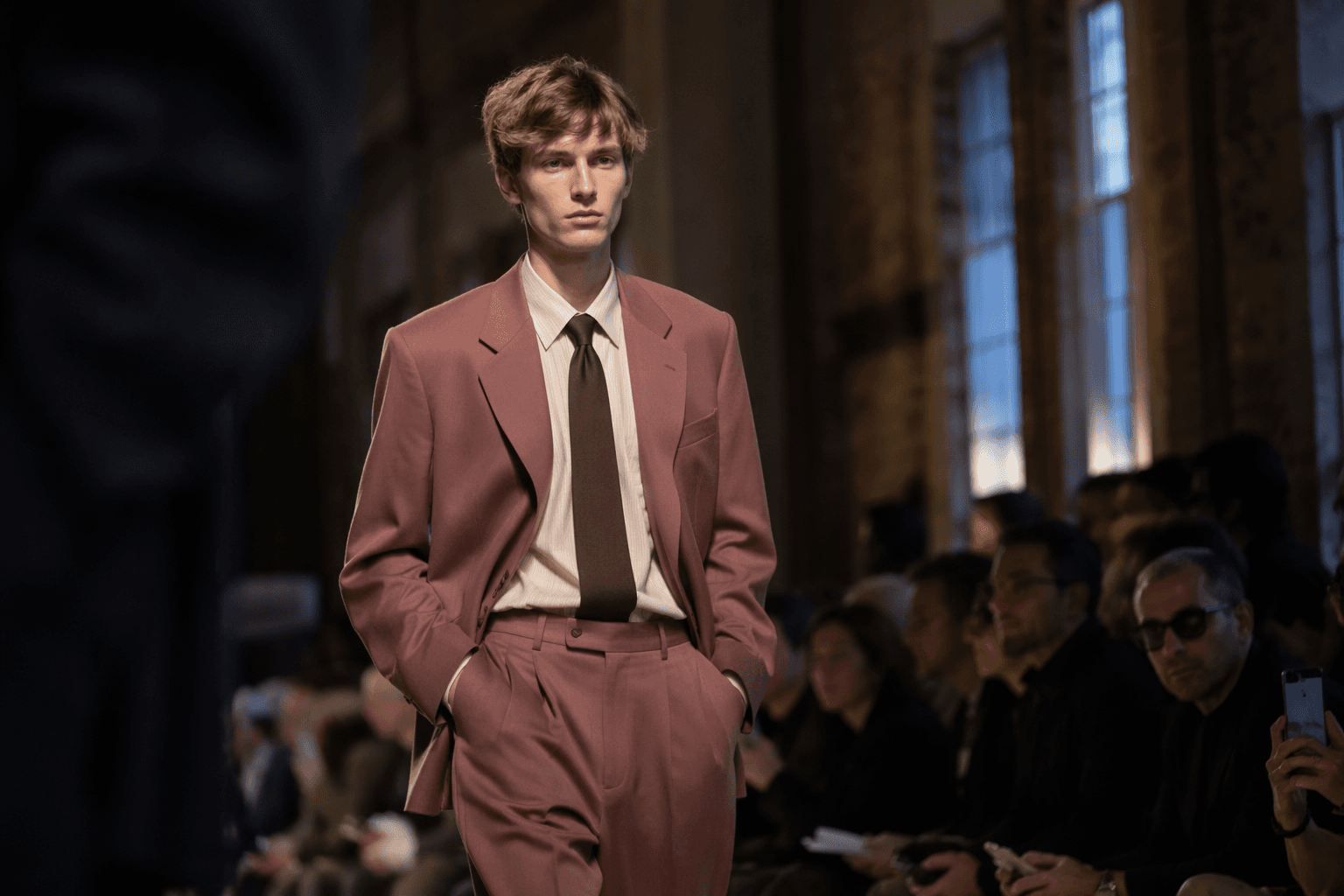
Paul Smith is making a convincing case that the suit does not need to look serious to be taken seriously. In his Spring/Summer 2027 men’s show, titled “Suits in Unsuitable Situations,” he softened tailoring with dusty colors, fluid fabrics and boxier cuts that read less like boardroom armor and more like a wardrobe that has learned to breathe. The result was a clear rehabilitation of the suit: not a rejection of classic menswear, but a loosening of its rules.
The suit, unbuttoned
The strongest idea in the collection was ease. Paul Smith stripped away the corporate stiffness that has made tailoring feel remote to younger luxury buyers, and replaced it with movement, color and a touch of mischief. WWD reported that the show riffed on Smith’s 1990s archive, and that historical pull gave the clothes a familiar backbone even as they felt newly relaxed. The message was simple: tailoring survives when it stops behaving like a uniform.
That point matters because the suit is back in the conversation, but not as the rigid symbol it once was. Smith linked the collection to a real-world appetite for dressing up again, noting the renewed interest in tailoring and even the use of tailoring fabrics in casual pieces. In other words, the suit is no longer isolated from the rest of the wardrobe. It is bleeding into everyday dressing, which is exactly why this version feels relevant.
Why Milan, why now
Smith presented the collection in an intimate, salon-style show during Milan Men’s Fashion Week, which ran from Friday, June 19 to Tuesday, June 23, 2026. His show took place on Saturday, June 20, placing it right in the middle of a menswear season that has become increasingly important to his brand strategy. Since his Milan catwalk debut in 2025, Milan has emerged as a key venue for his core men’s presentations, reducing the importance of the old French and British menswear circuit as the only stage for Paul Smith’s tailoring story.
That shift gives the collection extra weight. Milan is where tailoring language gets read with particular attention, and Smith used that setting to argue for a more human suit. The show’s salon format helped too. It felt intimate rather than declarative, which suited a collection built around softness, restraint and wearability rather than spectacle.
Old money style, updated
If old money fashion once depended on polish and distance, Smith is showing how it can survive by becoming less guarded. The color palette alone moves the conversation beyond the familiar beige-and-navy shorthand. Dusty tones, fluid fabrics and boxier proportions make the clothes feel lived-in, not precious. That is where this collection becomes more than a seasonal menswear update: it suggests a version of quiet luxury that is less about hiding the logo and more about easing the body.
The appeal for younger luxury buyers is obvious. Post-formality dressing has changed the rules, and not everyone wants a suit that looks like it is waiting for a handshake. Smith’s answer is a wardrobe that keeps the codes of heritage elegance, but edits out the pressure. It is still tailoring, just with the edges rounded off.
- softer, dustier colors instead of severe dark suiting
- fluid fabrics that move rather than hold a hard line
- boxier silhouettes that loosen the shape without losing structure
- playful styling that breaks up the old corporate read
- tailoring fabrics used in casual pieces, which makes the suit feel less ceremonial
What to notice in the new code:
What the archive adds
Smith’s use of his 1990s archive keeps the collection from drifting into novelty. That decade was already one of his sharpest periods for color and wit, so revisiting it gives the Spring 2027 clothes a sense of continuity instead of reinvention for its own sake. The official Paul Smith framing described the collection as a return to classics with unexpected details, playful combinations and moments of discovery, and that is exactly the right lens for this show.
There is also a subtle historical echo in the silhouettes. The brand’s own presentation pointed to tailoring that recalled the 1950s, which deepens the collection’s old-money credentials without making them stale. The 1950s reference brings structure and proportion; the 1990s archive brings attitude. Together, they create a suit that knows its lineage but refuses to dress like a museum piece.
The point of wearing a suit now
One of the most revealing details came from Smith himself: he said that even during the coronavirus pandemic, he wore a suit “pretty much every day.” That line cuts through the old assumption that tailoring is inherently restrictive. For Smith, the suit is not a costume for special occasions. It is a practical object, one that can be softened, adapted and worn with ease.
That is why this collection feels larger than one runway moment. It speaks to the way men actually dress now, moving between formal and casual codes without wanting a hard break between the two. The suit that wins in 2027 will not be the most imposing one. It will be the one that can sit comfortably beside a knit, a loose trouser, or a more relaxed shoe without losing its authority.
What to wear, what to skip
Wear the suit when it looks relaxed enough to become part of daily life. Choose the softer palette, the roomier jacket, the fabric with drape. Let the tailoring read as intelligent rather than armored, especially if you are drawn to old money style but do not want the stiffness that once came with it.
Skip the version that feels too corporate, too polished, too determined to signal status through severity. Smith’s show makes the case that the modern suit should feel emotionally easy as well as physically easy. That is the rehabilitation underway here: not a return to formality, but a smarter, more generous idea of what elegance can be.
This article was produced by Prism’s automated news system from verified source data, official records, and press releases, then run through automated quality and moderation checks before publishing. The system is built and supervised by the people who set the standards it runs under. Read our full AI policy.
Did this article answer your question?