Perfect Fit on Any Budget, Tailoring Secrets for Off-the-Rack Suits
A $35 sleeve alteration can make a $400 off-the-rack blazer read like bespoke; knowing which four changes deliver outsized elegance and which three to skip entirely is the real old-money secret.

The difference between a suit that looks expensive and a suit that *is* expensive often comes down to three inches of sleeve, a pinched side seam, and a tailor who knows when to stop. Old-money dressing has never been about the label inside the jacket; it has always been about how the jacket sits on the body. A $400 blazer altered with surgical precision will consistently outread a $1,500 one worn straight off the hanger, and the investment to close that gap is, in most cases, under $100.
The question is knowing exactly which alterations earn back their cost in elegance, which ones are traps, and how to walk into a fitting room or a tailor's shop with enough vocabulary to get what you actually want.
The four alterations worth every dollar
Sleeve length is the single highest-ROI alteration in tailoring. The standard off-the-rack sleeve is cut for a man with longer arms, which means most jackets arrive at your wrist instead of your shirt cuff. The rule is simple: a half-inch to three-quarters of an inch of white shirt should break past the jacket's sleeve at all times. Shortening costs $20 to $40 depending on whether the jacket is lined, and the transformation is immediate and legible at twenty paces. The one caveat is working buttonholes. If your jacket has functional buttonholes on the sleeve, adjustments are limited to roughly half an inch before the alteration becomes visible and awkward. If the gap is larger than that, flag it before committing to the purchase.
Waist suppression is where a boxy off-the-rack jacket becomes a garment with real authority. Taking in or letting out a suit jacket involves the tailor pinning the side seams based on your desired fit, drawing from the chest, the stomach and waist, the vents, or all three zones. Side seam work typically runs $30 to $40, and a center seam adjustment costs slightly less. Because the waist is the area that fluctuates most, manufacturers tend to allow a little extra fabric here for tailoring, which means there is usually room to work with. Even a modest suppression of an inch at the waist changes the silhouette from shapeless to intentional.
Collar adjustment addresses one of the most common and visually damaging fit problems: the collar that lifts away from the shirt at the back of the neck, creating a gap that reads as both sloppy and oversized. A minor collar fix runs $20 to $30. A collar roll alteration involves pinching and pinning the middle of the collar, taking in roughly 0.75 to 1.5 cm, and the cost should not exceed $15 to $20. It is not a complete solution when the problem is structural, but for modest gaps it improves the line considerably.
Lapel restoration is not always a tailor's job. When lapels get squashed in storage, they can fold at a point they are not supposed to, and often pressing the length of the lapel with a moderately heated iron, with steady pressure, is enough to return the original roll. Before paying anyone to fix a flattened lapel, try steam pressing at home first.
The false economies: alterations to avoid
Adjusting the shoulder width of a jacket is one of the most complex and challenging alterations possible. It requires a tailor to dissect, recut, and reconstruct the entire shoulder, and can significantly distort the original proportions, leading to awkward drape, unsightly lines, and poor fit. Shoulder alterations cost $75 to $150 and there is no guarantee the result will look convincing. This is the cardinal rule of buying off-the-rack: fit the shoulders first and alter everything else. The shoulder seam should land exactly where your arm joins your body, not a centimeter past it in either direction. If it does not, try a different size or a different brand. Do not try to buy your way out of the problem with a tailor's needle.
Shortening a jacket is similarly risky. Shortening more than an inch almost always throws off the proportions, and most suits have insufficient fabric in the hem to allow for it. The relationship between jacket hem and trouser break is architectural; change one without recalibrating the other and the whole silhouette collapses.
As a general rule, if alterations would exceed 50% of the cost of a new suit of similar quality, replacement is the smarter option. For example, extensive alterations totaling $400 might not make sense for a $600 suit but could be worthwhile for a $1,200 suit.
The six questions to ask your tailor
Walk into every fitting with these six questions ready. They will tell you within minutes whether you have found the right person for the job, and they will protect you from expensive mistakes:
1. "Is there enough seam allowance to let this out?" Always ask before assuming.
Cheap construction often leaves almost no fabric inside the seam. A good tailor will check before agreeing to any expansion.
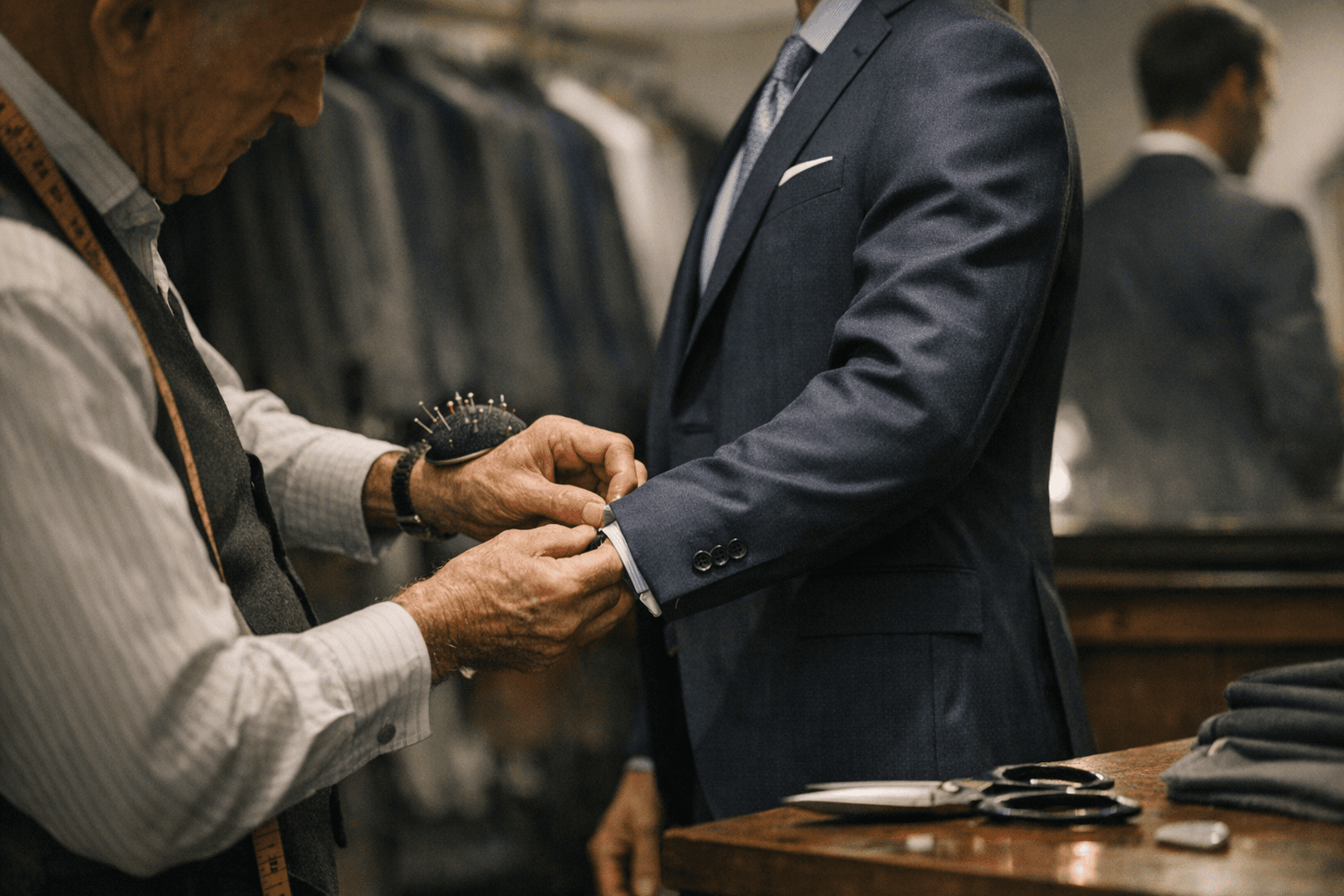
2. "Do these sleeves have working buttonholes?" Functioning buttonholes change the calculus on sleeve alterations entirely.
You need to know before you set a target length.
3. "How much can you take in at the waist without disrupting the pocket placement?" Pocket positioning limits how aggressively the front panels can be pulled in.
An experienced tailor will tell you the honest ceiling.
4. "Is the collar gap a fit issue or a posture issue?" Collar roll from posture is different from collar roll from cut.
The fix is different too, and a tailor who conflates the two will charge you for work that does not solve the problem.
5. "If I can only do two alterations, what would you prioritize?" This question reveals a tailor's eye and their priorities.
The right answer is almost always sleeves first, then waist. Anyone who leads with collar or shoulder work on a moderately-priced jacket is steering you toward expensive territory unnecessarily.
6. "How many fittings will this require and what is your turnaround?" Expect one fitting for simple jobs and two fittings when combining jacket and trouser work.
Basic sleeve and hem alterations take five to ten business days; moderate waist and tapering work runs seven to ten days; complex changes take two to three weeks or longer.
The home self-check: do this before you buy or book
Stand in the jacket in front of a full-length mirror wearing the shirt and shoes you plan to pair with it. Run through these five checks before spending a dollar:
- Shoulders: The seam sits exactly at the shoulder joint. Any overhang past your natural shoulder means the jacket is too large in a way that cannot be cheaply fixed.
- Chest: The jacket should button with no pulling at the front. If the lapels bow outward, the chest is too small.
- Waist: Slip your hand flat between the jacket's front panel and your torso when buttoned. You should feel contact but not compression.
- Sleeve: Bend your arm and confirm that shirt cuff is visible. If the sleeve covers your shirt entirely, add $20 to $40 to your purchase budget and flag it for the tailor.
- Collar: Press the jacket to the back of your neck. A gap larger than a finger-width suggests a fit issue worth addressing before purchase, not after.
Typical price ranges at a glance
- Sleeve shortening or lengthening: $20 to $40
- Side seam suppression or release: $30 to $40
- Center seam adjustment: $15 to $25
- Collar adjustment (minor): $20 to $30
- Collar roll correction: $15 to $20
- Shoulder alteration: $75 to $150 (avoid unless essential)
- Lining repair: $20 to $50 depending on extent
Prices vary by city and by tailor's reputation. In New York or Los Angeles, expect to pay at the higher end of every range. In smaller markets, the same work can cost significantly less.
The quiet truth about old-money dressing is that it has always been a system, not a budget. Buy at the right shoulder, commission the right alterations, and a navy blazer from any mid-range retailer can carry you for two decades. The tailoring is not the afterthought; it is the entire point.
This article was produced by Prism’s automated news system from verified source data, official records, and press releases, then run through automated quality and moderation checks before publishing. The system is built and supervised by the people who set the standards it runs under. Read our full AI policy.
Did this article answer your question?