Quiet Luxury Rises as Logo-Forward Fashion Faces a Corporate Reckoning
Logo-free luxury is winning wallets and boardrooms; Prada and Miu Miu's minimalist dominance is forcing a corporate reckoning at Versace.
The numbers don't lie, and neither do the runways. While Versace has spent years banking on its Medusa medallions and baroque maximalism to signal status, something quieter has been compounding interest on the other side of the luxury market. Prada and Miu Miu have been refining a language of restraint so precise, so culturally fluent, that the logo-forward playbook suddenly looks less like confidence and more like noise.
Bloomberg opinion columnist Andrea Felsted put the tension into sharp relief this month, framing what many in the industry have felt but few have said plainly: the corporate strategies underpinning these two very different visions of luxury are diverging, and the consequences are real.
The Versace Problem
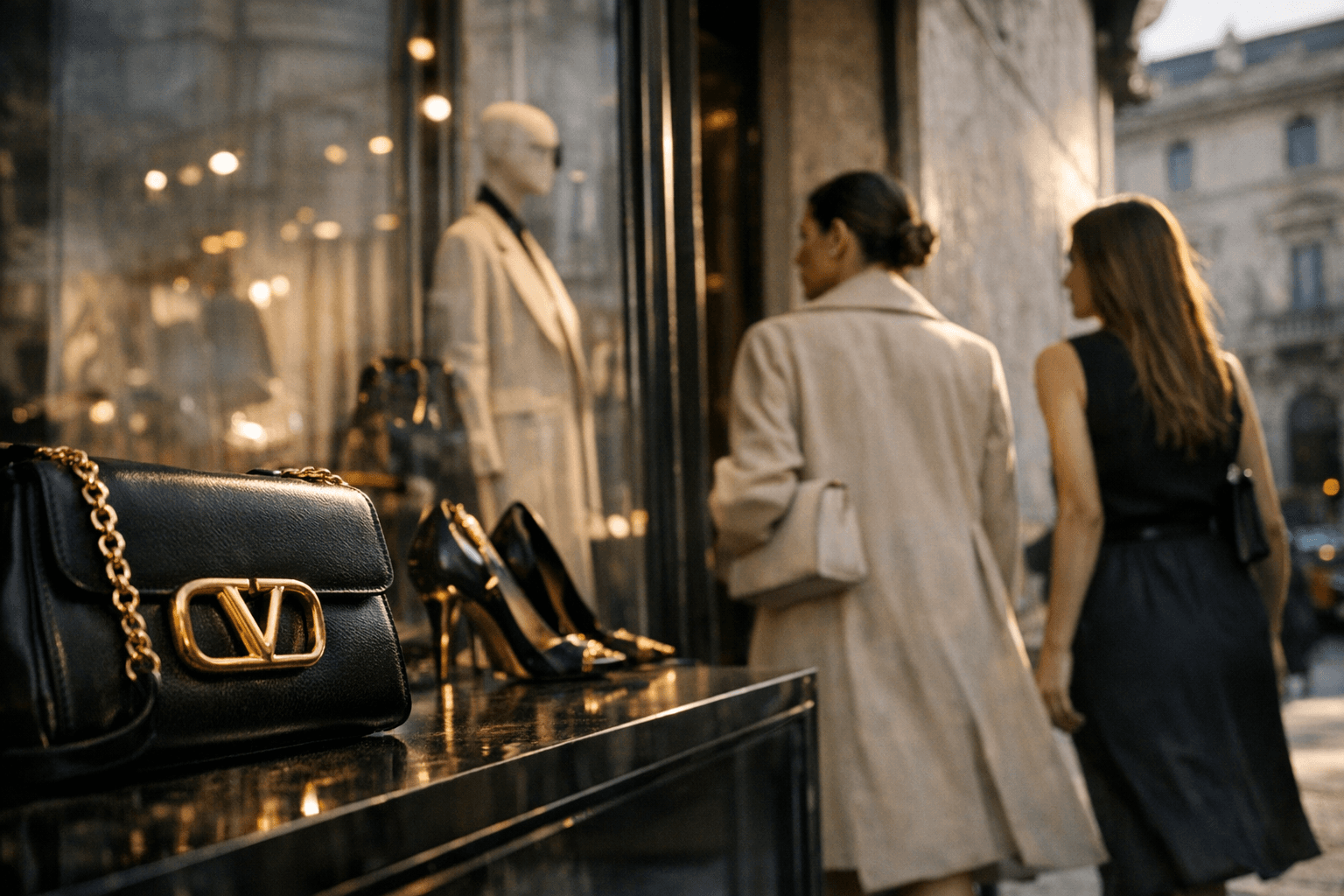
Versace built its empire on visibility. The Medusa head, the safety-pin dress, the gold chain print: these are not subtle signals. They are declarations. For decades, that loudness was a feature, not a flaw. Wearing Versace meant you had arrived, and you wanted the room to know it.
But arrival looks different now. The cultural appetite that once rewarded conspicuous branding has grown more sophisticated, or at least more self-conscious. The client who once reached for a monogram-covered bag is increasingly reaching for something that requires more decoding, something that signals taste rather than simply cost. Versace's challenge is structural: its identity is inseparable from its logos and prints, which makes pivoting toward restraint feel less like an evolution and more like an identity crisis. The corporate moves surrounding Versace's brand positioning, which Felsted examines in her analysis, reflect exactly this kind of friction between heritage aesthetics and shifting luxury appetite.
How Prada Learned to Speak in Silence
Prada has always occupied a peculiar, enviable position in the luxury hierarchy. It is cerebral where others are decorative, conceptual where others are aspirational. Miuccia Prada has spent decades building a house that rewards the informed eye: the nylon bag that chose utility over ostentation, the ugly-shoe moment that reframed beauty entirely, the sartorial intellectualism that made wearing Prada feel like a position statement rather than a purchase.
That foundation has paid off handsomely in the current climate. When quiet luxury became the dominant cultural frequency, Prada didn't need to reinvent itself. It simply stepped forward. The brand's instinct for restraint, for clothes that carry meaning without announcing it, positioned it perfectly for a consumer who has grown tired of being a walking advertisement.
Miu Miu's Precision Strike
If Prada represents the elder statesman of considered minimalism, Miu Miu has emerged as its most exciting practitioner. The brand, Prada's younger, sharper sibling, has executed something genuinely difficult: it has made understated dressing feel urgent, even transgressive.
The Miu Miu customer doesn't disappear into her clothes. She is simply legible only to those who know how to read the language. A micro-skirt in heavy wool, a shirt left deliberately untucked, a ballet flat worn with the specific casualness of someone who never had to try: these are not accidents. They are a vocabulary, and Miu Miu has been the most articulate speaker of it for several consecutive seasons. The brand's cultural momentum is not incidental. It is the result of a coherent, sustained creative vision that understands exactly what this moment in fashion demands.
Old Money's New Corporate Logic
What makes Felsted's analysis in Bloomberg particularly sharp is the insistence on reading these aesthetic choices as corporate strategy, not just creative preference. The tension between loud and quiet luxury is not simply a matter of taste. It has balance sheet implications.
When a brand is synonymous with logomania, its fortunes are tied to the cultural staying power of that logomania. When the wind shifts, as it has, the exposure is significant. A house built on quiet quality, on fabrication and cut rather than print and hardware, has a different kind of resilience. Its value proposition doesn't depend on a trend cycle turning in its favor because it was never trend-dependent to begin with.
This is the deeper argument embedded in the quiet luxury conversation: that restraint is not just aesthetically preferable right now, it is strategically sounder. A cashmere coat that asks nothing of the viewer except that they appreciate its weight and drape will outlast any season. A logo that announces its own price tag is vulnerable the moment conspicuous consumption loses its cultural cachet, and right now, it is losing it.
What This Means for the Wardrobe
The practical inheritance of this shift is straightforward, even if building toward it requires patience. The old money aesthetic that quiet luxury draws from has always been organized around the same principles: investment in material quality over surface decoration, silhouettes that flatter without performing, color palettes that recede rather than announce.
- Reach for fabric first. The difference between a coat that reads as expensive and one that merely costs money is almost always in the hand of the cloth. Wool with real weight, cashmere that doesn't pill after a season, silk that moves rather than stiffens: these are the details that communicate before any label does.
- Let the silhouette do the work. A well-cut trouser, a blazer with a shoulder that sits correctly, a dress whose proportions require no explanation: these are the building blocks of a wardrobe that survives trend cycles intact.
- Edit toward coherence, not completeness. The old money wardrobe is not a large wardrobe. It is a precise one. Every piece should be able to work with at least three others already hanging in the closet.
- Treat logomania as the exception, not the rule. This is not an argument for never wearing a recognizable house. It is an argument for wearing it selectively, for understanding when a logo adds meaning and when it simply adds noise.
The Reckoning Ahead
The corporate maneuvering that Felsted traces around brands like Versace points to something the industry is still working out in real time: what happens when the customer's taste evolves faster than the brand's identity can follow? Versace is not the only house asking that question, but it is currently the most visible example of a label whose loudness has become a liability in a market rewarding discretion.
Prada and Miu Miu have demonstrated that the answer is not to abandon heritage but to mine it for the elements that translate. The brands winning this moment are not the ones chasing quiet luxury as a trend. They are the ones for whom quiet was always the point.
This article was produced by Prism’s automated news system from verified source data, official records, and press releases, then run through automated quality and moderation checks before publishing. The system is built and supervised by the people who set the standards it runs under. Read our full AI policy.
Did this article answer your question?