Sergio Hudson's Ten Years of Timeless American Power Dressing
Sergio Hudson built a decade of American power dressing on three principles: sculpted shoulders, cinched waists, saturated color. Here's how to translate his playbook into your own wardrobe.

The question nobody asks when buying a blazer: will this still feel exceptional in 20 years? Sergio Hudson has spent a decade building a label around exactly that benchmark, and his answer to the question is the same now as it was when he launched: "I think the Sergio Hudson woman is a woman who wants real clothes that will stand the test of time... I want you to be able to put on my suit 20 years from when you bought it and say, 'Wow, this suit looks amazing on me.'"
Tailoring has always been where Hudson shines brightest, and after a decade of refining that conviction, his design language is specific enough to serve as an actual wardrobe framework, not just aesthetic inspiration. The signatures are three: sculpted shoulders, cinched waists, and saturated color. Master those three principles in the pieces you buy and how you have them fitted, and you have Hudson's entire philosophy working in your closet.
The Hudson Philosophy, Applied
Hudson staged his tenth-anniversary show at the New York Public Library in February 2026, honoring Black opera icons and sharpening his signature suiting into what reads as a decade of discipline. The Forbes profile that followed in March 2026 positioned the collection as a deliberate argument for longevity and investment dressing, situating Hudson's work against an industry constantly pulled between viral trends and lasting value. That framing is useful because it names something most wardrobes lack: a point of view with a long enough time horizon to make every purchase feel considered.
His collections consistently feature tailored jackets, body-conscious dresses, and statement color palettes that highlight bold femininity, drawing from the glamour of the 1990s while infusing modern innovation into timeless cuts. The result is clothing that photographs as trend-forward but wears as investment-grade — which is exactly the tension a well-curated wardrobe should hold.
The Capsule: Eight Pieces That Carry the Whole Argument
You don't need the full runway. You need eight pieces, chosen with the same precision Hudson applies at the pattern-cutting stage.
- A structured blazer in a saturated color. Cobalt, ivory, or deep burgundy. This is the load-bearing piece of the entire capsule. The collar should lie flat without pinning, and the jacket should close without pulling across the chest.
- High-waisted wide-leg trousers. The waistband sits at the natural waist, not the hip. A full leg from hip to hem creates the long-line proportion Hudson's silhouette depends on.
- A jewel-toned suit. Either a two-piece or a suit dress. Forest green, saturated teal, or deep amethyst. The color commitment is not decorative; it is structural to the look. A muted version of a jewel tone reads cheaper than the saturated original.
- A cinched-waist pencil skirt. Midi or just below the knee. The waist must be structured enough to hold its shape without a belt. Fabric weight matters: a heavy crepe or ponte keeps the line.
- A fitted turtleneck bodysuit. In matte jersey or ribbed knit. It eliminates volume at the torso so the blazer and trouser combination can do their proportional work uninterrupted.
- A structured overcoat. Knee-length, with a clean lapel and a slightly suppressed waist. This is the outermost signal of the whole wardrobe's intention. Treat it as a 20-year purchase.
- A column or sheath dress in a solid, saturated color. No print. The silhouette carries everything.
- A draped eveningwear piece. Hudson's FW26 show was a masterclass in impeccable tailoring, bold color-blocking, and extravagant silhouettes, with each look radiating what he called "the drama, the glamour, the emotion, the spectacle." For evening, that translates to a fluid column in a rich fabric or a one-shoulder gown in deep satin where the construction holds the drape.
Three Looks, Three Situations
Boardroom: Lead with the jewel-toned suit. Pair the jacket with matching high-waisted trousers and a fitted bodysuit underneath. Shoes: a pointed-toe block heel or a clean leather loafer. The trouser breaks just above the shoe, allowing one clean fold at the front of the leg. No excess fabric bunching at the ankle, no visible sock.
Wedding Guest: The column dress in a deep, saturated hue, with no accessories competing with the silhouette. If the weather requires a layer, the structured blazer in a contrasting tonal color outperforms a wrap or a shawl every time. Avoid anything draped loosely at the shoulder; a sharply tailored blazer cinched at the waist, paired with a calf-grazing skirt, is Hudson's own answer to how structured dressing handles a formal occasion.
Dinner: The draped eveningwear piece, or the cinched pencil skirt with a silk blouse tucked cleanly in. The goal is ease without losing the structural quality of the overall look. Hudson's evening pieces rarely rely on embellishment; the weight and movement of the fabric carry everything.
Tailoring Checkpoints
Before any piece in this capsule leaves the store or the alteration studio, run three checks.
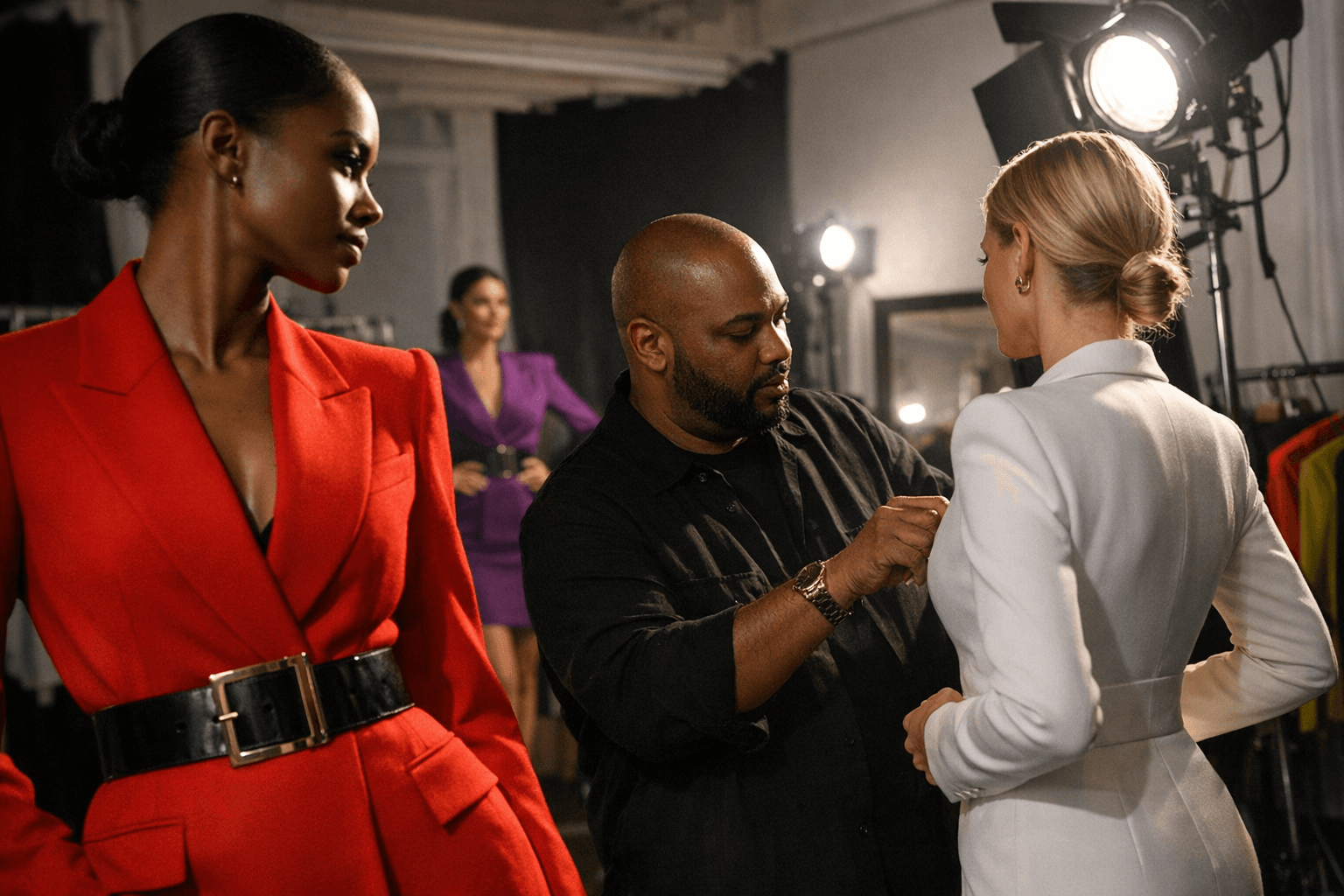
Shoulder. The seam should land at the exact edge of your shoulder bone. Half an inch down the upper arm signals a fit that will not hold its structure long-term. This is the single most important checkpoint in Hudson's aesthetic and the hardest to fix after purchase.
Waist suppression. For any structured piece — the blazer, the overcoat, the pencil skirt — look for visible shaping at the waist when the garment hangs on the body naturally. A straight tube from shoulder to hem has no suppression and undermines the entire proportional argument.
Trouser break. A full or half break is fine. Trousers pooling at the shoe are not. A standard hem alteration costs less than the difference between a trouser that reads tailored and one that reads borrowed.
Silhouette Do's and Don'ts
- Do commit fully to color. Half-measures in saturated tones read as indecision.
- Do prioritize waist structure. The defining characteristic of Hudson's silhouette is that the body's proportions are always acknowledged.
- Don't layer more than two capsule pieces in competing textures or prints. The strength of this aesthetic is the clean line.
- Don't sacrifice shoulder fit to save money on a jacket. A dropped shoulder undermines every other element, including the alteration investment below it.
Investment vs. High-Street
Worth the investment: Hudson's designs are available at Neiman Marcus, Saks Fifth Avenue, Bergdorf Goodman, and Net-a-Porter. His made-to-measure suits start around $5,000, but his ready-to-wear suiting and blazers sit below that entry point and carry the same construction philosophy. The structured overcoat and the jewel-toned suit are the two pieces where investment-level quality directly extends the wearable life of everything else in the capsule.
High-street alternatives: Hudson's past collaborations with Target demonstrated that his design principles translate across price points, and the mid-market has plenty of options for the functional underlayers: the fitted bodysuit, the turtleneck knit, and the wide-leg trouser in a heavy crepe or ponte. For the column dress, always choose the lined version over unlined; it holds the silhouette through a full evening rather than half of one.
Fewer independent designers are achieving the ten-year milestone these days. The ones who do tend to share one characteristic: a repeatable design principle that customers trust across seasons and decades. Buy the suit, get it tailored to the three checkpoints above, and wear it for the next twenty years. That is the whole playbook.
This article was produced by Prism’s automated news system from verified source data, official records, and press releases, then run through automated quality and moderation checks before publishing. The system is built and supervised by the people who set the standards it runs under. Read our full AI policy.
Did this article answer your question?