Signed Pieces, Lasting Value: How to Buy Heirloom Jewelry Like Old Money
The maker's mark is the difference between jewelry that wears out and jewelry that cashes out. Here's how to buy signed pieces that hold their value like old money.

There is a specific kind of weight to a signed piece of jewelry. Not just the heft of the gold or the cool press of a stone, but the gravitational pull of a name engraved in a space smaller than your thumbnail. That tiny mark, a "CARTIER" or "VAN CLEEF & ARPELS" stamped along the inner shank of a ring or clasp of a bracelet, is what separates a beautiful object from a generational asset. In the world of vintage jewelry, "signed" is the magic word: it means the piece bears the official mark or signature of its maker, like Van Cleef & Arpels, David Webb, or Bulgari. Buying heirloom jewelry the way old money does is less about spending the most and more about spending correctly. That starts with understanding exactly why the signature matters.
Why the Signature Changes Everything
A generic 3-carat diamond ring is valued primarily on the intrinsic worth of the stone and metal. A 3-carat diamond ring signed by Cartier, however, carries the weight of brand equity, design history, and craftsmanship. The signature is not a vanity stamp. It is a powerful mark of authenticity, quality, and provenance — the jewelry equivalent of an artist's signature on a painting, confirming you have the real deal, not a copy.
The financial logic is equally concrete. A signature can add a significant premium, sometimes 50% or even more, to a piece's worth, especially if it's from a highly collectible period like Art Deco. Iconic designs like a Cartier Tutti Frutti bracelet or a Van Cleef & Arpels Alhambra necklace command astronomical prices precisely because of the name attached to that specific style. And that premium tends to grow over time rather than erode. Signed pieces often hold their value better than unsigned ones, especially when they come from prestigious houses with documented histories.
The Houses Worth Knowing by Heart
Not all signatures carry equal weight. The following five names represent the blue-chip tier of heirloom jewelry, each with a distinct identity and a track record at auction.
Cartier is the starting point for any serious collection. If vintage jewelry had a royal family, Cartier would be on the throne. Iconic lines like the Panthère, Love, and Trinity are not just jewelry; they are cultural symbols. A vintage Cartier bracelet or cocktail ring is acquiring a piece of a 175-year legacy of serving royalty and stars. Their most popular and in-demand styles include the Love bracelet, introduced in the 1970s, and the Just Un Clou collection. If you want a designer piece that will retain value for decades to come, Cartier is one of the safest and most attractive options in fine jewelry.
Van Cleef & Arpels is arguably the strongest performer by the numbers. The RealReal found that Van Cleef & Arpels jewelry held its value the best of any other fine jewelry brand, retaining 74 percent of its original value on average with a 5 percent increase year over year. The Alhambra is its flagship: faithful to the first Alhambra jewel created in 1968, this style is both modern and on-trend while remaining classic for decades. The Van Cleef Perlee collection is also gaining traction, with necklace values increasing by 83% since 2022.
Tiffany & Co. rewards collectors who go deep into the archive. From the legendary Schlumberger designs with their whimsical, nature-inspired forms to the elegant severity of Paloma Picasso's designs, vintage Tiffany is incredibly diverse and sought-after. Pieces from their defining mid-century periods are particularly prized for their design innovation and unparalleled quality. Since being acquired under LVMH's wing in 2021, Tiffany has been the largest contributor to LVMH's growth in recent years, which only reinforces the brand's long-term market position.
Bulgari brings a boldness to the category that the French houses rarely match. The brand's legacy extends back to 1884, and its iconic aesthetic, from the serpent-like curves of Serpenti to the mesmerizing shapes of B.zero1, is instantly recognizable. A Bulgari jewel becomes valuable when design, color, craftsmanship, and condition align. Provenance and documentation can significantly enhance value by adding context and reducing uncertainty. The Serpenti is the piece to prioritize: a Bulgari Diamond Bangle Serpenti sold for 342,900 CHF in May 2025, a testament to how well preserved examples continue to perform at auction.
David Webb is the American outlier in this conversation, and the one most underestimated by first-time buyers. Founded in 1948, the house revolutionized jewelry with its audacious use of color, sculptural forms, and unapologetically bold aesthetic. While European jewelers favored delicate elegance, David Webb embraced maximalism, creating pieces that announced themselves with confidence and wit. Webb's unique design aesthetic attracted America's most elite women including Jacqueline Kennedy Onassis, Elizabeth Taylor, and Diana Vreeland. At Sotheby's, a David Webb tiger head gold, enamel, emerald and diamond bracelet sold for over $80,000 in 2024. Webb is also one of the most immediately identifiable hands in the field: the brand's signature motifs, particularly the instantly recognizable black and white enamel zebra bracelet, whimsical animal kingdom pieces, vibrant enamel work, and distinctive hammered gold, have become symbols of fearless American style.
How to Verify What You're Buying
The signature's power is only as strong as its authenticity. Counterfeits and misattributed pieces exist at every price point, so knowing how to read a mark is a non-negotiable skill.
Signed jewelry refers to pieces that are stamped, engraved, or hallmarked with the signature of the jewelry house or artisan who created them. These marks often include the maker's name, logo, or initials, certifying authenticity and craftsmanship. When examining a piece:
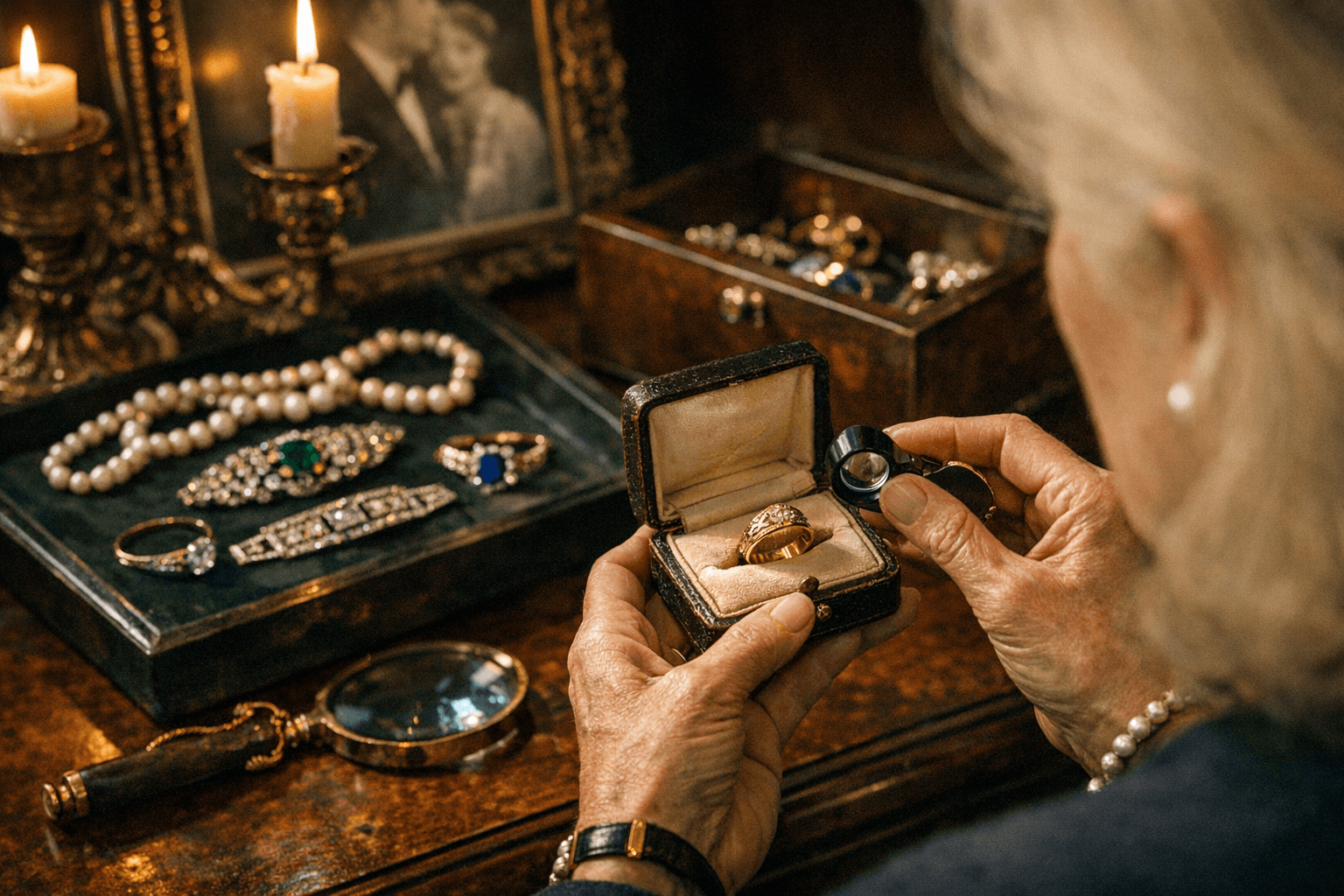
- Use a 10x magnifier loupe, which allows you to see details invisible to the naked eye.
- Authentic signatures are typically clean, sharp, and professionally engraved. Blurry, uneven, or overly deep engraving can be a red flag.
- For Bulgari specifically, genuine pieces have a Bulgari hallmark with the brand's name and metal type and "Made in Italy" stamped on the piece. Bulgari uses "v" in place of the "u" from the Latin alphabet, so the stamp reads "Bvlgari."
- If available, original documentation such as purchase receipts or certificates of authenticity can confirm the authenticity of a piece. For valuable pieces or when in doubt, consulting a jewelry expert or appraiser who specializes in high-end jewelry can provide professional verification.
The Paper Trail Is Part of the Piece
Old money doesn't just collect jewelry. It keeps receipts. The documentation that accompanies a signed piece is a direct multiplier of its value, and losing it is a quiet financial mistake many buyers only discover when they try to sell.
Identical items can have wildly varying resale values based simply on the presence or absence of proper documentation. For many pieces, a lack of certificates can lower their perceived value by 15% to 50%. For Bulgari in particular, provenance and documentation play crucial roles. Original boxes, certificates of authenticity, and purchase receipts significantly enhance a piece's marketability, and complete sets with all original components typically command premiums of 15-25% over items without documentation.
The practical steps are straightforward:
- Keep original certificates, purchase receipts, and service records together and stored in acid-free sleeves.
- Choose pieces in high-purity gold such as 18k or platinum, which retain their value better than lower-purity alloys.
- Diamonds should come with certification from the Gemological Institute of America to verify authenticity and grading.
- Schedule annual professional cleanings for valuable pieces, especially those with intricate settings, and inspect regularly for signs of wear.
Signed vs. Unsigned: Knowing When to Break the Rule
There is a legitimate argument for unsigned vintage pieces, and being aware of it makes you a sharper buyer. Many unsigned pieces were made by the exact same master workshops that supplied the big-name houses. A single workshop might have produced exquisite pieces for several top brands, with only the final stamp differentiating them. In Paris, Jacques L'Enfant was the top maker of gold chains from the 1940s to the 1970s and created signed pieces for all the French and American houses. Strauss, Allard & Mayer was similarly recognized in the Art Deco period for master enamel work.
That said, the practical case for signed pieces rests on one thing that unsigned pieces cannot offer: a signed piece from Tiffany & Co. has an established market, while an anonymous piece's value depends entirely on finding the right buyer who appreciates its particular charms. Anonymous pieces can sell for astonishing prices to collectors who fell in love, but they are less liquid than the blue-chip signed pieces.
For the buyer whose goal is style and capital resilience in equal measure, liquidity matters. If there is a quality signed vintage piece it will be more valuable because these pieces are no longer made and they are very collectible. There are more collectors now, so those pieces are harder to find and more valuable.
Building the Collection
The old money approach focuses on acquiring fewer, higher-quality pieces rather than following trends. One Cartier Love bracelet in excellent condition with original paperwork is worth more to a collection, both financially and aesthetically, than five unsigned pieces of comparable gold weight. Unlike stocks, jewelry can be worn, admired, and passed down through generations. Heirloom pieces often gain sentimental and historical value, making them more valuable to collectors.
The five houses, Cartier, Tiffany, Van Cleef & Arpels, Bulgari, and David Webb, represent different aesthetic registers: Cartier for architectural restraint and cultural currency, Van Cleef for nature-inspired whimsy with the best documented resale performance, Tiffany for mid-century American design at its most confident, Bulgari for chromatic boldness and Roman maximalism, and David Webb for a specifically American brand of sculptural bravado that is both undervalued by newcomers and deeply coveted by those who know. Together, they cover every occasion and every mood, which is precisely how a generational collection is built: not as a trend-driven accumulation, but as a considered archive of signatures that will outlast their wearer by decades.
This article was produced by Prism’s automated news system from verified source data, official records, and press releases, then run through automated quality and moderation checks before publishing. The system is built and supervised by the people who set the standards it runs under. Read our full AI policy.
Did this article answer your question?