Simone Rocha softens menswear with heirloom romance in Florence
Simone Rocha turns old-money menswear inside out, replacing power suiting with lace, checks and ballet flats, and making privilege look tender.

Simone Rocha has made menswear look less like armor and more like inheritance. In Florence, her first dedicated menswear runway show traded the usual codes of control for something softer, stranger and far more affecting: Prince of Wales tailoring, heirloom lace, Fair Isle knits, cutwork linen, pearl beading and ballet flats, all polished enough for an old-money wardrobe but emotionally charged enough to feel newly alive.
A gentler idea of privilege
Rocha’s latest menswear move matters because it resets the language of masculine dressing rather than simply decorating it. She began introducing menswear into her mainline collections in 2022, then committed to a standalone men’s line with AW25 and followed it with a second collection for SS26. By the time she arrived at Pitti Immagine Uomo No. 110, the message was clear: this is no side project, but a fully formed point of view about what men can wear when power dressing stops being the goal.
The old-money reference points are all here, but none of them land as costume. Prince of Wales checks read as inherited rather than corporate. Broderie anglaise and lace lend the clothes a kind of antique tenderness. Gingham, cutwork linen and Fair Isle cardigan vests keep the palette rooted in recognizable country-house tradition, yet Rocha uses them to loosen menswear’s shoulder-first stiffness. The result is less wall street, more family archive.
Florence gave the clothes their script
The setting sharpened the idea. Rocha’s guest-designer event took place on June 18, 2026, as part of Pitti Immagine Uomo No. 110, which ran from June 16 to 19 in Florence. The runway was staged at Teatro della Pergola, the historic Florentine opera house that opened in 1657 and is widely considered Italy’s oldest theatre. That alone made the show feel like a scene, not just a presentation.
Rocha leaned into that theatricality by seating guests in the main hall, stalls, balconies and even onstage. She said she wanted the men to be the “main characters,” imagining them arriving from Ireland to Florence, and that framing gave the clothes a narrative rather than a static polish. The references to E. M. Forster’s *A Room With a View* and James Ivory’s 1986 film adaptation make perfect sense here: the collection has the flushed romance of turn-of-the-century travel, where class, innocence and desire all sit uneasily together.
The signifiers: what to wear, what to soften, what to skip
If you are reading Rocha’s menswear as a guide to old-money style, the point is not to strip things back until they disappear. It is to make traditional privilege dressing feel more humane.
Wear the checks, but let them breathe. Prince of Wales tailoring gives the collection its backbone, yet Rocha interrupts that formality with tulle petticoats, pearl-beaded surfaces and, at the finish, ballet flats. Wear the knit, but choose one with a softness to it. The Fair Isle cardigan vests nod to country codes, but in this context they feel more like something borrowed from a well-kept attic than deployed as status signage.
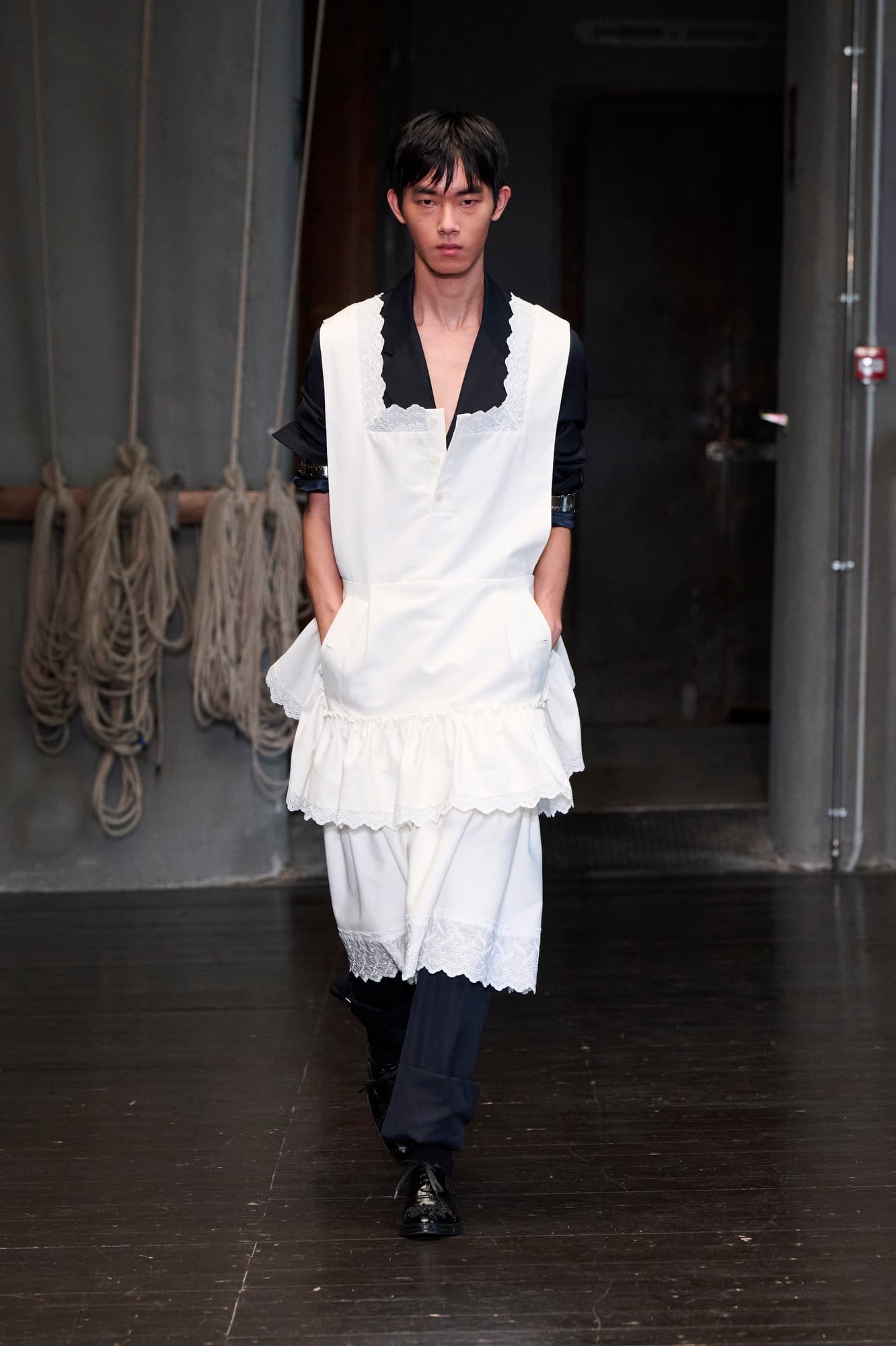
- Cutwork linen and broderie anglaise bring texture without noise.
- Gingham and lace shift the mood from authority to intimacy.
- Pearl beading acts like quiet jewelry for the body, not a loud flourish.
- Ballet flats change the posture of the whole look, making it lighter, less declarative.
What to skip is equally revealing. Rocha is not interested in the hard, glossy language of power suiting. She does not want the man flattened into a boardroom silhouette or dressed in armor-like confidence. Even when the collection returns to tailoring, it does so through fragility, with fabric and embellishment softening the line between ceremonial dress and daily wear.
The collection moved like a character study
The show’s look list made that evolution explicit. Early looks suggested youthful industry: cotton aprons and boxy camp-collared shirts gave the men the air of working, making, preparing. Later looks deepened into maturity, with voluminous tulle petticoats worn under Prince of Wales suits and pearl-beaded tailoring that felt almost devotional. By the finale, models carried organza boas and wore ballet flats, turning the runway into a procession of softened masculinity rather than a march of dominance.
Dazed counted 15 pairs of knobbly knees, nine feather boas and four bouquets of cornflowers in the presentation, a detail that tells you how far Rocha pushed the clothes away from conventional menswear polish. The first model carried cornflowers, a flower long associated in European folklore with young men in unrequited love, and that tiny gesture says a great deal about the collection’s emotional register. This is menswear that is not afraid of yearning.
Why the show landed so strongly
Industry reaction understood the shift immediately. WWD called the collection a “new template for masculinity,” and that feels right because Rocha is not just prettifying menswear. She is proposing a different hierarchy of values, one in which tenderness outranks force and lineage is expressed through texture rather than swagger. HERO also reported that Adrian Joffe of Dover Street Market was in the audience, a fitting detail given that Joffe has long been one of Rocha’s early champions.
The show also mattered because it arrived at Pitti Immagine’s official guest-designer slot, which placed Rocha squarely in the menswear conversation at one of the industry’s most watched stages. Pitti’s programming framed her appearance as a major event, and the collection delivered on that promise by making a persuasive case for gentler codes of status.
Rocha’s Florence show did not reject old-money style. It refined it. She kept the checks, lace and knitwear, then made them feel less inherited from a power structure and more passed down through memory, feeling and care. That is what makes the collection so compelling: it does not ask menswear to become feminine, only more emotionally literate, and in doing so it makes aristocratic fragility look like the most modern form of polish.
This article was produced by Prism’s automated news system from verified source data, official records, and press releases, then run through automated quality and moderation checks before publishing. The system is built and supervised by the people who set the standards it runs under. Read our full AI policy.
Did this article answer your question?