Thom Browne brings garden-party prep to Milan with insect motifs
Thom Browne turned Milan prep into a garden fantasy, opening with seersucker skirtsuits, beekeeper hats and 400 flowerpots under brutal heat.
Thom Browne did not simply bring American prep to Milan, he made it strange, ceremonial and far more decadent than the code usually allows. In the courtyard of Palazzo Serbelloni, his first runway show in the city turned old-money uniformity into an embroidered garden party, with guests fanning themselves through a brutally scorching afternoon as mist fans, ice cream, umbrellas and shade support kept the front row from melting.
The timing mattered as much as the theater. The official Milan Fashion Week Men’s Spring/Summer 2027 calendar listed the show for 3:00 p.m. at Corso Venezia 16 on June 22, 2026, placing Browne squarely inside a season that has leaned on a notable mix of American and Italian names. For Browne, who has long treated uniform dressing as a language to distort, Milan was a strategic reset and a declaration that his version of prep can now play on the global luxury stage without losing its wit.
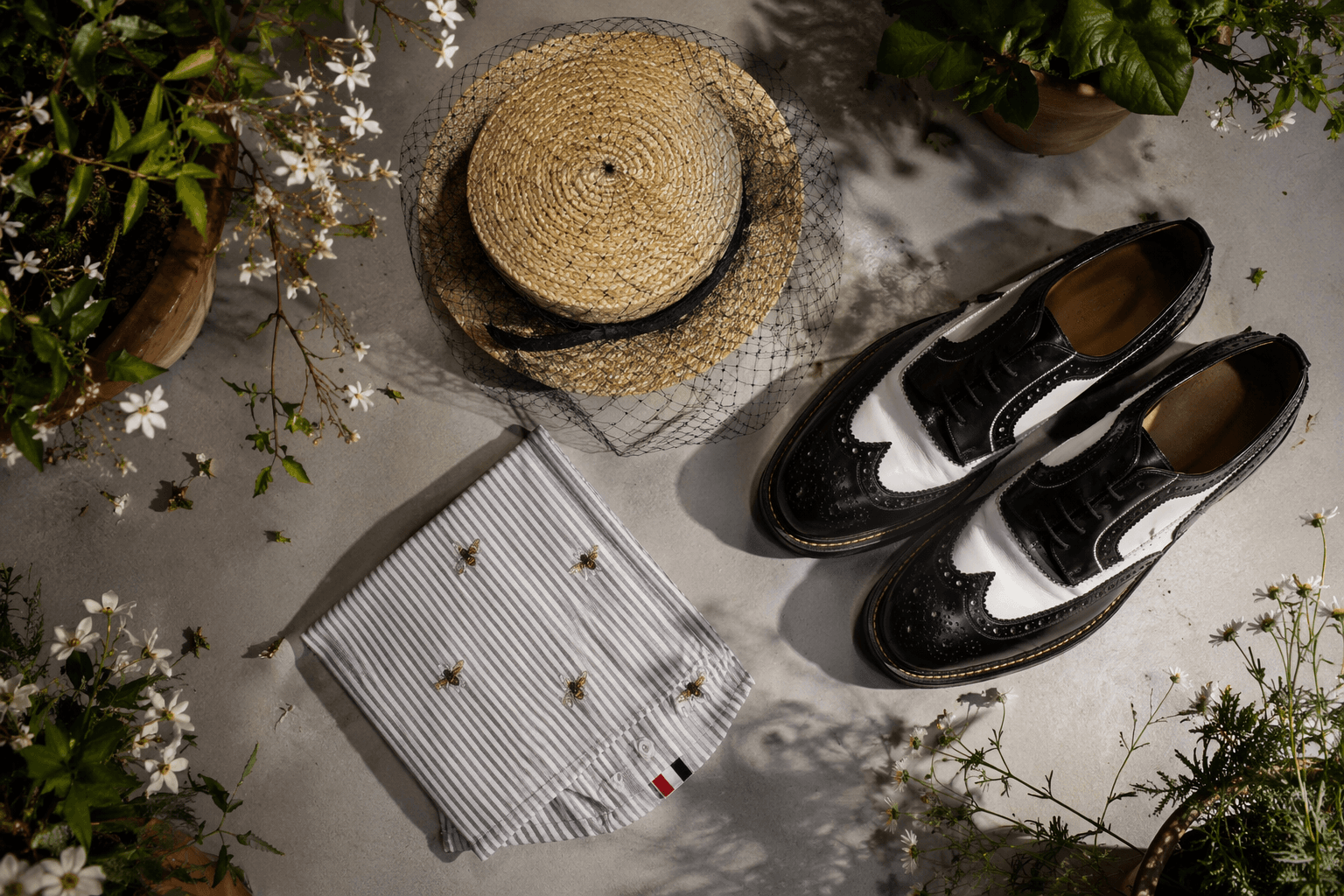
He opened with seersucker skirtsuits worn over capri-like pants, then pushed the joke into full costume with gloves, laced-up boots, beekeeper hats and watering cans wrapped in the same suit fabric. Around them, 400 seersucker flowerpots were arranged in a central grid through the palace porticoes, turning the Neoclassical setting into a cultivated greenhouse of sorts, part country-club fantasia, part couture set piece. Bugs, bees, dragonflies, honeycomb and floral embroidery threaded through the collection, but Browne kept the mood disciplined enough that the spectacle never slid into whimsy for its own sake.
The idea began, Browne said, after he watched A Bug’s Life on a plane, a premise he described as “a charming kind of nonsensical story.” Randy Newman’s music from the 1998 Pixar film ran through the show, reinforcing the collection’s childlike logic while the clothes themselves felt more technical and deliberate than nostalgic. Tailoring came in windowpane check cool wool, technical nylon seersucker, open-weave cotton and grid-check wool pique, with unlined short-sleeve sports coats and poplin shirts finished with detachable contrast collars and cuffs layered over fine-gauge cotton knits.
That lighter construction gave the old prep vocabulary a new kind of mobility. Browne kept his signature grays, white, red and navy in place, then startled the eye with emerald green, yellow and pastel pink, the sort of palette shift that makes heritage codes look less like rules and more like material for reinvention. He also made the case that the clothes should be mixed, not worn as a head-to-toe uniform, a reminder that the most persuasive American luxury today is not about rigidity, but about knowing exactly how to unsettle it.
This article was produced by Prism’s automated news system from verified source data, official records, and press releases, then run through automated quality and moderation checks before publishing. The system is built and supervised by the people who set the standards it runs under. Read our full AI policy.
Did this article answer your question?