Todd Snyder's $1,000 Suits Bridge Preppy Style and Accessible Luxury
Todd Snyder's Italian-made suits at roughly $1,000 carve out the mid-market gap between J.Crew and Brioni that most American designers have ignored since 2011.
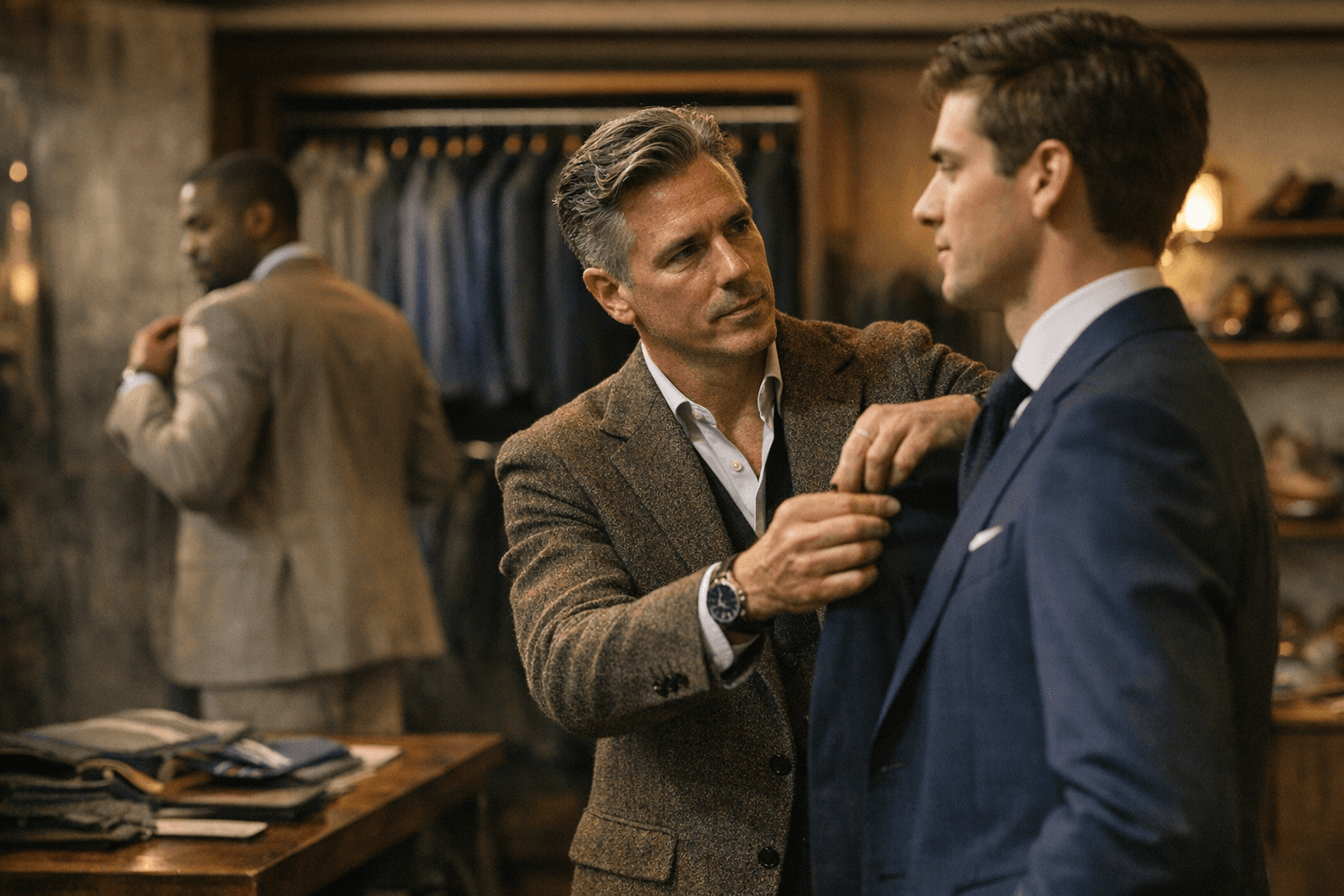
There is a price point in menswear that almost no one has successfully owned: above the mall, below the truly untouchable. Canali starts climbing past $1,500. Brioni and Kiton operate in a different atmosphere entirely. Below them sits a vast, underserved territory, and Todd Snyder has been quietly building his label into its defining address since 2011, when he started the brand using his own money and turned his attention toward the approachable menswear he had long daydreamed about.
The result is a label that hits roughly $1,000 for suits and coats, made in Italy, cut in the British tradition. That sentence, read quickly, sounds almost too good to be true. It is, in fact, the entire strategic thesis of the Todd Snyder brand.
The Sweet Spot Between Preppy and Luxury
The old-money aesthetic has had a complicated relationship with price. Its whole visual language, the chalk-stripe suit, the single-pleat trouser, the herringbone topcoat, was historically built around investment dressing: pieces bought once, worn for decades, repaired rather than replaced. The irony is that the modern luxury market has priced that sensibility out of reach for many of its most enthusiastic adherents. A Savile Row commission runs well north of $5,000. Even the more accessible Italian houses with genuine craft behind them routinely clear $2,000 for entry-level tailoring.
Todd Snyder's positioning is a direct answer to that gap. The label occupies what has been described as a mid-market, old-money and preppy sweet spot: elevated enough to signal genuine taste, accessible enough that a thoughtful consumer in his thirties does not need to treat a single suit as a six-month financial decision. At roughly $1,000, the suits and coats undercut ultra-luxury pricing while still drawing on the visual grammar and production standards associated with it.
British Inspiration, Italian Execution
The design language Snyder leans into is explicitly British-inspired, which is the correct reference point for this kind of tailoring. British tailoring carries specific connotations: a slightly suppressed waist, structured shoulders, cloth with enough weight to drape rather than cling. It is the aesthetic of a Pall Mall club or a country house weekend, translated for an American designer who understands that his customer is more likely to wear the suit to a board meeting in Manhattan or a wedding in Connecticut than to Ascot.
The execution, however, is Italian. That is not a contradiction; it is a deliberate and commercially intelligent pairing. Italian manufacture brings with it a particular standard of internal construction, fabric sourcing, and finishing that the British aesthetic inspires but that the Italian craft infrastructure consistently delivers at scale. For a label operating at the $1,000 price point, made-in-Italy production is also a credibility signal that luxury consumers recognize immediately. It places Snyder's tailoring in a different conversation than anything assembled offshore, and it justifies the price premium over mid-tier American brands without requiring the leap to full European luxury pricing.
Founded on Conviction, Not Venture Capital
Snyder launched the brand in 2011 with his own capital, a founding detail that carries more strategic weight than it might initially appear. Self-funding at launch means no investor pressure to chase volume, no compromise on aesthetic for the sake of a faster path to a liquidity event. It is the kind of origin story that fits the brand's sensibility: deliberate, personal, built on a vision that had been forming for years before it found a label attached to it. Bloomberg reported that Snyder turned his sights toward the approachable menswear he had daydreamed about, which is a telling phrase. Daydreams imply specificity and longing, not a market opportunity identified in a spreadsheet.
That origin shapes the brand's entire posture. Todd Snyder is not a conglomerate's answer to a demographic gap. It is a designer's response to a personal frustration, the absence of American menswear that took classic tailoring seriously without requiring its customer to spend like a hedge fund partner.
Why the $1,000 Price Architecture Works
Price architecture in fashion is more precise an instrument than it often appears. Set a suit at $600 and you compete with the better department store private labels; the quality expectation is moderate and the customer is comparison-shopping aggressively. Set it at $2,500 and you enter a tier where the customer expects either a storied Italian or French name or a genuine made-to-measure experience. The $1,000 range, executed correctly, sits in a zone where the customer has already decided to invest in tailoring, expects real fabric and real construction, but is not yet requiring the full theater of luxury retail.
For the old-money and preppy customer specifically, that price point lands with particular logic. The preppy tradition was never actually about conspicuous spending; it was about knowing which things mattered and buying them without excess. A $1,000 Italian-made suit in a classic British cut is, within that value system, exactly the right answer. It demonstrates taste without announcing expenditure.
The Broader Market Context
What Snyder has identified and exploited is a structural failure of the American menswear market. For the better part of two decades, the space between fast-fashion suiting and true luxury has been occupied largely by brands that deliver the silhouette without the substance: adequate construction, synthetic linings, fabrics that photograph well and wear poorly. The customer who actually knows what a floating canvas or a hand-padded chest feels like has historically had to jump straight to the $2,000-plus tier to find it.
Todd Snyder's label argues that the production and design infrastructure now exists to deliver genuine quality at the $1,000 level, provided the designer has the relationships, the aesthetic clarity, and the willingness to accept margins that are tighter than a volume play would produce. That is a harder business to run than it sounds. It is also, for the right consumer, a more compelling proposition than almost anything else currently available in American menswear tailoring.
The label has had fifteen years to refine that argument. The fact that the brand is still making the case on the same terms it started with, British-inspired silhouettes, Italian manufacture, mid-market pricing with a luxury sensibility, suggests that Snyder's original daydream was both specific enough to have real edges and durable enough to build a genuine brand identity around.
This article was produced by Prism’s automated news system from verified source data, official records, and press releases, then run through automated quality and moderation checks before publishing. The system is built and supervised by the people who set the standards it runs under. Read our full AI policy.
Did this article answer your question?