Valentino Resort 2027 recasts old money polish with playful prep
Michele turns Valentino’s inherited polish into mischievous prep, sending a “Villain Teen” through a fifteenth-century villa in looks that flirt with rebellion but never lose the house’s grandeur.
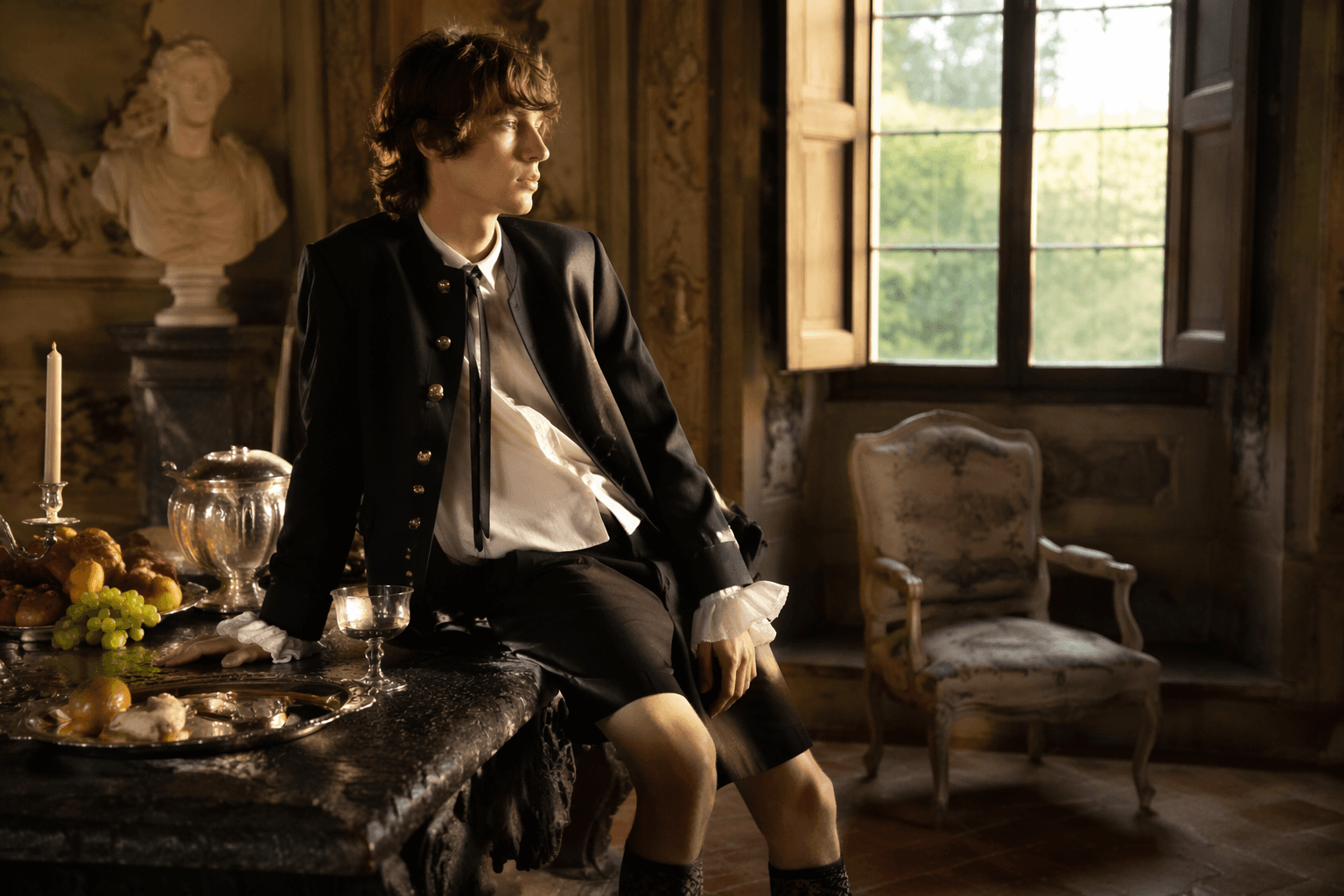
Alessandro Michele’s Resort 2027 Valentino is less a runway collection than a sly piece of social theater. Staged as a lookbook at Villa Gaia Gandini, a fifteenth-century house on Milan’s Navigli canal, it recasts aristocratic polish through preppy styling, tailored pleats, and a deliberately more playful resort energy. More than 60 looks reportedly passed through the villa, and the strongest impression is not of severity or ceremony, but of a grand house caught giggling at its own rules.
The villa does half the work
Villa Gaia Gandini is not just a backdrop. Its age and frescoed rooms lend the pictures a sense of inherited authority, the sort of visual gravitas Michele clearly likes to borrow before he starts undoing it. Set on the Navigli, the house gives the collection a patina of old-world privilege, but the mood is lighter than stately. That tension matters: Michele is not rejecting the codes of the house, he is making them less obedient.
The choice to present the collection as a lookbook rather than a traditional show sharpens that effect. Instead of a linear runway narrative, the clothes feel like evidence gathered from a very specific fictional life, one lived in the rooms of a villa rather than on a catwalk. The result is closer to a character study than a product rollout, and that is exactly where Michele tends to be most persuasive.
Meet the “Villain Teen”
At the center of the collection is the “Villain Teen,” Michele’s mischievous, adolescent-coded house guest wandering through an Italian villa with just enough insolence to unsettle the silver. He or she appears in tartan skirts, collegiate blazers, slogan tracksuits, embroidered eveningwear, Aran knits, striped shirts, and front-slit denim maxi skirts. The mix is intentionally unruly: prep school polish collides with the sort of pieces that usually belong to opposite ends of the dress code spectrum.
The slogans sharpen the joke. “Villain Teen” and “You Can Come to My Villa” read like mischievous invitations from a teenager who knows the family silver is too good to be taken seriously. Michele uses that youthful irreverence to destabilize Valentino’s inherited polish without stripping away its grandeur. The clothes still belong to a house with a long memory, but they are worn by someone who refuses to behave as if memory is sacred.
Why the styling matters more than the pieces
The collection lands hardest when you look at how it is styled rather than at any single garment. Critics have pointed out that Michele’s long-running method is to collapse high and low fashion codes, and this outing extends that habit with confidence. Yet the more compelling reading is that the styling creates the emotional logic of the collection: the blazer feels sharper over a slogan track layer, the tartan skirt feels cheekier next to a collegiate reference, and the embroidered eveningwear becomes less formal when it is placed inside this adolescent fantasy.
That is also why some reviewers described the collection as Michele “thinking out loud.” The idea is abundant, even exuberant, but not every look resolves with equal force. Still, that looseness is part of the appeal. Michele’s “gentle villain” self-portrait, as one review framed it, suggests a designer who understands that mischief can be more seductive than authority when you are working with a house built on authority.
The new old money code
For readers drawn to old money fashion, the collection offers a useful update: the new polish is not pristine, it is mixed. Michele takes familiar status signals, such as tartan, collegiate tailoring, pleats, and knitwear, then lets them rub against slogan dressing and denim. The result feels less like inherited etiquette and more like a younger generation raiding the family wardrobe, then styling it with just enough irony to keep it alive.
A few details make that especially clear:
- Tartan skirts and collegiate blazers supply the prep-school backbone.
- Aran knits and striped shirts soften the formality with a touch of country-house ease.
- Slogan tracksuits and denim maxi skirts break the seal on old-money restraint.
- Embroidered eveningwear keeps the collection anchored in Valentino’s taste for ceremony and finish.
That balance is what keeps the collection from tipping into costume. Michele is not mocking the codes of privilege so much as loosening their collar, making them feel wearable for a generation that mixes sportswear, tailoring, and embellishment without dressing for inherited rituals.
How this fits Michele’s wider Valentino story
Resort 2027 does not stand alone. It follows Valentino’s Spring-Summer 2026 “Fireflies” campaign, shot by Willy Vanderperre at Villa Parisi in Frascati near Rome. That campaign centered on vulnerability and interdependence, a quieter and more reflective tone than the amused provocation of Resort 2027. Together, the two projects sketch out a larger Michele-era Valentino: one side intimate and fragile, the other mischievous and theatrical, both rooted in a strong sense of place.
Fashionotography noted that Vanderperre captured nine models at Villa Parisi, a 17th-century estate outside Rome, while the campaign’s mood turned away from rigidity and toward human connection. That matters because it shows Michele is not only rearranging clothes. He is building a world in which aristocratic glamour can survive by becoming less fixed, more mixed, and a little less sure of itself.
Why the collection feels relevant now
What Michele understands, perhaps better than anyone currently working inside a major luxury house, is that modern glamour rarely arrives in a single register. It arrives in layers: prep against embellishment, heritage against slang, elegance against the joke. Valentino Resort 2027 makes that tension look deliberate, even seductive, and uses the villa setting to insist that old money style can still move, tease, and misbehave without losing its sense of lineage.
That is the collection’s real achievement. It does not discard the grand-house DNA that makes Valentino recognizable; it rewrites the household script so the next generation can wear it with a smirk.
This article was produced by Prism’s automated news system from verified source data, official records, and press releases, then run through automated quality and moderation checks before publishing. The system is built and supervised by the people who set the standards it runs under. Read our full AI policy.
Know something we missed? Have a correction or additional information?
Submit a Tip