Corporette’s 2026 suiting guide spotlights petite workwear, from budget to designer
Petite suiting is finally getting a real map, from Ann Taylor's 280-item petite page to Reiss's 5'3"-and-under cut. The win is fewer hems and fewer headaches.
Why petite suiting still hits a nerve
A blazer that swallows your hands or trousers that drag on the floor can make even a sharp outfit look borrowed. That is the petite workwear problem in one sentence: the fit fails before the styling even has a chance.
Corporette’s suiting guide is useful because it treats that problem like a real wardrobe need, not a niche footnote. Kat Griffin updated the main women’s suits roundup in April 2026, and Corporette says it has been covering professional women’s workwear since 2008. The roundup first appeared in its current form in 2018, which tells you everything about the category: suiting is not a trend cycle story, it is a permanent shopping headache for a lot of women.
The need is bigger than the petite rack suggests. CDC FastStats puts the measured average height for U.S. women ages 20 and older at 63.5 inches, and IBISWorld estimated the U.S. women’s clothing stores market at $67.4 billion in 2025 and $67.6 billion in 2026, with 0.8% growth in 2025. Petite demand is not some tiny side quest. It is part of a very large market still trying to fit real bodies into standard patterns.
The budget lane: where petite shoppers actually start
If you need a suit fast, the smartest move is to look where petite sizing is already built into the offer, not where a regular suit might be shortened after the fact. Corporette’s petite roundup points readers to Hobbs, J.Crew, Banana Republic Factory, and Ann Taylor, and that mix matters because it gives you both access and range, from interview basics to sharper office looks.
Ann Taylor is especially telling. Its petite suits page showed 280 items, with petite blazers and pants ranging from about $65.40 to $219.00 at the time of the crawl. That spread is exactly why petites keep returning to the brand: it sits in the zone where you can buy a full suit without immediately crossing into designer territory, but you still have enough room to step up if the fabric or construction looks worth it.
Macy’s also maintains a dedicated petite workwear section, which reinforces the same point from a different angle. Petite suiting is not an afterthought to retailers. It is a persistent, commercially supported corner of office fashion, and that matters when you are trying to solve for interview clothes, courtroom dressing, or any situation where the fit has to look correct on the first try.
What to look for when the suit has to do the work
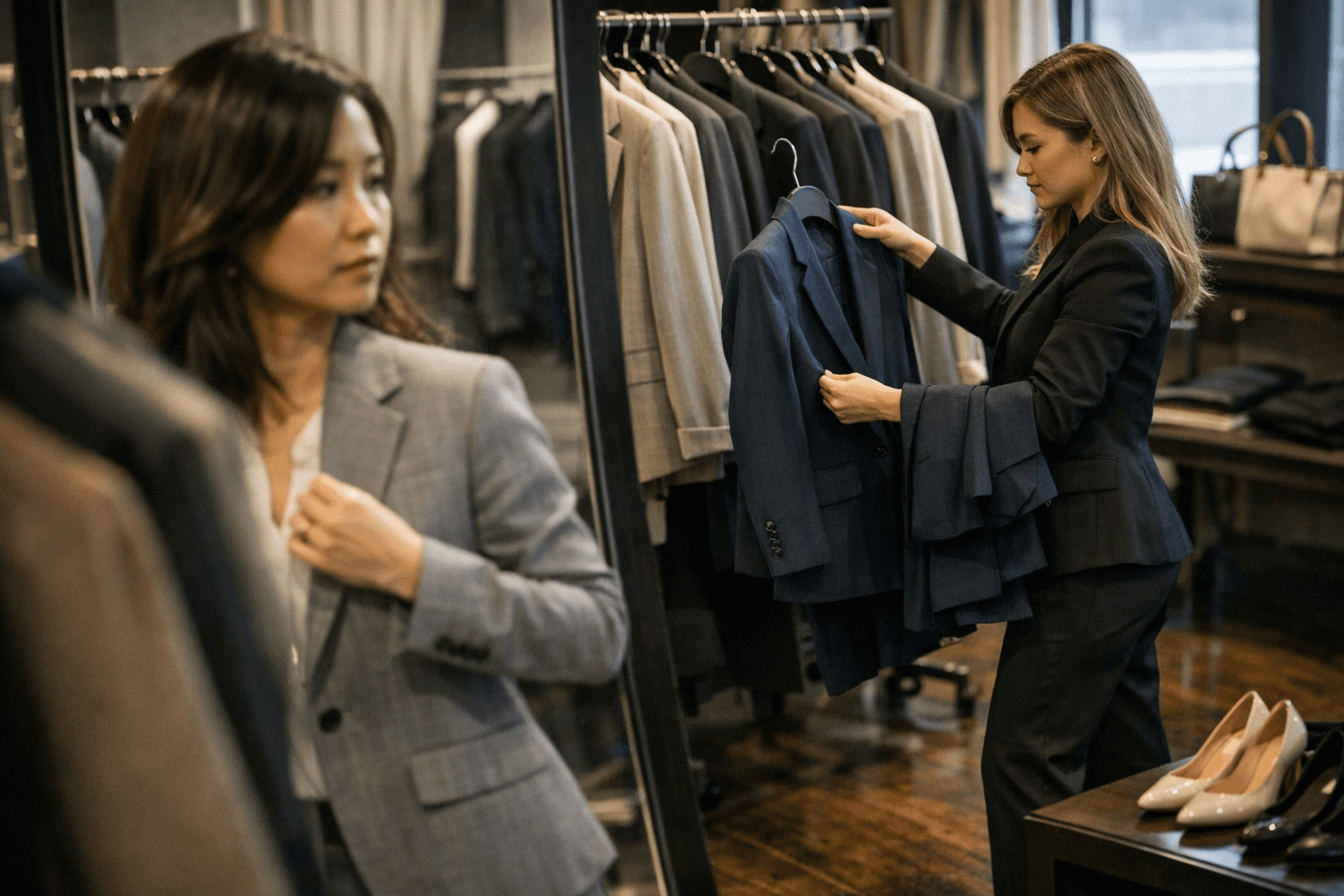
The biggest petite mistake is buying a good jacket in the wrong proportions and hoping tailoring will save it. For petites, the jacket has to get the basics right first: shoulder width, sleeve length, and overall body length. If the lapel starts too low, the waist lands too long, or the sleeve covers half your hand, the suit reads oversized instead of polished.
Trousers matter just as much. Petite shoppers should be looking for a rise that sits where the torso actually ends, not a waistband that climbs too high and shortens the leg line, and for hems that do not pile up at the shoe. When the inseam, knee break, and leg opening are cut for a shorter frame, the whole silhouette looks cleaner and more expensive.
- The jacket hem should hit closer to the high hip, not slide down into the thigh.
- Sleeves should end near the wrist bone, so the hand still looks elegant instead of swallowed.
- Trouser hems should skim, not puddle.
- The trouser knee should fall in the right spot, because a shortened leg with a misplaced knee still looks off.
A few fit cues separate a true petite suit from a regular suit with a shorter inseam:
That is why petites should care about patterning, not just lengths. Taking three inches off a hem is one thing. Recutting a jacket so it does not overwhelm the shoulders and chest is another. The best petite suiting solves the proportion problem before it reaches the tailor.
Mid-range is where the math starts to improve
This is the sweet spot for shoppers who want better drape and cleaner lines without jumping straight to designer pricing. J.Crew, Hobbs, Banana Republic Factory, and Ann Taylor all sit in the orbit Corporette points petites toward, and the appeal here is less about flash than about getting closer to a wearable fit out of the box.
The real value in this tier is structural. When a petite suit is cut for shorter proportions, the shoulder line lands more naturally, the sleeve doesn’t need as much surgery, and the trouser hem can be a minor adjustment instead of a full remake. That is where paying a bit more upfront often saves money later, because the alteration list gets shorter and simpler.
This is also the level where a conservative suit starts to make sense for settings that are less forgiving, especially interview rooms and courtroom appearances. A petite shopper in that situation does not need a fashion suit pretending to be businesswear. She needs a jacket that closes cleanly, trousers that don’t drag, and a silhouette that looks intentional from across the room.
Designer is worth it when the cut is already right
Reiss is the clearest designer-level answer in the mix because it says its petite suits and tailoring are designed for women 5'3" and below. That detail matters more than the logo. A suit built around petite proportions can be the better buy if it spares you expensive shoulder work, sleeve shortening, and repeated hemming.
This is where spending more can actually save you money. If the jacket body is scaled correctly and the trouser proportions are right from the start, you are not paying twice, once for the garment and again for the rescue mission. That is the whole game with petite suiting: the best purchase is the one that does not need to be argued into working.
Reiss sits at the polished end of the spectrum, while Ann Taylor shows how much breadth exists lower down the price ladder. Together they make the case for a smarter petite strategy: start with brands that actually design for your frame, then move up only when the fabric, finish, and cut justify the cost.
Why this category is still growing up
The cleanest read on petite suiting is that it has finally become a real category with real shelf space. Corporette has kept a suits roundup alive for years, then layered in plus-size, tall, and petite suit resources, which is exactly how a useful workwear edit should behave: broad enough to cover the market, specific enough to solve the fit problem.
The numbers back up the need. A market worth $67.4 billion in 2025 and $67.6 billion in 2026 still leaves room for better petite options, especially when the average U.S. woman is 63.5 inches tall and standard suiting still misses the mark so often. The brands that understand this are the ones that will keep winning petite shoppers over, because the best petite suit is not the prettiest one on the hanger. It is the one that looks professional the second you put it on.
This article was produced by Prism’s automated news system from verified source data, official records, and press releases, then run through automated quality and moderation checks before publishing. The system is built and supervised by the people who set the standards it runs under. Read our full AI policy.
Did this article answer your question?