Four Fit Features Petites Need for a Longer, Leaner Silhouette
Four precise fit features separate the dress that wears you from the one that works for petites: V-neck, above-knee hem, bare arms, solid color.
The hems land wrong. The waist hits at the hip. The sleeves swallow your hands. If you are under 5ft 4in, you already know this intimately: the dress that looked streamlined on the model reads boxy and oversized on you, not because the dress is bad, but because it was built for a body with more vertical real estate to work with. The fix is not always a tailor. Sometimes it is four specific fit features, applied consistently, that do more for your silhouette than a full wardrobe overhaul.
Here is exactly what to look for and why each one works.
The V-Neckline: Your Vertical Axis
A V-neckline does one thing exceptionally well: it draws the eye down the center of the body in a continuous vertical line. For petites, that line is everything. The torso on a 5ft 2in frame is proportionally short, which means any neckline that widens horizontally (a wide boatneck, a wide square neck, a jewel neck sitting high on the chest) functions as a horizontal interruption. It tells the eye to travel sideways, not upward, and sideways movement on a small frame creates the illusion of width rather than height.
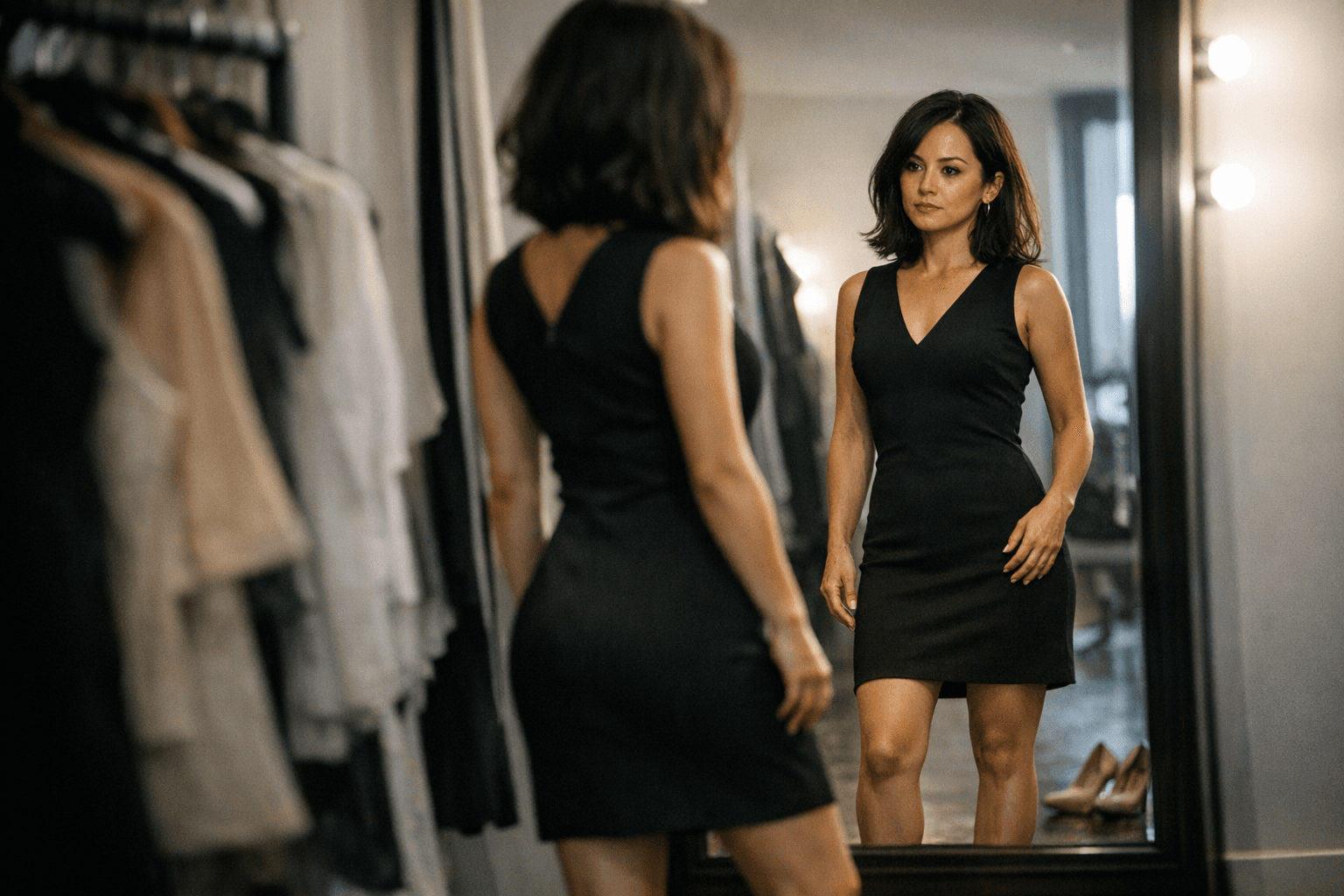
The V-neckline cuts that horizontal impulse off entirely: the vertical lines elongate the torso, drawing attention to the face and décolletage and suiting petite frames specifically. How deep should the V go? Deep enough to be clearly visible, not so deep it becomes a layering headache. A V that ends roughly 3 to 4 inches below the collarbone hits the functional sweet spot: visibly elongating and easy to style without anything underneath.
Reese Witherspoon, who stands at 5ft 1in, has consistently applied this logic: necklines that direct the eye downward and inward, never outward and across. She leans into all-black or saturated single-color dresses with necklines that point vertically, creating the appearance of added length. That is not a coincidence. It is a proportion decision.
The Above-the-Knee Hem: The Leg-Exposure Equation
Visible leg is visible height. It is a straightforward equation, but the execution requires precision. An above-the-knee hem creates the impression of height by exposing the longest continuous run of leg possible, pulling the eye vertically from the hemline down through the shin to the shoe. The more leg exposed, the taller the overall silhouette reads.
The sweet spot, based on the research, sits 2 to 4 inches above the knee. At 2 inches, the hem clears the kneecap cleanly. At 4 inches, the hem sits firmly in mini territory and maximizes the leg line. Anything shorter than 2 inches above the knee starts to read as midi-adjacent on shorter legs: the kneecap gets cut visually in half, interrupting the vertical line and making the leg appear to end earlier than it does.
One practical note worth measuring yourself: when shopping online, check the model's inseam measurement if it is listed, then compare it to yours. A hem that sits 2 inches above the knee on a 5ft 9in model will not sit 2 inches above the knee on a 5ft 2in frame. The math does not scale linearly. Add approximately 1 to 1.5 inches to your estimate to land in the right range on your actual body.
Short Sleeves or Sleeveless: Keeping the Line Alive
A long sleeve on a petite frame creates a visual anchor at the wrist. The eye travels down the arm, hits the sleeve's hem, and stops. That stop is the problem. It breaks the vertical movement that the V-neckline started and the above-the-knee hem is working to finish.
Short sleeves and sleeveless styles keep the arm's vertical line intact by exposing the forearm and wrist. This continues the elongating momentum of the rest of the outfit. The forearm is lean, the wrist is narrow, and both read vertically on the body. Exposing them keeps the silhouette moving in the eye's perception rather than anchoring it at a mid-arm stopping point.
The specific problem a long sleeve creates is proportional: on a petite frame, the distance from shoulder to wrist is shorter overall, which means a standard sleeve often ends before it should, cutting the arm visually at the forearm. The result is a limb that looks foreshortened rather than lean. A short sleeve ending at the mid-upper arm, or a sleeveless cut, bypasses this entirely. The arm then contributes to the vertical line rather than interrupting it.
Clean, Unbroken Color: The Single-Tone Rule
A horizontal break in color is a horizontal break in silhouette. When a dress has two tones (a color-blocked bodice and skirt, a contrasting waistband, a print that shifts at the hip), the eye reads that transition as a line drawn across the body. On a petite frame, that line divides an already short vertical space into two even shorter segments, making the overall silhouette read as wider and lower than it actually is.
A saturated, solid color in a streamlined cut removes every one of those interruptions. The eye has nowhere to stop. It travels from shoulder to hem in an unbroken sweep, reading the entire length of the dress as the full height of the body. The color does not have to be neutral: a deep cobalt, a clean scarlet, a rich emerald all work as effectively as black. What matters is the absence of contrast, not the specific hue.
If you want visual interest, keep it to texture rather than tone. A tonal jacquard or a subtle fabric shift within the same color family reads as detail without creating a horizontal break.
Three Outfit Formulas to Build From Now
These three combinations apply all four fit features simultaneously and can be assembled directly from what you already own:
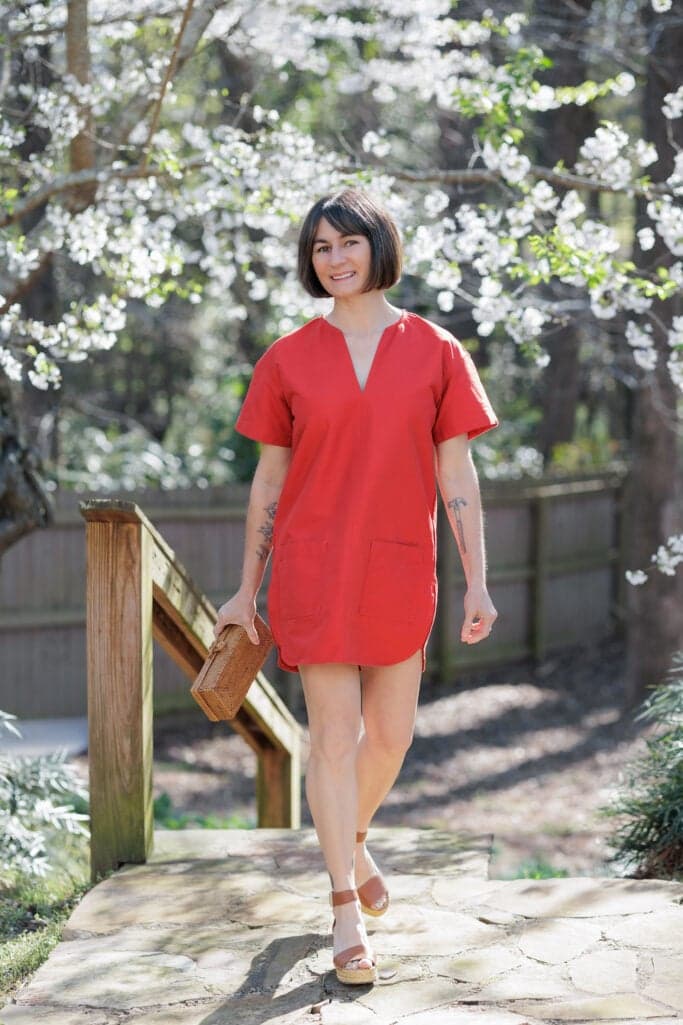
- The Shift Dress + Low Wedge: A solid-color shift in a saturated hue, V-neck, hem landing 2 to 3 inches above the knee, sleeveless. Pair with a low wedge under 2 inches in the same tone as the dress or a nude close to your skin tone. The matching tone extends the leg line through the foot without introducing a new horizontal band at the ankle.
- The V-Neck Belted Mini: A solid-color mini dress, V-neck, hem at 3 to 4 inches above the knee. Add a narrow belt (under 1 inch wide) placed at the natural waist, not the hip. On most petites, the natural waist sits closer to the rib cage than the navel; belting there marks the body's narrowest point and gives the torso its longest possible read below the V. A belt dropped to the hip introduces exactly the kind of false horizontal break you are trying to eliminate.
- The Solid Color with Subtle Shoe Contrast: Any solid, V-neck above-the-knee dress in a mid-to-deep tone, short-sleeved. Pair with a pointed-toe flat or low heel in a shade two tones lighter than the dress. The slight tonal lift draws the eye toward the tip of the shoe without hard-stopping the vertical line, making the foot read as a continuation of the look rather than a visual full stop.
When all four features align, the geometry of the outfit does the work. The silhouette reads as one continuous vertical unit, not a top-plus-bottom calculation. That is the difference between proportion dressing as a struggle and proportion dressing as a system.
This article was produced by Prism’s automated news system from verified source data, official records, and press releases, then run through automated quality and moderation checks before publishing. The system is built and supervised by the people who set the standards it runs under. Read our full AI policy.
Did this article answer your question?