How Short Women Can Find Joggers That Truly Flatter Their Frame
Joggers fail petite frames for three fixable reasons — and once you know the exact inseam, rise, and taper that work, you'll wear them everywhere.

Joggers are supposed to be easy. Comfortable, flattering, effortless. But if you're on the shorter side, you know the reality: the inseam is too long, the waistband sits too low, and suddenly "relaxed fit" turns into "completely swallowed." It's one of the more frustrating wardrobe experiences, precisely because joggers feel like they should be the easiest thing to get right.
The good news is that the fix is entirely knowable. It comes down to three measurable factors: inseam length, waist rise, and leg taper. Get those right, and a well-fitting jogger becomes one of the most versatile pieces you own, carrying you from a morning workout to weekend errands without a second thought.
Why Standard Joggers Don't Work on Petite Frames
Most joggers are cut for a body that doesn't belong to the majority of women who wear them. The standard inseam runs long, which means the ankle cuff lands mid-calf rather than at the ankle, creating a bunched, shapeless hem that visually cuts the leg at its widest point. The waistband sits low on the hip, shortening the torso and compressing the leg line. And drop-crotch proportions, common in relaxed-fit styles, add volume exactly where a petite frame doesn't need it: through the seat and thigh, disrupting the clean silhouette that makes a shorter leg look longer.
These aren't aesthetic preferences. They're proportion problems with proportion-based solutions.
The Fit Criteria That Actually Work
The best joggers for petite women are high-waisted, tapered, and cut with a shorter inseam, around 24 to 26 inches. That specific range is worth writing on your phone before you shop, because most mainstream joggers run 28 to 30 inches or longer. Those extra inches don't just pool at the ankle; they visually compress your entire lower half.
Here's what the right pair looks like on your body:
- Sits high on the waist, creating the longest possible leg line from hip to floor
- Tapers through the calf and closes cleanly at the ankle, with no bunching or excess fabric
- Avoids extra volume at the crotch, which elongates the visual distance from waist to knee
- Falls at a length that skims the ankle bone rather than folding over it
Cropped joggers deserve particular attention here. Because they end above the ankle rather than at it, they expose a sliver of skin or sock that visually extends the leg. It's a simple optical trick, but it works consistently across body types.
The Three Mistakes That Are Shortening Your Silhouette
Understanding what to avoid is just as important as knowing what to look for. There are three recurring fit errors that make petite frames appear shorter, and they're all avoidable once you can identify them.
The first is extra-wide, unstructured legs. A wide-leg jogger is not automatically off-limits, but it requires structure through the waist and seat to work on a smaller frame. Without that fitted anchor at the waist and glutes, a wide-leg cut hides every proportion and swamps the body. If you love the wide-leg silhouette, look for styles that are deliberately shaped through the upper half and let the volume begin at the thigh, not the hip.
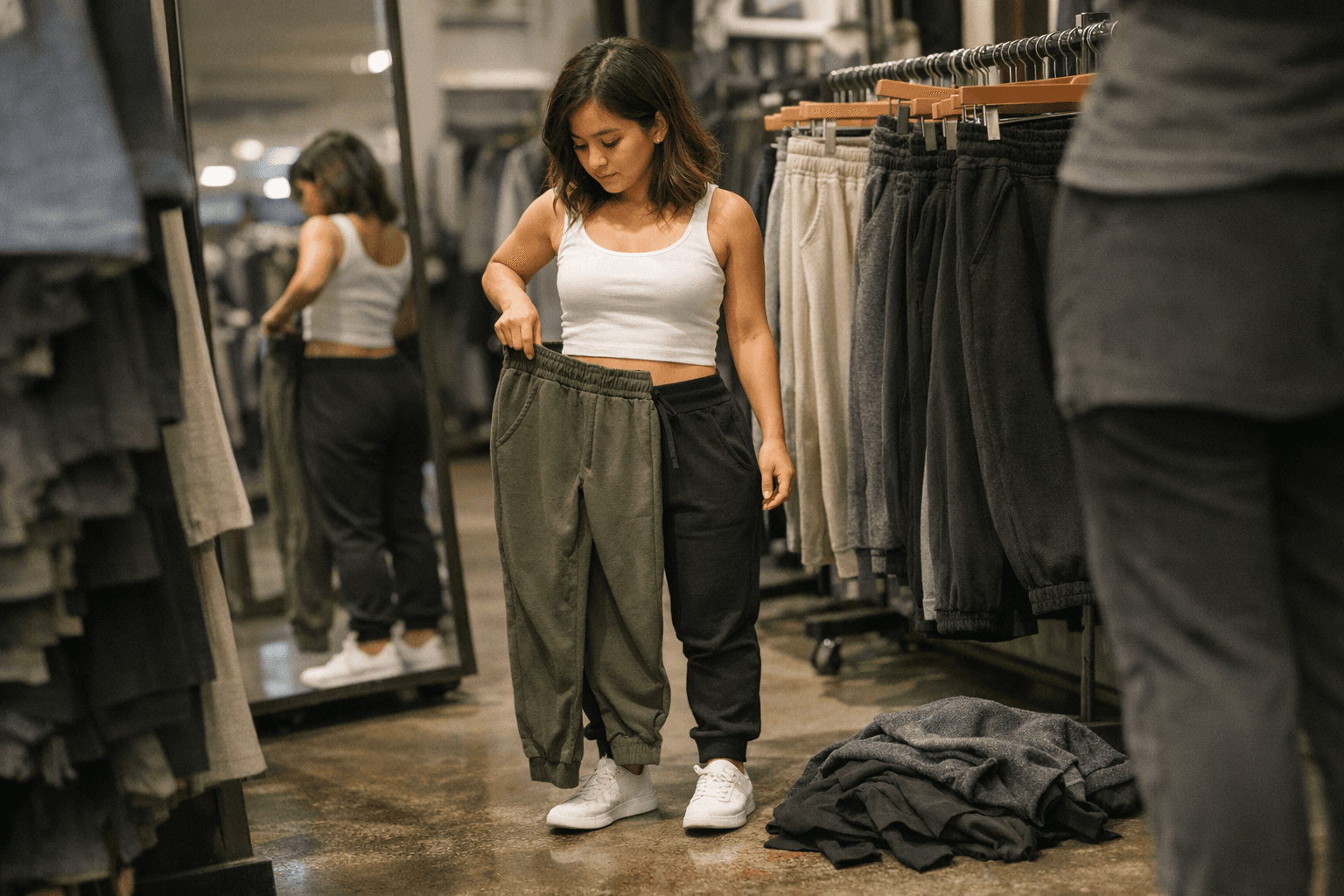
The second mistake is ankle bunching. This is the most common complaint for petite women in any trouser category, and joggers are particularly prone to it because of their elastic or ribbed cuffs. When too much fabric gathers around the ankle, the effect reads as costume rather than casual, and the horizontal bulk at the hem makes legs appear shorter. Measuring your inseam before you buy is the single most effective way to avoid this. Know your number, and check product specs before you add anything to your cart.
The third, and perhaps most proportion-damaging, is a low-rise waist. Low-rise cuts sever the leg line at the hip, making legs look shorter from the very first inch. For petites especially, the waistband placement sets the visual foundation for everything below it. High-rise is the ideal choice; medium-rise is acceptable. Low-rise, regardless of how flattering the rest of the cut is, works against you.
How to Shop by Fit
Before you browse, measure your inseam. Stand barefoot, measure from your crotch to the floor (or to the ankle point where you want the hem to land), and use that number as your filter. For most petite women, that number will fall somewhere in the 24-to-26-inch range, but your specific measurement is the one that matters.
When you read product descriptions, look beyond the vague category labels. "Petite" sizing at mainstream retailers is not standardized, and a jogger labeled petite may still run at 27 or 28 inches. Check the listed inseam. If it isn't listed, ask or skip.
Prioritize these features as non-negotiables:
- High-waisted or medium-rise waistband
- Tapered or slim leg through the calf
- Ankle cuff that sits at or just above the ankle bone without folding
- No drop-crotch construction
Styling to Lengthen the Line
Once you have the right fit, a few styling choices can amplify the proportional work the jogger is already doing. Cropped joggers, as noted, expose the ankle and extend the visual leg length. Pair them with a fitted top that hits at or just above the waist rather than an oversized sweatshirt that drops to the hip, since covering the waistband eliminates the high-rise effect entirely.
Footwear matters here too. A sleek sneaker or low-profile shoe in a color close to the jogger keeps the eye moving downward without interruption. Chunky, heavy soles add visual weight at the hem; they can work intentionally as contrast but can also undercut the elongating effect of a well-tapered ankle.
The Bottom Line
Finding joggers that flatter a petite frame is not a matter of settling or endlessly tailoring. It's a matter of knowing the numbers: 24 to 26 inches of inseam, a high or medium rise, a tapered leg, and no excess fabric bunching at the ankle or crotch. Once you filter by those criteria, the options narrow quickly, and the right pair becomes obvious. The key, as always, is knowing what works for your frame and avoiding the oversized styles that simply were not designed with shorter proportions in mind. Once you find that pair, you'll wear it far beyond the gym.
This article was produced by Prism’s automated news system from verified source data, official records, and press releases, then run through automated quality and moderation checks before publishing. The system is built and supervised by the people who set the standards it runs under. Read our full AI policy.
Did this article answer your question?