How To Dress If You Are Short — The Complete Proportion Guide
The hem lands wrong, the waist hits at the hip, the sleeves eat your hands — but three proportion rules fix almost every fit problem for frames under 5'4".

The hem lands wrong. The waist hits at your hip. The sleeves swallow your hands before you've even looked in the mirror. If you're under 5'4", you already know this script by heart — and the frustrating part is that none of it is your body's fault. It's a proportion mismatch, and proportion mismatches have solutions.
The entire framework for dressing a shorter frame rests on three rules: raise the visual waist, elongate the lower body, and never let a horizontal break land at your widest point. Everything else, every tip, trick, and formula you'll read below, is a variation on those three ideas.
The Proportion Framework
Think of your body in thirds. The 2:3 principle is the foundational rule for petite dressing: your top should occupy roughly two parts of your visual silhouette while your lower half takes up three. When that ratio flips, or collapses into equal halves, height disappears. High-waisted trousers paired with a slightly cropped top keeps the waistline elevated where it works best, making legs appear longer — shifting the visual break point upward creates an instant leg-lengthening effect.
The most powerful trick to create the illusion of height is to create the illusion of longer legs. That means every garment decision — rise, hem length, jacket cut — should be evaluated against one question: does this make my legs look longer, or shorter?
Raising the Visual Waist
High-waisted bottoms are non-negotiable. By placing the waistband at the narrowest part of the waist, you visually raise the starting point of the legs. A standard high-rise sits at around 9.5 inches of rise, but for petite frames, a true high-rise should measure 10 to 11 inches to achieve the full lengthening effect. Low-rise and mid-rise cuts do the opposite — they drop the waist toward the hip, compress the leg line, and visually shorten the torso simultaneously.
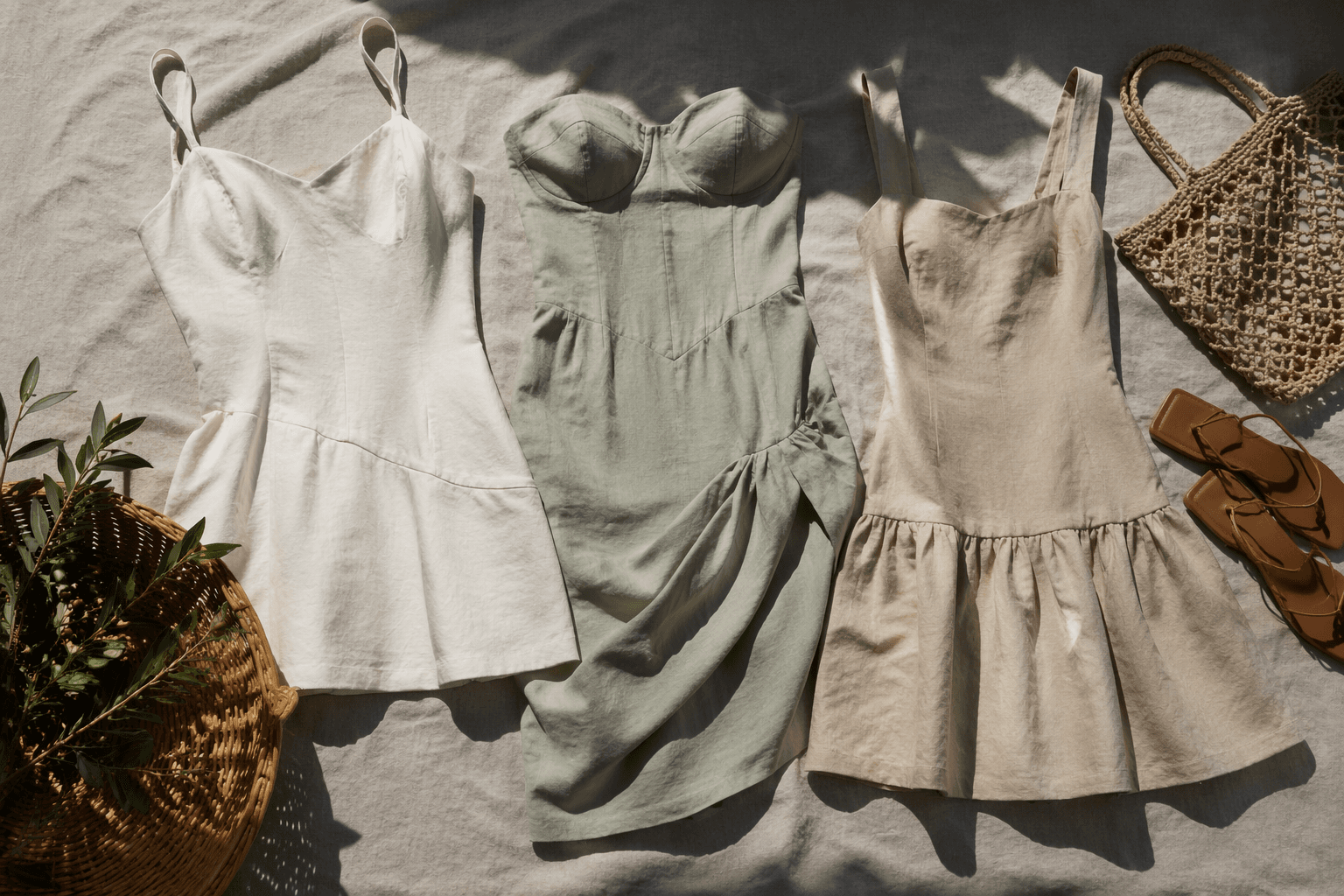
The trick extends to dresses, too. Empire waist dresses, which emphasize the area just below the bust, and A-line styles help elongate your frame. Fit-and-flare dresses work beautifully, as they emphasize the smallest part of the body while giving a longer appearance. Wrap dresses sit in the same category — the diagonal line of the wrap creates natural vertical movement and allows you to tie the waist exactly where you want it, not where the manufacturer decided.
Getting Trouser Inseam Right
This is where most petite dressing falls apart at the seam, literally. The average inseam length for petite women typically ranges from 25 to 28 inches, depending on the specific pant style and the individual's height and proportions. For cropped straight-leg jeans on frames between 5'0" and 5'2", the sweet spot sits at 26 to 28 inches — long enough to give a full leg line when standing, short enough to break cleanly above the ankle without bunching.
Cropped trousers deserve their own annotation: the hem should hit just above the ankle bone, exposing a narrow strip of skin. That exposed sliver is doing real proportion work. It signals where the leg ends and creates a visual continuation that a hem sitting at mid-calf entirely destroys.
Petite sizing adjusts for shorter inseam, rise, and leg proportions, not just height. A petite label isn't simply a shrunken version of a regular size — the shoulder width, arm length, and torso depth are all recalibrated. This is why buying regular sizing and hemming the legs often still doesn't look quite right; the rise and torso length remain mismatched.
Jacket Length and the Torso Problem
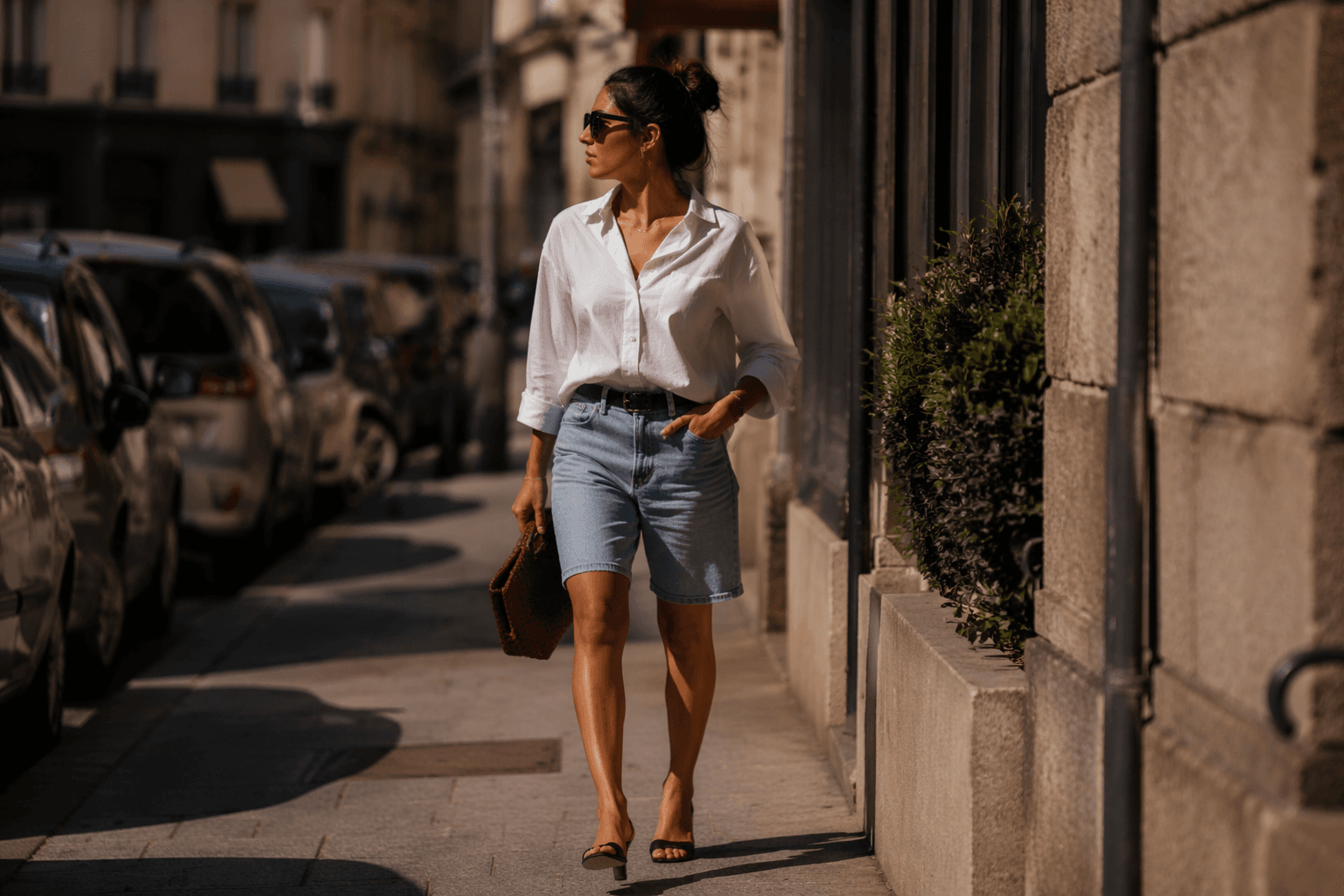
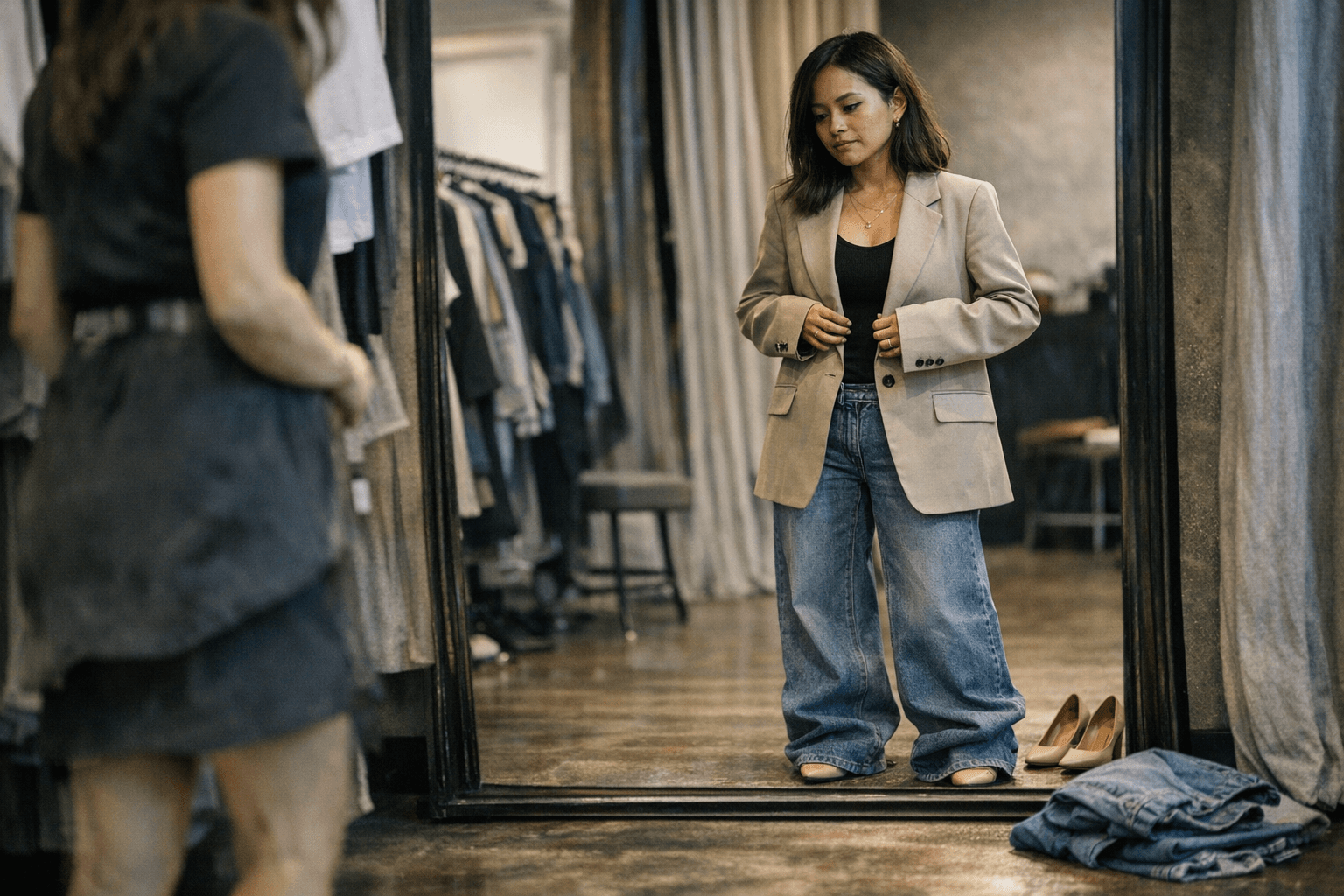
Jacket length is where proportions either click into place or collapse. For petite frames, the ideal jacket hem should hit at or just above the hip bone. A blazer that falls to the widest part of the hip creates a horizontal break at exactly the wrong place — it visually widens and shortens simultaneously.
Cropped jackets cut at the high hip or just below the natural waist are the most reliably flattering option because they expose the full leg line below. Longline blazers can work, but only when worn open and treated as a vertical element rather than a structured layer — more on that below.
Vertical Lines and the Monochrome Formula
Vertical lines, including pinstripes, seams, and long cardigans, guide the eye up and down to lengthen the silhouette. This is physics, not fashion opinion. The eye follows lines, and vertical lines read as height. Pinstriped trousers with a tonal top, a long open cardigan over a fitted base, a column dress with vertical seaming — all of these work on the same principle.
Monochromatic dressing can add the illusion of 1 to 2 inches to your frame while projecting sophisticated confidence. A head-to-toe tonal look eliminates every horizontal break between garments, creating one uninterrupted vertical line from shoulder to shoe. The pieces don't need to be identical in shade — tonal variation within the same color family reads as intentional and interesting while still doing the length work.
Tonal textures, like a matte knit with silk, keep visual interest without chopping the line. This is how you wear a monochrome outfit that doesn't look like a uniform.
What to Avoid: Horizontal Breaks at the Wrong Points
The most common mistake isn't a single garment — it's where the garment ends. Avoid anything that creates a strong horizontal line at the widest point of the hip. That includes:
- Midi skirts that hit at the widest part of the calf without a pointed shoe or heel to extend the leg line below
- Oversized bags — large, oversized bags tend to be overwhelming for petite frames because they can look as though they're taking up too much space on the body and make you appear shorter
- Wide horizontal stripes centered on the hip
- Ankle-strap shoes that cut across the narrowest part of the lower leg and visually shorten it
Outfit Formulas That Actually Work
Three combinations do the heavy lifting for most styling situations:
- Cropped top and high-waisted wide-leg trouser: The cropped hem raises the visual waist; the wide leg adds drama without breaking proportion. Inseam should graze the floor in heels, hit mid-ankle flat.
- Fitted turtleneck and straight-cut high-rise jeans in the same tonal family: Monochrome from neck to shoe, clean vertical line, zero horizontal interruption.
- Wrap dress or fit-and-flare with a pointed-toe flat: The pointed toe extends the leg line without requiring a heel. The waist-definition in both dress styles does proportion work even without added height.
Using the rule of thirds in your outfits can make a significant difference — this styling principle divides the body into visually appealing proportions, with one-third for your top and two-thirds for your bottom.
The Knee Break Question
Where the knee lands relative to a hem matters more than most people realize. On a woman at 5'0", a midi skirt hitting mid-knee reads completely differently than the same skirt on a 5'6" frame. The goal is to let the knee become an asset rather than a cut-off point. Above-the-knee hems, at roughly 2 inches above the kneecap, show enough leg to elongate without tipping into a length that looks disproportionate. Right-at-knee hems often stall the eye precisely where the leg is widest. If you love midi length, pair it with a heel or pointed flat and keep the top half closely fitted and tonal with the skirt to maintain vertical momentum.
The underlying truth of petite dressing is that fit precision, not size, is the real variable. A perfectly proportioned garment in the right inseam and rise will always outperform an expensive piece that's half an inch off at the hem. Once you understand where your visual waist should sit, where your jacket should end, and why a 27-inch inseam changes the entire silhouette of a straight-leg jean, the rules stop feeling like restrictions and start working like a toolkit.
This article was produced by Prism’s automated news system from verified source data, official records, and press releases, then run through automated quality and moderation checks before publishing. The system is built and supervised by the people who set the standards it runs under. Read our full AI policy.
Did this article answer your question?