Lisbon Fashion Week Spotlights Craftsmanship, Knitwear, and Footwear Fit Innovations
Lisbon FW 2026 delivered knitwear worth measuring twice: here's which proportions, stitch weights, and shoe silhouettes petites can actually wear.
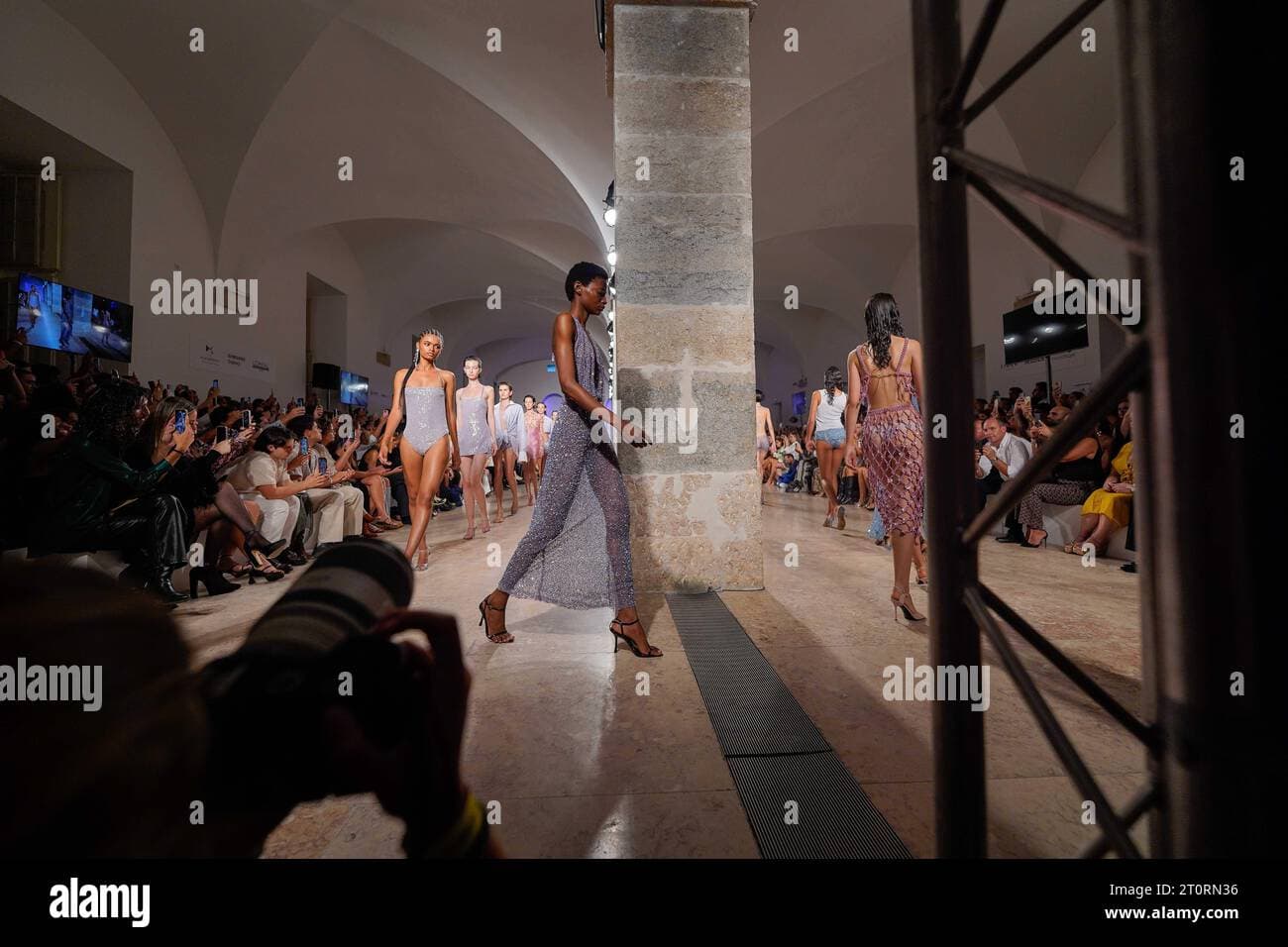
The coat hits at the wrong hip. The midi skirt pools at the ankle. The sleeves swallow the hand. These are the three silent failures that follow petite women through every runway season, and Lisboa Moda 2026 was not exempt from that reality. But buried inside the 66th edition of ModaLisboa PEBBLING, staged across Lisbon from March 12 to 15, were ten precise takeaways that reviewer Joanne Shurvell identified as the event's defining story: craftsmanship, artisanal knitwear, sustainable materials, and footwear innovations designed around fit. Across approximately 20 brands and 15 fashion shows, the Portuguese capital proved it has something specific to offer petite dressers: small houses, made-to-measure philosophies, and a deep-rooted textile culture that produces proportionally sympathetic clothes when you know exactly where to look.
Portuguese Craftsmanship and the Case for Made-to-Measure
Portugal's fashion industry employs over 200,000 people across more than 40,000 companies, and the production infrastructure behind Lisboa Moda is not decorative. It is load-bearing. Designers showing at this event work closely with factories accustomed to running smaller quantities, modified grades, and custom lengths, all of which translate directly into shorter inseams and adjusted torso drops without the cost penalties that penalise petite shoppers at larger fashion houses. Shurvell flagged small houses showing wearable proportions and made-to-measure approaches as one of the event's defining editorial angles, and for petite dressers, that is the lead. A cropped trench from a Portuguese atelier offering custom finishing typically lands between 21 and 24 inches in length, the sweet spot that skims above the knee on a 5'2" frame without breaking a leg line.
- Buy guide: cropped trench 21–24 in. length, Portuguese atelier, custom hem finish
Mestre Studio and the Fine-Gauge Knit Formula
Diogo Mestre launched Mestre Studio with a Sangue Novo debut built entirely around knitwear and the deconstruction of traditional techniques. Mestre holds degrees in both Sculpture and Fashion Design from the University of Lisbon, and he approaches a sweater as an architectural object: stretched grids, re-routed rib structures, garments that expose the logic of their own making. For petite wearers, the relevant detail is gauge. Fine-gauge knits, those running at approximately 3 to 5 stitches per centimetre, drape without adding visual bulk at the shoulder and can be cropped at 19 to 21 inches without losing structural integrity. Chunky gauge, by contrast, foreshortens the torso and pushes the waistline toward the bust, compressing vertical space. Mestre Studio is a house worth tracking closely.
- Buy guide: fine-gauge knit crop 19–21 in., 3–5 stitches/cm, rib-detail hem
The Crochet Revival: Why Stitch Density Changes Everything
The knitwear and crochet revival Shurvell identified at Lisboa Moda is not merely a texture story. For petites, it is a proportion story. Open-stitch crochet, the kind with a lacy, airy grid, visually elongates because it allows the eye to travel through the fabric rather than resting on it. A crochet midi skirt hitting at 21 to 23 inches from the waist, the precise midi point for frames under 5'4", reads as fluid rather than heavy. Closed-stitch crochet behaves like a woven and should be treated accordingly: keep lengths above the knee or ground them with a pointed-toe heel that adds an inch of leg below the hemline and holds the visual line intact.
- Buy guide: open-stitch crochet midi 21–23 in. waist-to-hem, petite frame under 5'4"
Sustainable Textile Partnerships: Shorter Runs, Better Proportions
The Sangue Novo competition was supplied with sustainable materials by three Portuguese textile producers: Calvelex/Fabrics4Fashion, RDD Textiles, and Riopele. These are not symbolic partnerships. The fabrics they supply are used in competition collections graded and sewn in smaller sample runs, which means the textile behaviour in a size 34 or 36 is better understood than in most commercial runway contexts where the 38 sample is the reference point. Burel Factory, whose brand award is one of the two Sangue Novo prizes, produces wool fabrics from Serra da Estrela sheep that are dense enough to hold a clean hem at any length and need no lining, which removes an extra layer of bulk from shorter garments entirely.
- Buy guide: unlined Burel wool coat 24–27 in., clean-cut hem, no lining for petite silhouette
Sangue Novo: Five Finalists and Two Prizes
The Sangue Novo competition brought five finalists to Pátio da Galé on March 13 and awarded two prizes: the ModaLisboa x IED from the Istituto Europeo di Design, and the ModaLisboa x Burel Factory award. The jury evaluated entries against criteria spanning craftsmanship innovation, brand development, international education, and ethical manufacturing, criteria that collectively describe a designer who thinks systemically about how a garment is made and by whom. For petite shoppers, these are the designers worth watching earliest. Emerging houses with small production runs are far more likely to accommodate non-standard sizing requests, and a Sangue Novo finalist in their first commercial season is often still grading samples by hand, which means the conversation about a shorter inseam is still possible.
- Buy guide: search 'Sangue Novo 2026 finalist' + 'custom size' or 'made to order'
Workstation Design: Five Emerging Names, One Structural Advantage
In its second edition, the Workstation Design platform, supported by hair-care brand Jean Louis David, presented five designers: ARNDES, Bárbara Atanásio, Çal Pfungst, Francisca Nabinho, and DRIONADREAM, the last making its debut on the emerging creation platform. Each received access to venues, technical production, and support teams, with 100 seats per show opened to the public. The platform's significance for petite dressers is structural: these designers are in the earliest stages of building commercial collections, before standard size charts have been locked in, which creates a genuine opening for conversations about shorter inseams, raised waistlines, and cropped outerwear proportions. Following these five names now positions you to have that conversation before the window closes permanently.
- Buy guide: search designer name + 'ModaLisboa Workstation 2026' + 'commission' or 'pre-order'
Kolovrat and Constança Entrudo: Performance Shapes Proportion
Two presentations at Lisbon's Gulbenkian CAM centre took the conventional runway format apart. Kolovrat used the concept of the seed as a structural premise for a site-specific installation in the Engawa Space, staging garments within a performative, free-to-attend format that invited scrutiny of how clothes move in real space rather than how they read at 30 metres. Constança Entrudo's Fall/Winter 2026 collection, titled 'Second Best', showed in the Studio Room in three 20-minute slots, an intimate format that allowed close reading of construction details. Both presentations favour clothes designed to work in motion, which for petites translates to garments with a lower visual centre of gravity: narrow shoulder seams, longer bodice drops, and hemlines that anchor rather than float.
- Buy guide: structured midi 22–24 in. waist-to-hem, narrow shoulder seam under 14 in.
The Portuguese Shoe Association Presentation: Choreography Meets Fit
One of the most distinctive moments at Lisboa Moda 2026 was the presentation organised by the Portuguese shoe industry association, which merged choreography and footwear in a format that treated shoes as the lead design object rather than an accessory footnote. Portugal is one of Europe's largest footwear exporters, and this presentation was built to demonstrate range: heeled boots, sculptural flats, and architectural mules, all staged with dancers whose movement made fit legibility central. For petite dressers, a shoe that fits cleanly at the ankle and instep is not an aesthetic preference; it is a proportion decision. A clean-cut ankle boot with a 1.5 to 2 inch block heel adds leg length without the instability of a stiletto and keeps the visual line unbroken below a cropped trouser hem.
- Buy guide: ankle boot block heel 1.5–2 in., ankle opening under 13 cm, pointed or almond toe
Footwear Fit Innovations: The Luís Onofre Standard
Luís Onofre, whose label launched in 1999 after early career work at Cacharel, Daniel Hechter, and Kenzo, is now distributed across five continents and represents the benchmark for Portuguese footwear construction at a global level. His approach to last-making, the form over which a shoe is built, prioritises the relationship between heel height and arch pitch, which directly affects how a shoe balances on the foot and how it reads against the leg. A poorly pitched heel on a short frame widens the calf visually and shortens the leg; a correctly pitched last can extend the leg line by two to three visual inches. Fit innovation at Lisboa Moda is not about novelty shapes but about this precision in construction, and Portugal's footwear heritage is the reason it shows up here before anywhere else.
- Buy guide: narrow last heel Portugal, petite arch pitch, heel under 3.5 in.
Wearable Proportions and the High-Rise Trouser Formula
Shurvell's review specifically flagged wearable proportions as a defining note of the event, and that language deserves decoding. Wearable in this context means neither oversized nor excessively structured, proportioned to sit correctly on a body rather than to read from the back of a large venue. High-rise trousers with a 27 to 28 inch inseam, hemmed precisely at the ankle bone, and a wide leg that begins at the hip rather than the thigh create the vertical channel of space that visually lengthens a 5'2" to 5'4" frame more effectively than any heel height. Lisbon's designers, shaped by a production culture that builds to order, are more likely than most to let you specify that inseam before the first fitting arrives.
- Buy guide: high-rise wide-leg trouser, 27–28 in. inseam, hip-point flare, petite custom inseam
Portugal's fashion week does not carry the commercial weight of Milan or Paris, but that is precisely why it rewards closer attention. At 66 editions deep, Lisboa Moda has built an infrastructure, material, production, and competitive, that incentivises the qualities petite dressers have the hardest time finding elsewhere: small runs, genuine craftsmanship, and designers who are still close enough to the sample to change it. The 2026 edition made the case clearly.
This article was produced by Prism’s automated news system from verified source data, official records, and press releases, then run through automated quality and moderation checks before publishing. The system is built and supervised by the people who set the standards it runs under. Read our full AI policy.
Did this article answer your question?