Petite capsule wardrobe formula turns 10 pieces into 14 outfits
Ten well-chosen petite pieces can spin into 14 outfits when every seam, hem, and rise is calibrated to the frame. Buy less, tailor less, repeat more.
The petite wardrobe trap is always the same: sleeves swallow the hand, hems drag the eye down, and a jacket that looked sharp online lands like borrowed clothing in real life. The fix is not more shopping, it is better math. A petite capsule works when every move in the system is built around shoulder placement, waist position, and clean visual lines.
Why petite dressing works better as a system
Petite sizing is not just a height label. Petite is generally defined as 5'4" and under, but the real difference is structural: the proportions shift in the shoulders, arm length, rise, and overall balance, while misses sizing is built for average-height frames. That is why a piece can be technically “small” and still look off, because the problem is often placement, not scale.
The CDC’s FastStats page lists the average height for U.S. women age 20 and older at 63.5 inches, which is just under 5 feet 4 inches.
The 10-piece formula that does the work
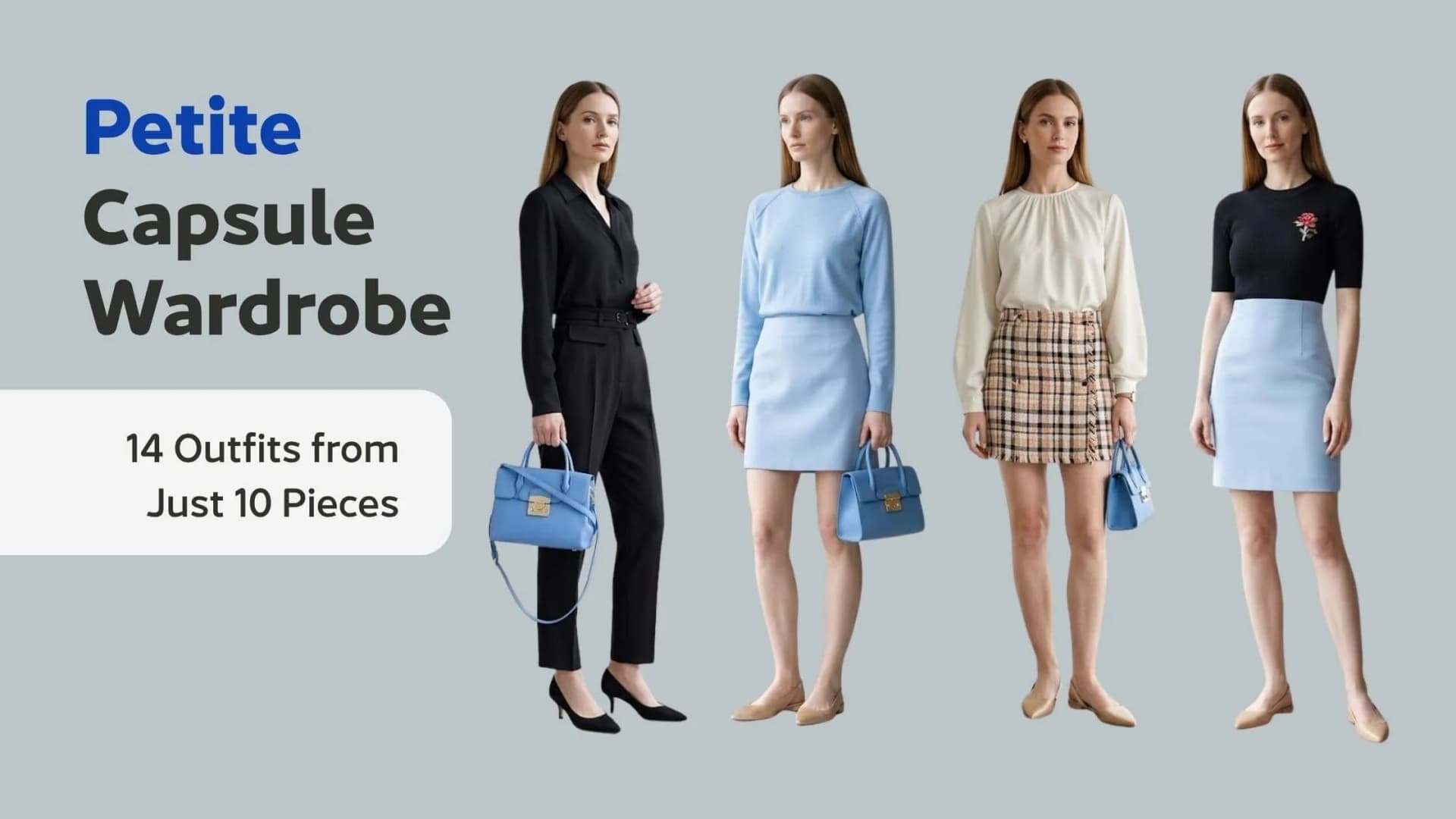
Wonder Wardrobe’s petite capsule model is brutally simple: 4 tops, 3 bottoms, 2 dresses, 1 jacket, 2 pairs of shoes, and 1 bag. That gives you 10 pieces and, in its example, 14 interchangeable outfits for women under 165 cm. Four tops and three bottoms already create 12 combinations, and the two dresses push the capsule to 14 without adding clutter.
The system also forces every item to pull its weight. Each piece should work with at least three other pieces in the capsule, which cuts out the dead weight that usually sneaks into a closet, especially when a petite shopper buys on impulse and then discovers the item only works with one exact pant or one exact heel.
The silhouette stays disciplined: a top that can sit at the right point on the torso, a bottom that keeps the leg line long, a jacket that ends where the body still feels open, and shoes that do not interrupt the line.
The fit rules that keep the capsule sharp
The most useful petite rules are the ones that sound almost too exact to be stylish, because that precision is what keeps the outfit from slipping off your frame:
- Shoulder seams should land within 2 cm of your actual shoulder line.
- Waistlines should hit at or above your natural waist.
- Hemlines should be mentally adjusted by 10 to 15 cm from what you see on the model.
- Every piece should work with at least three other pieces in the capsule.
Those rules matter because petite fit problems usually happen at breakpoints. If the shoulder seam falls too far down the arm, the whole top starts looking borrowed. If the waist sits too low, the torso reads shorter than it is. If the hem is left at model length without adjustment, the proportion can turn heavy fast.
Rise matters just as much as hem length. A trouser or skirt with the wrong rise can chop the body in half, which is why petite shopping has to account for the distance between waist, hip, and leg line, not just inseam. The cleanest petite outfits are the ones that keep the eye moving upward and downward in one continuous path, rather than stopping at a bad cutoff.
The shapes stylists keep reaching for
Angela Foster, a wardrobe consultant who specializes in short women’s style, recommends 10 capsule pieces for women under 5'4". Her favorite tools are the ones that create vertical motion without trying too hard. V-neck blouses and sweaters work because their angled lines pull the eye down and in, creating an arrow effect that visually lengthens the body without adding bulk.
Cropped outerwear plays the same game more quietly. Foster points to cropped trench coats because they tend to land at the hipbones or slightly above. PureWow’s petite spring coverage also put cropped coats near the belt line as a figure-lengthening choice when the rest of the outfit is balanced correctly.
The rule of thirds still earns its keep because thirds are easier on the eye than a blunt half-and-half split. A cropped top with a high-rise bottom, or a tucked blouse with a jacket ending near the belt line, gives the body a longer lower section and a cleaner break point than a standard, boxy layer ever could.
Why this approach beats tailoring every trend
At Who What Wear, a 4'11" editor favored spring pieces for petites that did not require tailoring in a 2025 petite trend guide. That is the hidden cost people forget when they buy a trend first and think about proportion later. Every extra hem, sleeve, or waist alteration adds time, money, and friction, and petite wardrobes get expensive fast when every “almost right” piece needs work.
The capsule approach reduces that drag. Instead of chasing separate looks for every occasion, you are buying pieces that already understand each other. The clothes stay closer to the body’s natural architecture, the lines stay cleaner, and the closet starts functioning like a system instead of a pile.
Wonder Wardrobe says its method has been used by 17,000+ women across 106 countries.
This article was produced by Prism’s automated news system from verified source data, official records, and press releases, then run through automated quality and moderation checks before publishing. The system is built and supervised by the people who set the standards it runs under. Read our full AI policy.
Did this article answer your question?