Petite Inseam Guide: How Short Frames Can Find Their Perfect Fit
The hems pool, the waist gaps, the proportions feel all wrong: your inseam number is the fix petite shoppers have been missing.
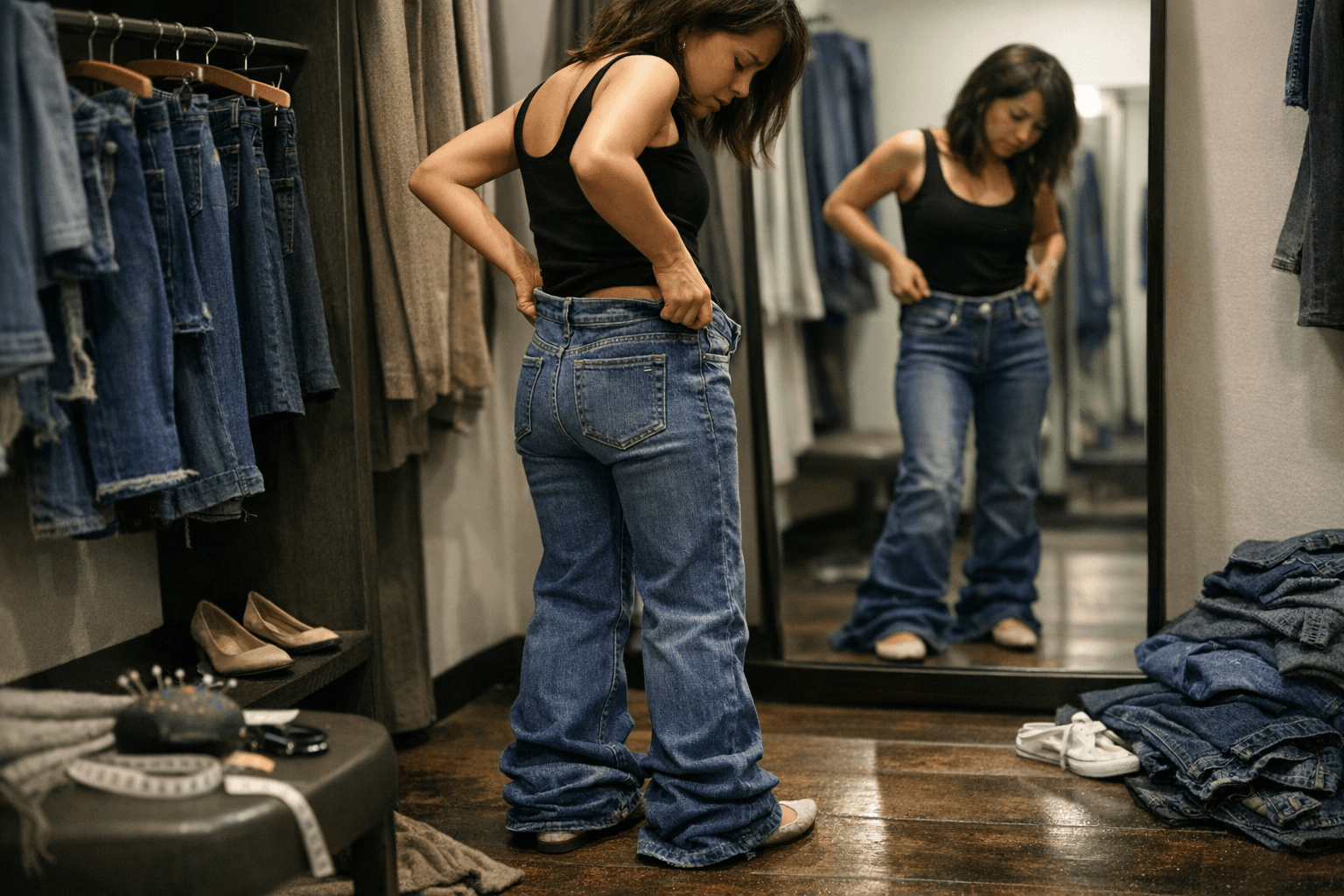
The hem lands two inches too low. You fold it up, and suddenly the bulk at the ankle cuts your leg line in half. You try cuffing — same problem, different configuration. This is the petite fitting loop that so many shorter women know intimately, and it almost always traces back to one overlooked number: the inseam.
Inseam is the measured length that runs from the crotch to the hem of a garment — covering pants, shorts, jumpsuits, overalls, anything with a leg attached. For petite frames, getting this number right is not a styling preference; it is the difference between a pant that elongates and one that swallows. As one petite style resource put it plainly: "Getting the inseam right is especially important for a petite stature because the most common problem we run into is finding the correct length."
Why Inseam Matters More Than You Think
The instinct when pants run long is to cuff them or fold the hem. But that fix creates its own problem: the extra fabric bunches into a chunky roll at the ankle, visually cutting off the leg at its widest point. The result is the opposite of the streamlined silhouette most petite dressers are after. Knowing your inseam before you shop — not after you've already committed to a pair — gives you a filter that eliminates most of this trial and error before it starts.
That filter is becoming more critical as the retail landscape shifts. True petite sizing, with dedicated patterning that adjusts rise, knee placement, and proportions throughout the garment, is increasingly being replaced by what Armoire Style describes as "piece-meal short-lengths." Brands that once offered robust petite collections now frequently just shorten the inseam and call it done. The rise stays regular. The pocket placement stays regular. The knee hits in the wrong place. In other words, the "petite" label becomes a length category more than a genuine proportion correction — which means a shopper who knows her inseam can at least identify whether a shortened pant will actually work for her body, even if the broader proportions fall short.
How to Measure Your Inseam
There are two reliable methods, and both require nothing more than a soft measuring tape.
The most accurate approach is a body measurement: hold the top of the tape at the top of your inner thigh, let it run straight down without pulling, and note the number where it hits your ankle bone. Enlisting a friend makes this considerably easier and more precise — trying to read a tape measure at your own ankle while standing upright introduces more margin for error than most people expect.
If measuring directly on your body feels awkward, the garment method works just as well. Find a pair of pants that already fits you perfectly in the leg — not the waist, not the hips, just the length. Lay them flat on a hard surface and run your tape from the crotch seam straight down to the hem. This is the Petite Stylist Tip worth writing on a sticky note inside your wardrobe: "If you are finding it hard to measure your inseam on yourself, select a pair of jeans that already fit well lengthwise. Lay those jeans flat and use a soft measuring tape to measure the inseam from the crotch to the hem."
For shorts specifically, the process has one additional step: locate the crotch point just below the fly where all four seams converge — the front seam, back seam, left inseam, and right inseam. From that junction, measure straight down the inside leg to the bottom of the hem. Some shorts have no visible stitching along the inseam, but the measuring method stays the same: simply run the tape along the inner thigh to the hem edge.
What Inseam Length Should Petites Be Looking For?
Most sources cluster the petite inseam range between 24 and 28 inches for the majority of shorter frames, with about 26 inches emerging as the most commonly cited average. The variation within that range is determined by two factors: height and the style of pant you're buying.
The most detailed breakdown comes from Armoire Style's height-specific mapping:
For women at 5'0" and under, cropped pants typically work at a 24 to 25 inch inseam, ankle-length styles at 25 to 26 inches, and full-length pants at 27 to 28 inches.
For women between 5'1" and 5'3", cropped pants land well at 25 to 26 inches, ankle styles at 26 to 27 inches, and full length at 28 to 29 inches.
Many petite women find 28 inches to be their reliable go-to for a full-length pant. By contrast, many mainstream denim brands set 30 inches as the default "regular" inseam — a gap of two full inches that seems small in theory and enormous in the fitting room.
At the lower end, some sources include 24 inches as the starting point for cropped styles on the shortest frames. At the upper end, some guidance extends the petite range to 30 inches depending on individual proportions and the specific garment style, though the majority of sources converge on 28 inches as the practical ceiling for most petite lengths.
At 5'0", a 26-inch inseam tends to hit at just the right point to wear most shoe heights comfortably without needing a single alteration.
Matching Inseam to Silhouette
Your measured inseam is your baseline. What you do with that number depends on the cut of the pant.
For skinny and straight-leg styles, aim for an inseam that matches your measured number as closely as possible. These silhouettes are unforgiving of extra length because there is nowhere for the excess fabric to go except into a bunched ring above the ankle. Getting the length exactly right allows the pant to run smoothly down the leg, creating the clean vertical line that makes petite frames look proportional and longer. Some petite shoppers deliberately size down an inch on skinny styles to keep the hem above the ankle entirely — useful when the goal is to let footwear do the work.
Cropped and ankle-length styles offer more flexibility, but come with a specific warning: a cropped pant from a non-petite label might hit at the right length while the rest of the garment — the rise, the knee seam, the pocket placement — is still sized for someone five foot four or taller. That misalignment can make everything above the hem feel subtly off even when the length looks right.
Capri styles, which hit at mid-calf by design, can work on petite frames but require attention to how that particular horizontal break divides the leg visually. Fit and styling choices do the heavy lifting here, and buying from a label with dedicated petite patterning makes the difference.
Beyond Inseam: The Proportions That Make Petite Sizing Work
Inseam is the most frequently cited number in petite fitting conversations, but it is far from the only measurement that separates a genuinely petite-cut garment from a regular pant with a shorter leg. A well-constructed petite garment adjusts across multiple dimensions simultaneously:
- Shorter rise: a rise between 8 and 10 inches works best for most petite frames; anything over 10 inches can overwhelm the torso unless you carry more of your height there
- Higher armholes to prevent gaping at the shoulder
- Waist placement adjusted to sit at the correct point on a shorter torso
- Narrower shoulders for a cleaner line through the upper body
- Raised knee placement in pants so the seam hits the actual knee rather than falling below it
- Pocket placement scaled to the frame so pockets don't sit too low or too wide
This is the distinction between petite sizing done properly and petite sizing done lazily. When brands shorten only the inseam and leave everything else at regular dimensions, the rise can feel too high, the pockets drift toward the thigh, and the overall silhouette reads as ill-fitting despite the correct leg length.
Where to Shop and What to Look For
Brands that maintain dedicated petite lines rather than simply offering a "short" inseam option are worth seeking out. Gap's petite collection and Charlie B are frequently cited as labels with genuine petite-specific construction. Slimsation designs ankle pants and straight-leg styles explicitly for petite proportions — the EASE-Y-FIT straight leg pant, for example, is cut with an inseam calibrated to avoid ankle bunching, which is the most common length complaint from shorter shoppers.
The practical rule when shopping: prioritize brands that specify petite rises and petite proportions in their product descriptions, not just petite inseam lengths. If a brand's "petite" offering only shortens the leg and leaves every other measurement identical to the regular cut, treat it as a cropped regular pant, not a petite one, and shop accordingly.
Knowing your inseam number — that one measurement from inner thigh to ankle bone — will not solve every petite fitting problem on its own. But it is the most efficient filter available, and in a market where true petite sizing is harder to find than it once was, it is the piece of information that separates a shopping trip that ends in frustration from one that ends in a pant that actually fits.
This article was produced by Prism’s automated news system from verified source data, official records, and press releases, then run through automated quality and moderation checks before publishing. The system is built and supervised by the people who set the standards it runs under. Read our full AI policy.
Did this article answer your question?