Six Style Mistakes Petites Should Avoid to Look Instantly Taller
The hem lands wrong, the waist sits too low, and the jacket swallows you whole. Six specific fixes that actually change how tall you look.

The problem is never your height. It is the hem that pools at your ankle, the color-block seam that cuts you across the widest part of your torso, the jacket that ends somewhere between your hip and your knee and does absolutely nothing for your silhouette. Proportion is a set of solvable equations, and for anyone 5'4" and under, the six mistakes below appear in dressing rooms with exhausting reliability. Here is exactly what to do instead.
Letting Hems Hit the Wrong Spot
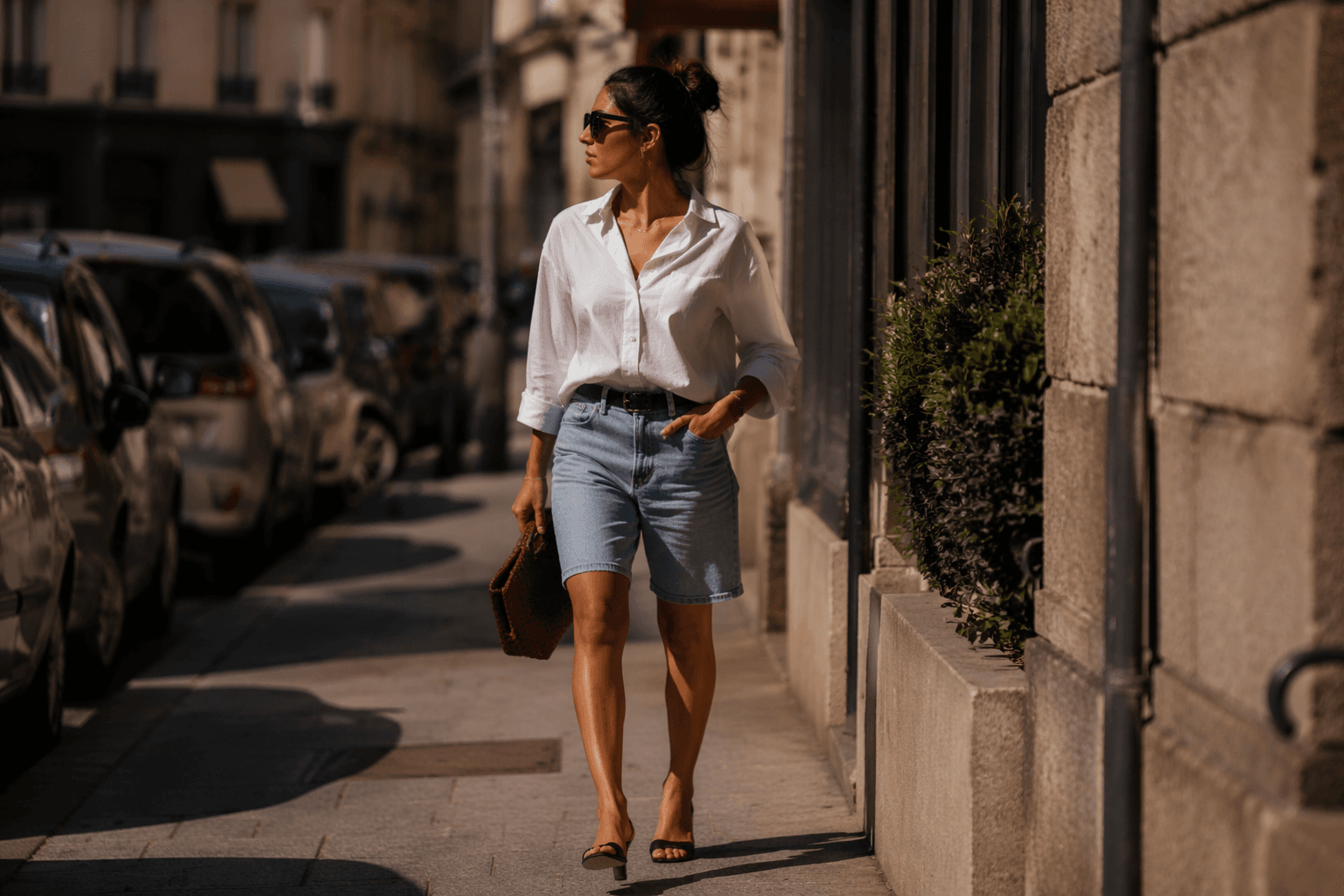
This is the single most common proportion mistake, and it is fixable with a tape measure and, occasionally, a tailor. Trousers that bunch at the shoe or drag across the floor add visual weight to the one area you most want to look lean. The target inseam for a clean straight-leg or slim pant on a petite frame sits between 25 and 28 inches, hitting just at or above the ankle bone. For cropped wide-leg styles, aim for a 24 to 26-inch inseam; for full-length wide-leg, 27 to 29 inches, but expect to hem because even one inch too long collapses the silhouette entirely. Skirts and dresses are equally precise: the most elongating hemlines on a 5'0" to 5'4" frame end just above the knee or, if you want to wear a maxi, skimming the body all the way to the floor with no excess fabric dragging. The danger zone is the mid-calf, a length that visually stubs the leg by interrupting it at its widest point. If altering seems excessive, it is not: a single hem adjustment of half an inch can transform how a pair of trousers reads on a shorter frame.
Relying on Heavy Horizontal Color-Blocking
Contrast is the enemy of length. When a bright top meets dark trousers, the eye is drawn directly to that seam and your body is effectively divided in half, compressing both halves in the process. This is compounded in coat dressing: wearing a midi coat over a contrasting skirt with light shoes creates three distinct horizontal bands that, as one stylist comparison noted, "mercilessly chop off your height." The antidote is monochrome dressing, which creates an unbroken vertical line from shoulder to shoe. A column of the same tone, even varying shades of navy or camel, reads as continuous and therefore tall. Vertical stripes reinforce this effect further, drawing the eye up and down rather than across. If you love print, keep it on the upper half; pattern on the lower body makes legs appear shorter, while pattern at the shoulder or neckline pulls the gaze upward.
Wearing a Too-Low Waistline
Low-rise fits drag the body's visual centre of gravity downward, making the torso appear disproportionately long and the legs correspondingly short. High-waisted cuts correct this by lifting the waistline toward its natural position, which immediately extends the perceived leg length. The styling principle at work here is sometimes called the Rule of Thirds: the most proportionate silhouette divides the body one-third top to two-thirds leg, and a high-rise bottom paired with a tucked-in blouse or a cropped top achieves exactly that ratio. Empire-waist dresses and high-waisted jumpsuits work on the same logic. A slim belt layered over a high-rise trouser reinforces the waist definition without adding bulk, provided the belt stays narrow; a wide sash undoes all the work by creating its own horizontal break.
Choosing Shoes That Swamp the Ankle
The instep line, the unbroken visual run from the hem of your trousers to the floor, is one of the most powerful elongating tools available, and ankle straps cut straight through it. Any strap that crosses the ankle introduces a horizontal line that shortens the leg above it. The most flattering shoe shapes for petite proportions are pumps, pointed-toe styles, and slingbacks, all of which keep the leg line intact and draw the eye forward and down rather than stopping it mid-foot. The pointed toe is particularly effective because it extends the visual line of the leg beyond the foot itself. Low vamp styles, which cut across the foot close to the toes rather than rising up toward the ankle, have the same leg-lengthening effect. Nude shoes in a tone close to your own skin eliminate the visual full-stop of a contrasting shoe altogether, quietly adding the illusion of several extra inches.
Adding Bulk With Wide Cuffs and Heavy Hems
Cuffed sleeves and wide, turned-up trouser hems seem like minor styling choices, but on a compact frame they draw the eye outward rather than upward, adding perceived width at the wrist and ankle precisely where you need clean lines. The wrist is the narrowest point of the arm, and a wide cuff obscures it, making the whole sleeve read as heavier than it is. At the ankle, a deep cuff shortens the leg by the exact depth of the fold. The fix is clean, uninterrupted hemlines: let trousers hit at the ankle without folding, and choose sleeve lengths that end at the wrist bone without excess fabric. If a sleeve is too long, have it taken up rather than rolling it back; a generous roll sits higher on the forearm and introduces exactly the horizontal break you are trying to avoid.
Getting the Jacket Length Wrong
Outerwear and blazers that end somewhere around the upper thigh create a visual divide that shortens the lower body. A jacket hitting at the widest part of the hip effectively frames and emphasises that width, while simultaneously cutting off the leg before it has a chance to read as long. The cropped jacket is arguably the most proportionally generous silhouette in a petite wardrobe: ending just at or above the natural waist, it exposes the full run of the leg from waist to shoe and creates a clear definition between top and bottom. Reese Witherspoon, who stands at 5'1", has long used cropped denim jackets over dresses to precisely this effect. If you own a mid-length blazer you love, the workaround is to wear it open and tuck the top underneath it, adding a slim waist belt to reclaim the definition the jacket length has taken away. The principle extends to coats: a standard 125 cm-plus length coat will either drag on the floor or hide the ankle entirely, while a shorter cut that reveals the ankle maintains the visual line and keeps the silhouette upright and articulated.
Proportion dressing is not about following arbitrary rules; it is about understanding which specific details the eye reads as height, and then building those details into the clothes you already own. The six mistakes above all share the same underlying logic: they interrupt, widen, or compress the vertical line. Address each one, and the mirror will tell the rest of the story.
This article was produced by Prism’s automated news system from verified source data, official records, and press releases, then run through automated quality and moderation checks before publishing. The system is built and supervised by the people who set the standards it runs under. Read our full AI policy.
Did this article answer your question?