Tucked tops and defined-waist maxi skirts flatter petites best
A tucked top and defined waist give petites the proportion control a dress cannot, and Boden’s petite range shows why true petite tailoring matters.

The case for separates is simple: petites need control. A tucked-in top with a defined-waist maxi skirt gives you that control in a way a one-piece dress often cannot. The waist sits where you want it, the vertical line stays clean, and the eye gets a clear path from shoulder to hem without extra fabric swallowing the frame.
That is the real argument here, not just a styling preference. On a shorter body, proportion is the whole game. A dress can be beautiful and still land too low at the waist, too full through the skirt, or too uninterrupted in a way that makes the body look compressed. Separates solve that by letting you engineer the silhouette: top length, waistband height, skirt shape, and hem placement all work together instead of being locked into one fixed garment.
Why the tucked-top formula works so well
A tucked top creates a visible waistline, and that matters more for petites than for almost any other frame. When the waist is defined at the narrowest point, the lower half reads longer and cleaner, especially if the skirt falls in a straight or gently fluid line. The effect is subtle, but it is powerful: more leg line, less visual bulk, and far more control over where the body appears to begin and end.
A maxi skirt can be surprisingly flattering on shorter women when it is not overbuilt. Recent petite-focused fashion coverage has leaned toward sleeker, slimmer maxis rather than the old tiered, bohemian kind, precisely because less volume keeps the silhouette streamlined. That is the difference between being overwhelmed by cloth and being lengthened by it. The skirt should skim, not swirl.
There is also a practical advantage to separates that dresses rarely offer. If your torso is shorter, your bust sits higher, or your waist-to-hip ratio is pronounced, a dress may only flatter one of those measurements while compromising another. A tucked top and skirt let you adjust each part independently, which is why the formula can feel more exacting and more forgiving at the same time.
What Boden gets right for petites
Boden’s petite range is a useful case study because it does more than simply shorten hems. The brand says its petite sizing is designed for customers 5ft 3in or under and is proportionally shortened throughout the garment. That detail matters because true petite sizing changes the balance of the whole piece, not just the length at the bottom.
For shorter shoppers, that distinction solves a familiar frustration: a dress or skirt that is technically the right length but still sits wrong through the body. If the shoulders are too broad, the waist too low, or the rise too long, the garment can still feel “off” even when the hem is fine. Boden’s approach points to a more intelligent kind of petite dressing, one that respects the body’s architecture instead of treating height as an afterthought.
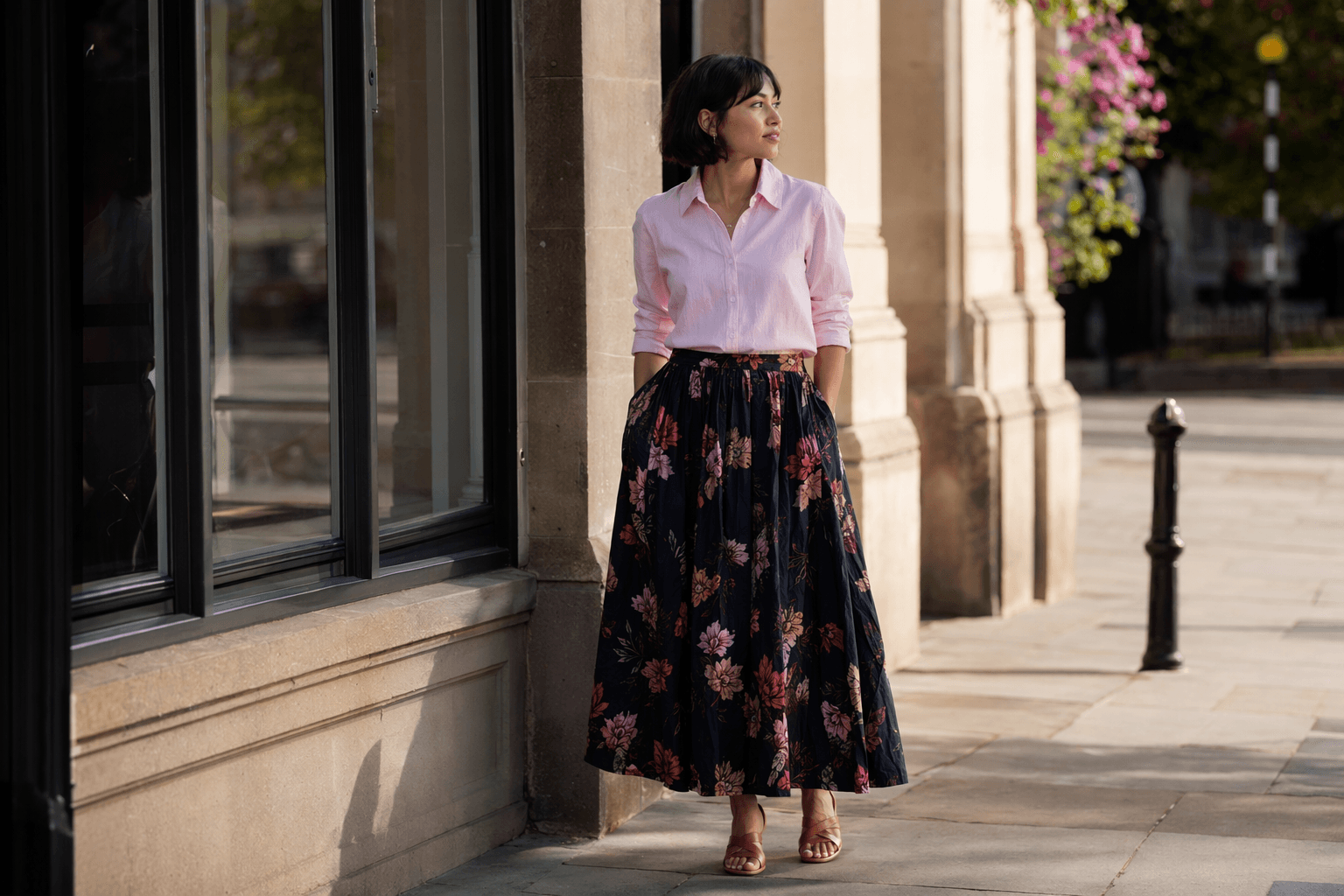
This is where the skirt-and-top combination becomes especially persuasive. When petite proportions are built correctly, the waistband can land where it should, the skirt can fall without excess length, and the top can be tucked without bunching. The result is a silhouette that looks composed rather than corrected.
The body-shape problems this formula solves
The tucked-top, defined-waist maxi skirt pairing is particularly good for petites who struggle with any of these issues:
- A dress that drops the waist too low and makes the torso look longer than it is
- Extra fabric through the midsection that hides shape instead of refining it
- Skirts that are too full, tiered, or bohemian and therefore visually heavy
- Footwear that cuts the line of the leg and shortens the frame further
- One-piece summer dresses that fit in one area and fail in another
That last point is especially important. One-piece dressing is convenient, but convenience does not always flatter. Separates let you solve the common petite problem of proportion mismatch, where the top half and lower half need different treatment. A defined waist gives the body a center of gravity; a maxi skirt then extends that line downward without clutter.
Footwear matters too. Overly chunky shoes can visually shorten the leg line, which is exactly what petites do not need when wearing a longer skirt. A lighter shoe, or at least one with a more streamlined profile, keeps the silhouette from being chopped up at the ankle.
Why the petite market keeps growing
This conversation is not happening in a vacuum. Apparel coverage has noted that the petite category is increasingly viewed as a revenue opportunity for brands, and companies are clearly paying attention. Brands such as Mother Denim and Kjinsen are targeting women under 5'4", while petite-focused retailers often define their customer as 5'4" and under or 5'3" and under. The commercial interest is obvious: petite shoppers are numerous, underserved, and highly attuned to fit.

But the market is not easy to serve. Petite assortments create production and inventory challenges because they require more careful grading, more specific pattern work, and more disciplined forecasting. A shortened hem alone does not solve the problem, which is why well-built petite lines stand out when they get the proportions right from the beginning.
That complexity is part of why the conversation around petite dressing has become more sophisticated. Fashion is moving further away from one-size-fits-all thinking and toward better-fit categories, including body-positive and inclusive sizing. Petites have been part of that shift for years, but they remain less consistently served than the demand suggests they should be.
What the measurement evidence tells us
The reason generic sizing so often disappoints is not mysterious. A 2016 study compared the body measurements of petite women with the retail sizing charts of 14 apparel companies, and the implication is clear: petite proportions differ meaningfully from regular sizing conventions. In other words, a shorter woman is not simply a scaled-down version of a taller one.
That is the underpinning of the whole argument for tucked tops and defined-waist maxis. When the industry assumes height is only a matter of subtracting inches, it misses the shape changes that matter most: torso length, rise, waist placement, and overall balance. Proper petite sizing and smart styling work together to correct that mismatch.
The sharper takeaway for shorter frames
What makes this silhouette strategy persuasive is that it gives petites more agency. A one-piece dress can be lovely, but it asks you to accept its proportions as they are. A tucked top and skirt let you decide where the waist sits, how much volume belongs below it, and how cleanly the eye travels down the body. That is why the formula feels less like a trend and more like a fit solution.
For petites, especially those who have been frustrated by dresses that almost work, the answer is not more fabric. It is better proportion, cleaner line, and waist placement that earns its place. When those three things line up, a maxi skirt stops being a risk and becomes one of the most reliable ways to look longer, sharper, and unmistakably put together.
Know something we missed? Have a correction or additional information?
Submit a Tip