30 Things to Know About American Streetwear
American streetwear went from Shawn Stüssy's surfboard shack to a multi-billion-dollar global industry — and the forces that built it are still rewriting wardrobes right now.
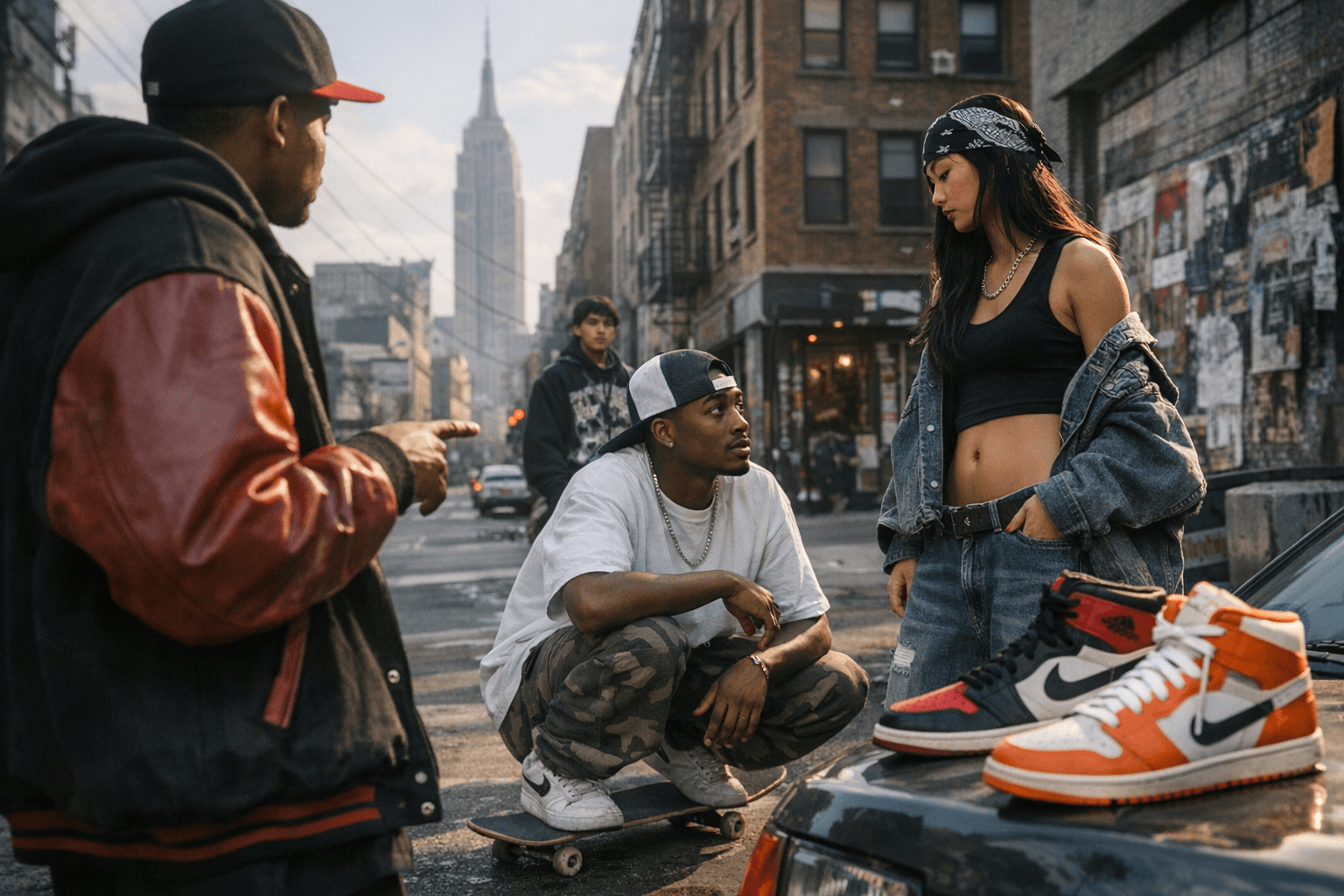
American streetwear was never supposed to become a global industry. It started as a coded language between skaters, graf writers, and hip-hop kids who couldn't find themselves in any department store. Three decades later, the vocabulary those subcultures invented is worth billions — and still evolving fast. These 30 things aren't just history. They're the operating system still running in 2026.
THE BRAND ECOSYSTEMS: HOW THE INFRASTRUCTURE GOT BUILT
1. Stüssy's California Origin Shawn Stüssy was shaping surfboards in Laguna Beach when he started scrawling his signature on T-shirts in the early 1980s.
What began as a surf label exploded into the first true streetwear brand, catching the attention of style-minded young men from Manhattan to Tokyo long before anyone had a name for what it was doing.
2. The Surf-to-Skate Pipeline Surfing gave streetwear its relaxed silhouettes and West Coast ease; skateboarding gave it its DIY defiance and tolerance for destruction.
Baggy shorts, oversized tees, and boxy hoodies weren't aesthetic choices so much as functional ones that the culture then turned into identity markers.
3. Graffiti's Secondhand Revolution As Futura 2000 once described it, this was "the second coming" of graffiti culture.
New York crews like the Soul Artists and Fame City spawned labels including Haze, PNB Nation, and Not From Concentrate, moving the bold lettering and saturated color palettes off subway cars and directly onto cotton.
4. Hip-Hop as Co-Author Hip-hop didn't just wear streetwear — it co-wrote it.
The music and the clothes were inseparable, each legitimizing the other. Tracksuits, leather bombers, and Kangol bucket hats became the visual shorthand for a generation asserting itself loudly in cities that often ignored it.
5. Run-DMC and the Adidas Handshake When Run-DMC performed "My Adidas" at Madison Square Garden in 1986 and held up their shell-toes to a roaring crowd, they secured the first major sneaker endorsement deal for non-athletes.
It set the blueprint for every music-meets-brand partnership that followed, establishing hip-hop credibility as a commodity that sportswear brands needed.
6. Dapper Dan's Harlem Logomania Before luxury brands came looking for the streets, Dapper Dan was in Harlem remixing their logos without permission.
His boutique, open from 1982 through the early 1990s, custom-built garments for rappers and athletes using bootlegged Louis Vuitton and Gucci prints. Decades later, Gucci collaborated with him officially — a full-circle moment that no one saw coming in 1988.
7. Ralph Lauren and the Lo Lifes Obsession The Lo Lifes, Brooklyn's legendary crew of style-obsessed boosters, turned Ralph Lauren's Polo line into a streetwear totem in the 1980s.
Rappers including Raekwon and Grand Puba carried that obsession into the '90s, and the Ralph Lauren influence never really left — it echoes today in the DNA of Supreme, The Hundreds, and Aimé Leon Dore.
8. Union Los Angeles as Ground Zero Union opened in 1989 as one of the first American shops specifically built around this emerging underground look: baggy, oversized, and full of attitude.
Its premise was deliberately inclusive — different worlds under one roof — and its regulars included the exact people who would go on to build the next generation of the industry.
9. Supreme's Founding in 1994 Union co-founder James Jebbia opened Stüssy's first New York flagship in 1990, then launched Supreme in 1994 as a small skate shop on Lafayette Street.
The logo, deliberately mirroring conceptual artist Barbara Kruger's visual language, became one of the most recognizable marks in fashion history. Then vs. now: Supreme launched with affordable T-shirts in tight quantities; today a box-logo hoodie on StockX starts where retail ends.
10. FUBU and the Black Entrepreneur Wave Daymond John founded FUBU — For Us By Us — in Hollis, Queens, building one of the first labels explicitly designed for and by Black communities.
Rocawear and Karl Kani followed similar logic: these weren't brands chasing the culture; they were the culture incorporated, building businesses in a space the fashion establishment had overlooked entirely.
COLLABS AS DISTRIBUTION: HOW THE ECOSYSTEM SPREADS
11. The Drop Model as Power Structure Limited releases weren't just a sales strategy; they were a worldview.
Small quantities, no restocks, deliberate scarcity. Supreme proved this worked at scale. The line outside the Lafayette Street store became its own performance, its own press release. Every brand that followed — from Nike to Palace to Fear of God — borrowed the architecture.
12. The Japanese Feedback Loop Tokyo's Ura-Harajuku scene absorbed American streetwear and sent it back improved.
Hiroshi Fujiwara and Nigo studied the baggy silhouettes and oversized graphics coming out of New York like textbooks, then reworked them with sharper construction, tighter editing, and cleaner detail. In 1993, Nigo and designer Jun Takahashi opened Nowhere, a boutique that became the anchor of the entire Japanese streetwear scene.
13. Pharrell and Billionaire Boys Club Pharrell Williams launched Billionaire Boys Club with Nigo in 2003, bridging American hip-hop's commercial ambition with Japanese streetwear's craftsmanship obsession.
Ice Cream, the sneaker imprint that came alongside it, kept the price points accessible. The collab model Pharrell helped define in the early 2000s is now the standard playbook for anyone releasing product.
14. Colette as the Bridge Between Worlds Long before luxury took streetwear seriously on the runway, Sarah Andelman's Paris boutique Colette was already shelving limited-edition Nikes next to Chanel and Prada.
Its collaborative résumé included Alife x G-Shock, Virgil Abloh x Champion, and Married to the Mob x Reebok — pairings that looked improbable then but feel inevitable now. Colette closed in 2017, right at the peak of the era it helped create.
15. Virgil Abloh and Off-White's Institutional Takeover Abloh launched Pyrex Vision in 2012 and transformed it into Off-White in 2013, building a brand on deliberate quotation marks around streetwear's own references.
In 2018, he became Louis Vuitton's men's artistic director — the first Black American to hold that position at a French luxury house. His death in November 2021 marked an irreplaceable loss for the industry he redrew entirely.
16. Supreme x Louis Vuitton: The 2017 Earthquake The Supreme and Louis Vuitton collaboration in 2017 functioned as both a cultural moment and a market event, with pieces reselling at ten times retail value.
It was the clearest signal yet that the distance between skate shop and fashion week had collapsed — and that the people most shocked were the luxury executives who had spent decades keeping streetwear at arm's length.
17. Kanye West and Yeezy's Dual Life Kanye's Yeezy line began with Nike, migrated to Adidas, and became one of the best-selling sneaker franchises in the world.
When Yeezy x Gap launched, it crashed the retailer's website. The round puffer jacket from that collaboration resold at triple its retail price within hours. Then vs. now: in 2009, Kanye was photographed outside a Comme des Garçons showroom being mocked for his streetwear fits; within a decade he had restructured how Adidas reported revenue.
18. Tyler the Creator and the Internet Generation Tyler, the Creator broke out in 2011 through Odd Future, using the internet to distribute music, merchandise, and attitude simultaneously.
He wedged Supreme into pop culture through sheer presence, then built Golf Wang into an editorial operation with genuine taste: controlled distribution, thoughtful lookbooks, and pieces he actually designed. It was proof that an artist could run a fashion business without a single concession to the industry.
UNIFORM DRESSING: HOW STREETWEAR BECAME DAILY LIFE
19. The Sneaker as Status Object The Air Jordan 1 launched in 1985 in colorways the NBA immediately banned.
Nike paid Michael Jordan's fines and turned the controversy into advertising. What sneakers meant to a generation shifted permanently that year — from athletic equipment to cultural credential. The market that grew from that single shoe is now worth tens of billions globally.
20. Graphic Design as Brand Language Streetwear labels didn't hire marketing departments; they hired artists.
The logo, the graphic, the font choice — these were the entire communication strategy. Labels that got this right (Supreme's Kruger-referencing wordmark, Stüssy's interlocked S script, the Palace triangle) built recognizable marks that still land without explanation.
21. The Mid-2000s Brand Explosion By the mid-2000s, a second wave of American brands had emerged: LRG, Diamond Supply Co., The Hundreds, Crooks & Castles, Obey.
These labels scaled the indie-shop aesthetic into mall-adjacent businesses, bringing streetwear's aesthetic codes to a much wider suburban audience. The democratization was real; the dilution was, too.
22. Justin Bieber and the Mainstream Pivot When Justin Bieber began wearing Obey, Diamond Supply Co., and Crooks & Castles in his daily wardrobe around 2012, those labels landed on MTV and TMZ simultaneously.
The underground found a mainstream vector it didn't ask for — and the brands that navigated it most carefully were the ones that survived the attention with credibility intact.
23. Instagram as the New Store Window Instagram didn't just accelerate streetwear's spread; it restructured its economics.
A brand could build a following before stocking a single shelf. A drop could sell out before a physical queue formed. Styling, photography, and posting cadence became as strategic as the garments themselves. The consumer relationship moved from IRL loyalty to scroll-and-buy.
24. The T-Shirt as Permanent Infrastructure The T-shirt remains streetwear's most democratic and most powerful object.
Owning the right one still signals membership in something specific — a brand universe, a cultural moment, a community. That dynamic was true in 1980 and remains true in 2026, regardless of how many billions the industry generates around it.
RESALE FATIGUE: WHERE THE HYPE CYCLE BREAKS DOWN
25. Hypebeast Media and the Attention Economy Hypebeast, founded in 2005 by Kevin Ma, gave the streetwear world its own trade press.
Drop dates, collab announcements, sizing specs — information that once circulated through tight community networks was now available to anyone with a browser. The democratization of knowledge also democratized competition, flooding every drop with buyers who had no connection to the culture.
26. The Resale Market's Formalization StockX's launch in 2016 applied a stock market model to sneaker and streetwear resale, with live bid/ask spreads and authenticated transactions.
GOAT followed similar logic on mobile. The secondary market went from back-alley negotiation to a structured asset class, and collectors began treating their wardrobes like portfolios. Some of them were right to.
27. Resale Fatigue Sets In By the mid-2020s, the mood had shifted.
Buyers burned by inflated StockX prices, failed flips, and hype objects that dropped in value within weeks began questioning whether the resale game was worth playing. The brands that kept loyalty through quality and community rather than manufactured scarcity found themselves in better shape than the ones who had leaned entirely on FOMO.
28. The Uniform Dressing Turn Where streetwear once prized novelty and visible logos, a quieter current gained force: the uniform.
Heavyweight basics in neutral tones. A small logo or no logo. Garments built to be worn daily rather than displayed once. Brands like Carhartt WIP, Engineered Garments, and the more restrained side of Stüssy's current catalog captured this appetite directly.
29. Legacy Brands Holding the Line Stüssy and Supreme still produce garments that look nearly identical to what they did three decades ago.
That's not creative stagnation — it's strategic fidelity. The market rewards legacy when the original product was strong enough to hold relevance without reinvention. Then vs. now: in 1994, Supreme was a skate shop that celebrities occasionally visited; today it functions as a cultural institution with a global retail footprint and LVMH backing.
30. What to Watch in 2026: Denim Tears, Hellstar, Carpet Company The brands carrying streetwear's next chapter share its founding spirit: creativity, community, attitude.
Denim Tears, built around Tremaine Emory's visual exploration of Black American history through cotton and denim, operates with genuine conceptual weight. Hellstar runs loud graphics with a sincerity that recalls early 2000s energy. Carpet Company keeps things deliberately small and referential. None of them are chasing luxury validation. That might be exactly why they matter.
The force that built American streetwear was never a single brand or a single moment. It was a recurring impulse: take the culture that surrounds you, put it on a shirt, and find the people who get it. The industry scaled that impulse into a global machine. The brands worth watching in 2026 are the ones still running the original code.
This article was produced by Prism’s automated news system from verified source data, official records, and press releases, then run through automated quality and moderation checks before publishing. The system is built and supervised by the people who set the standards it runs under. Read our full AI policy.
Did this article answer your question?