Buffer channels 1980s after-school nostalgia with collectible graphic tees
Buffer's June capsule turns a couch, a rental video shop and a VCR into graphic tees, keeping its Shibuya nostalgia project playful and easy to wear.

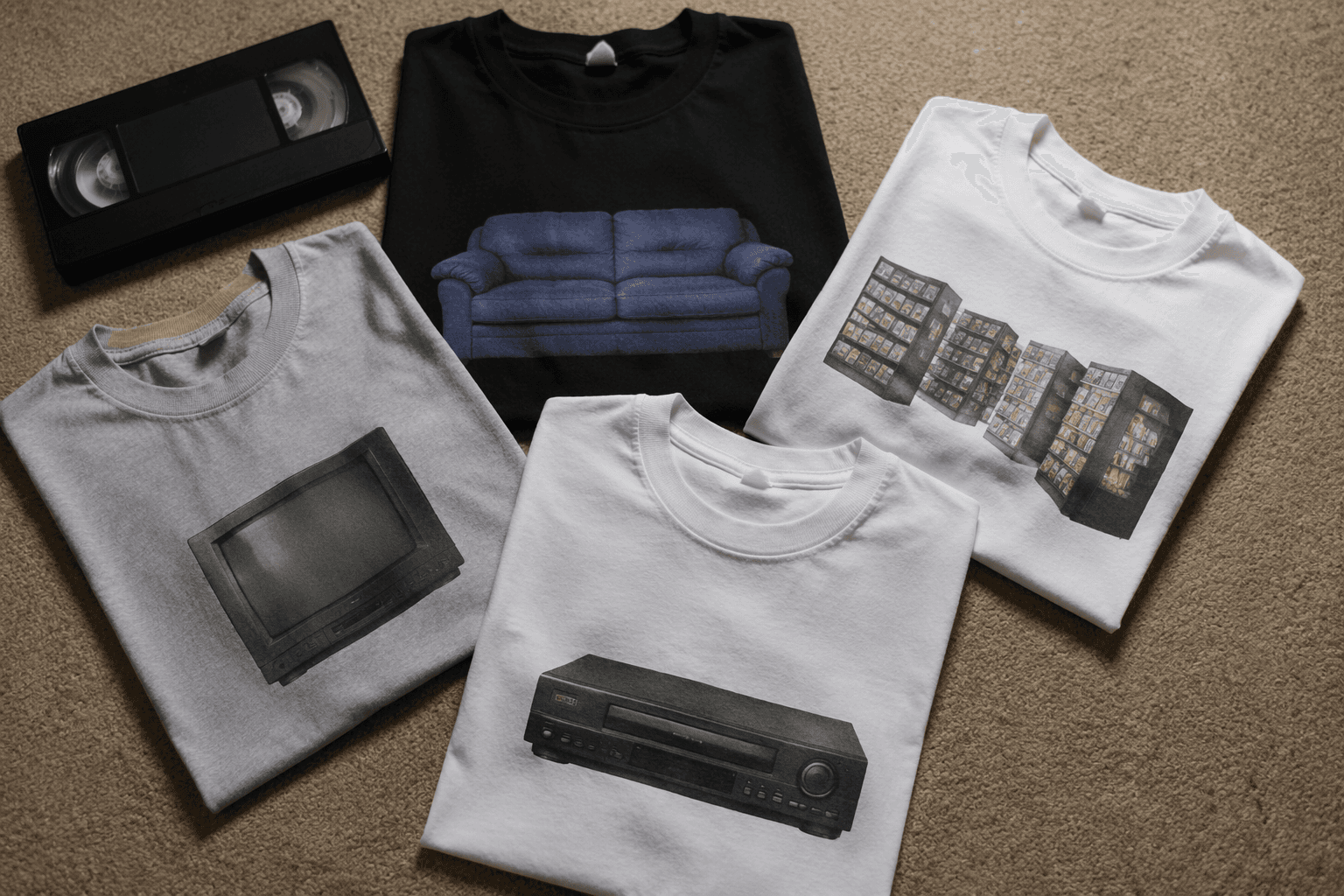
Buffer's June 6 drop keeps the label's concept sharp and simple: three collectible graphic tees, a sling bag, a 6-panel cap and stickers, released in-store in Shibuya and online. The appeal is not loud collaboration heat or logo overload. It is the smaller thrill of pieces that feel like they were pulled from a very specific memory, then translated into something you can actually wear.
A June capsule built around one clear mood
This is a capsule with discipline. Instead of scattering the message across too many references, Buffer narrows the frame to 1980s American after-school downtime, the kind of period detail that can easily become vague nostalgia if a brand is not careful. Here, the line stays grounded in ordinary objects and easy shapes, which makes the collection feel more like a scene than a slogan.
That focus matters because Buffer is still a young label, and young labels often try to say too much at once. This drop does the opposite. It gives the customer a concise entry point into the brand's world, and it does so with pieces that are meant to be worn, not archived.
Three tees, three objects, one after-school story
The heart of the release is the trio of graphic tees built around a couch, a rental video shop and a VCR. Those are not broad retro symbols. They are the kind of specific props that instantly summon a routine: sitting too close to the television, killing time at a friend's place, or bringing home a rented tape and treating the whole afternoon like an event.
That specificity is what makes the graphics feel collectible. A couch print reads less like a generic throwback and more like the backdrop to a hanging-out ritual. The rental video shop and VCR push the story even further, anchoring the tees in the analog habits that shaped a pre-streaming childhood. Together, they feel like three frames from the same memory, which is exactly why the collection lands with more personality than a simple retro logo tee.
The extras are deliberately low-key
Buffer rounds out the drop with a sling bag, a 6-panel cap and stickers, and that mix tells you a lot about the label's priorities. None of these items is meant to dominate the conversation. Instead, they extend the graphic tee story into the everyday uniform around it, the kind of add-ons that make the whole release feel complete without turning it into a costume.
The sling bag and cap are especially smart companions to the tees because they keep the styling casual and immediate. You can imagine them worn with washed denim, loose chinos or work pants, the sort of wardrobe that lets the graphics do the talking. The stickers, meanwhile, are the most obviously collectible piece in the set, a small gesture that reinforces Buffer's taste for souvenirs with personality.
Why the original body matters
One of the more telling details in Buffer's approach is its use of an original T-shirt body. That choice gives the tees a shared silhouette, which is important when the graphics are meant to read as one coherent mini-collection. A custom body also lifts the line above the standard blank-and-print formula that dominates much of streetwear.
It is a quiet move, but an important one. Buffer's first drop also leaned on its own T-shirt body, and the June release builds on that foundation instead of abandoning it for a quicker commercial route. In a market full of tees that look interchangeable once the graphic is removed, the cut and feel become part of the identity, not an afterthought.
The brand story started in Shibuya this spring
Buffer launched its first collection on April 25, 2026, alongside the opening of Buffer Store in Jinnan, Shibuya, while Buffer_Delta opened earlier in Jingumae on April 10. That rollout made the brand feel like a real-world project from the start, not just a mood board on a timeline. It also gave Buffer a physical geography inside Shibuya, which suits a label built around memory, context and carefully edited cultural references.
HUMAN MADE Inc. positioned Buffer as a bridge between generations and values, a blank space meant to connect the past with the present rather than flatten it. The first collection reflected that idea with four T-shirts and souvenir goods, and the tees were priced at 6,600 yen including tax, about $41, a deliberate access point rather than a collector-only statement. The line was sold in sizes S through 2XL, and the brand framed its mission as passing on the history and context of 1980s and 1990s U.S. culture to the next generation.
Who this nostalgia is really for
Buffer's June capsule is aimed at a very particular customer: someone who likes their nostalgia edited, not exaggerated. This is for the shopper who wants a tee with a story, but not a costume piece; someone who understands the difference between generic retro styling and a graphic that actually tells you where to stand in the scene. The couch, the video shop and the VCR work because they feel lived-in, not licensed.
Tetsu Nishiyama's background with WTAPS and DESCENDANT helps explain why the collection feels this considered. His streetwear language has always leaned into subculture, utility and memory, and Buffer pushes that instinct into a lighter register, one that favors collectible graphics and approachable accessories over hype-culture noise. The result is a label that knows exactly what it is selling: not just shirts, but a very specific way of remembering childhood, filtered through Shibuya and made easy enough to wear on a normal day.
This article was produced by Prism’s automated news system from verified source data, official records, and press releases, then run through automated quality and moderation checks before publishing. The system is built and supervised by the people who set the standards it runs under. Read our full AI policy.
Did this article answer your question?