How to Authenticate Limited Sneakers Before You Buy in 2026
Fake sneakers got smarter in 2026, but so did the checks. Here's the ruthlessly specific authentication playbook, starting with the part that catches most buyers off guard.
Counterfeit sneaker factories are now shipping fake StockX green tags alongside replica pairs. Read that again. The authentication tag that once signaled you were safe has itself become a commodity on replica markets, which tells you everything about where the game stands in 2026. StockX claims they rejected nearly $74 million worth of products in 2024 that didn't meet standards, and over 30,000 pairs were flagged as suspected counterfeits, with the gross merchandise value of those suspected fake sneakers totaling nearly $10 million. And that's just one platform. The replicas getting intercepted now are not the cheap foam bricks from five years ago. They are frighteningly good, and the fraud infrastructure around them has evolved to match.
Here is what changed, and what still works.
What's Different in 2026
The biggest shift isn't the sneakers themselves. Brands like Nike and Adidas have taken steps in fighting counterfeiting by incorporating technologies into products such as RFID chips and QR codes that let buyers verify a sneaker's authenticity using a smartphone app. However, it remains to be seen how those technologies will hold up against increasingly sophisticated counterfeiters. The replica industry responded fast: bootleg NFC chips that ping back plausible-looking authentication pages are already circulating on high-ticket Jordan and Dunk releases. Always verify that a QR or NFC scan resolves to an official brand domain, not a lookalike URL.
AI-generated product listings are the other new threat. Sellers on peer-to-peer platforms are now using AI tools to generate convincing product photos complete with correct box labels, tissue paper, and even fake wear patterns on insoles. If a listing's photos look unusually clean and uniform across different seller accounts, that uniformity is a red flag, not a green one. StockX blocked more than 500,000 bad seller listings in 2024, a number that reflects how aggressively fraudsters are attempting to enter even authenticated marketplaces.
The Box and Label Check
Start here, every time. The box label should match the sneaker's physical details exactly: colorway name, SKU, size, and country of manufacture must align across the box side panel, the insole stamp, and the tongue tag. Cross-reference the SKU against brand databases or community resources like Legit Check By Ch before you ever look at the shoe itself. On Jordan 1s, the barcode on the box should scan cleanly to a valid UPC linked to that specific colorway. Discrepancies in font weight on the label, or a mismatch between the label's listed size and what's molded into the outsole, are reliable tells that hold up even against sophisticated replicas.
Material and Construction
Authentic Jordan 1s feature a double-stitch seam around the logo, and the gap between the seams on a fake is often larger than on the original. The stitches on replicas are also frequently smaller than they should be. Run your thumb along the stitching on the ankle collar and the Swoosh border. On real pairs, the thread tension is consistent throughout. On fakes, you'll find thread pooling, skipped stitches, or a visible difference in tension between panels that were likely stitched on different machines.
For suede panels, the nap direction matters. Authentic Nike suede is finished with directional brushing that catches light consistently. Replica suede tends to look flat or shows inconsistent grain direction, especially around the toe box where the lasted edge meets the upper. Glue bleed along the midsole-upper bond is another reliable indicator: real pairs show a clean, even seam; fakes often show excess adhesive or an uneven gap on one side.
Silhouette-Specific Tells
No two models authenticate the same way, and this is where generic advice fails buyers.
- Jordan 1: The Jordan 1's silhouette has an "hourglass" design, wider at the top and bottom and narrower in the middle. Fake Jordan 1 pairs often showcase an overly bulky and inflated heel that misses this distinct shape. Lay the shoe on a flat surface and sight down the lateral side. The curvature from heel to toe should look smooth and continuous. A replica's heel will often look stacked or squared off rather than sculpted.
- Jordan 4: Focus on the mesh panels on the side of the shoe. Authentic Jordan 4 mesh has a uniform open weave with consistent cell size. On fakes, the mesh is frequently tighter or the cells are irregular, and the plastic wing eyelets often sit at a slightly different angle than on legit pairs. The lace lock at the top of the tongue should snap shut with minimal play; loose or wobbly lace locks are a consistent replica tell.
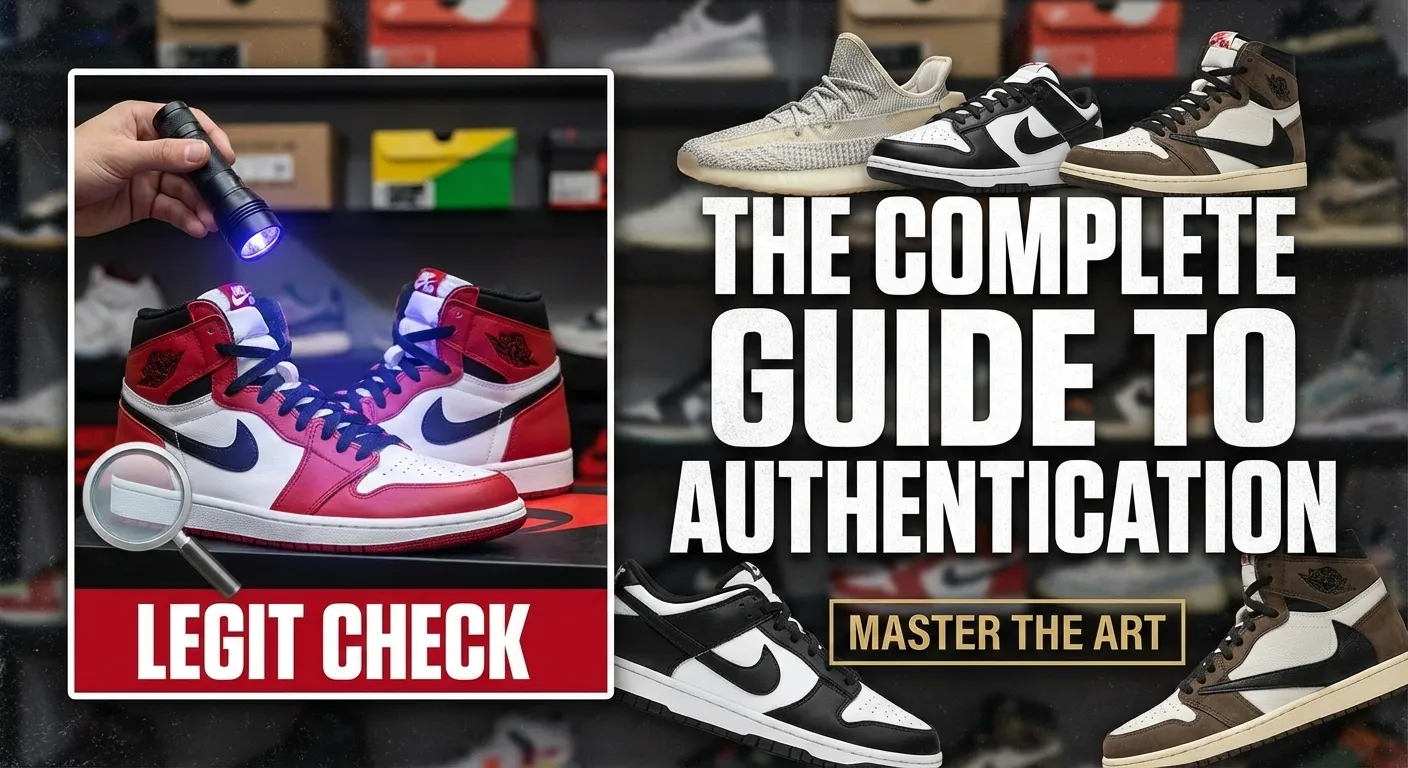
- New Balance: Blacklight examination reveals different stitching reactions, with counterfeits showing characteristic dotted lines. Authentic versions show white stitching and laces under infrared, while counterfeits display both elements in black. Logo comparison on New Balance fakes reveals a slightly elongated "N," and the two-tier eyelet system shows differences in internal corner shapes. Authentic versions feature rounded inner corners, while counterfeits display angular corners. A UV flashlight costs less than $10 and is one of the highest-return tools you can own.
Packaging and Accessories
Serious replica operations now pack extra laces, inserts, and tissue paper. But the details still trip them up. Authentic tissue paper from Nike and Jordan Brand is either fully unbranded or carries a subtle pattern that is consistent across the box. Replica tissue often has off-register printing or a slightly different weight. The extra lace bag should be heat-sealed uniformly. On premium New Balance releases, the hang tag string should be woven, not a simple twist-tie substitute. Smell the box: genuine factory-fresh sneakers have a rubber and adhesive scent that is noticeably different from the sharper chemical smell that many replica factories produce.
Digital Legit-Checks and Seller Signals
Before any transaction, run the seller's account through reverse-image search on their listing photos. If those images appear across multiple accounts or on replica forums, walk away. Check marketplace feedback specifically for mentions of "not as described" or "replica" rather than just looking at star ratings. Sellers who refuse additional photos, who can't provide box shots with the label visible, or who push urgency without reason are exhibiting a consistent pattern across fraudulent accounts.
Professional authentication apps utilize machine learning algorithms trained on thousands of authentic sneaker images to identify counterfeit products. These services typically require multiple high-resolution photos showing specific angles and details for accurate analysis. For free first-pass checks, the Legit Check By Ch community on Discord provides fast turnaround on Jordan and Nike models. LegitApp is listed by Whatnot in its Counterfeit and Restricted Branded Items Policy as a recommended third-party authentication service, underscoring its trusted expertise in providing professional, verifiable authenticity for secondhand transactions.
When to Pay for Authentication
For any pair over $300, the math on paid authentication is straightforward. SNKRDUNK achieves 99.96% authentication accuracy, calculated from transactions between November 2023 and October 2024. GOAT's Assurance of Authenticity covers buyers if a pair passes their inspection and later proves fake, making it one of the stronger buyer protections in the resale market. For in-person buys, services like Entrupy, which StockX itself references in its brand protection infrastructure, offer AI-powered physical inspection that can catch fakes a visual check might miss.
Meeting a Seller in Person
Meet in a public place with good lighting, ideally during daytime. Bring a UV flashlight and a phone charged to run real-time comparisons against authenticated reference photos. Inspect the actual pair before handing over any payment. Never accept a seller's offer to "go get the box from the car." If the box isn't part of the initial meeting, the box doesn't exist.
The counterfeit market in 2026 is better funded, better equipped, and more technically sophisticated than it has ever been. The checks that still work aren't the ones that look for obvious errors. They are the ones that go deep into material consistency, silhouette geometry, and seller behavior, because that's the level the fakes have reached. The good news is that so has the toolkit available to buyers who know where to look.
This article was produced by Prism’s automated news system from verified source data, official records, and press releases, then run through automated quality and moderation checks before publishing. The system is built and supervised by the people who set the standards it runs under. Read our full AI policy.
Did this article answer your question?