Menswear's New Power Piece Is Pants, and They're Going Wide
The sharpest menswear signal right now is the trouser leg: wider, softer, stranger, and far more revealing than another sneaker drop.
The trouser is back at the center of the outfit
Christophe Lemaire has long treated trousers as the quiet centerpiece of a wardrobe, and that instinct suddenly feels like the sharpest read in menswear. At Lemaire, the pant is not a supporting actor to the jacket or the sneaker, but the piece that changes the whole temperature of a look. The house’s men’s line moves from twisted and workwear-inspired constructions to tailored, wide-leg, straight, pyjama, parachute, and shorts shapes, which tells you everything about where taste is heading: away from default basics and toward silhouette as signal.
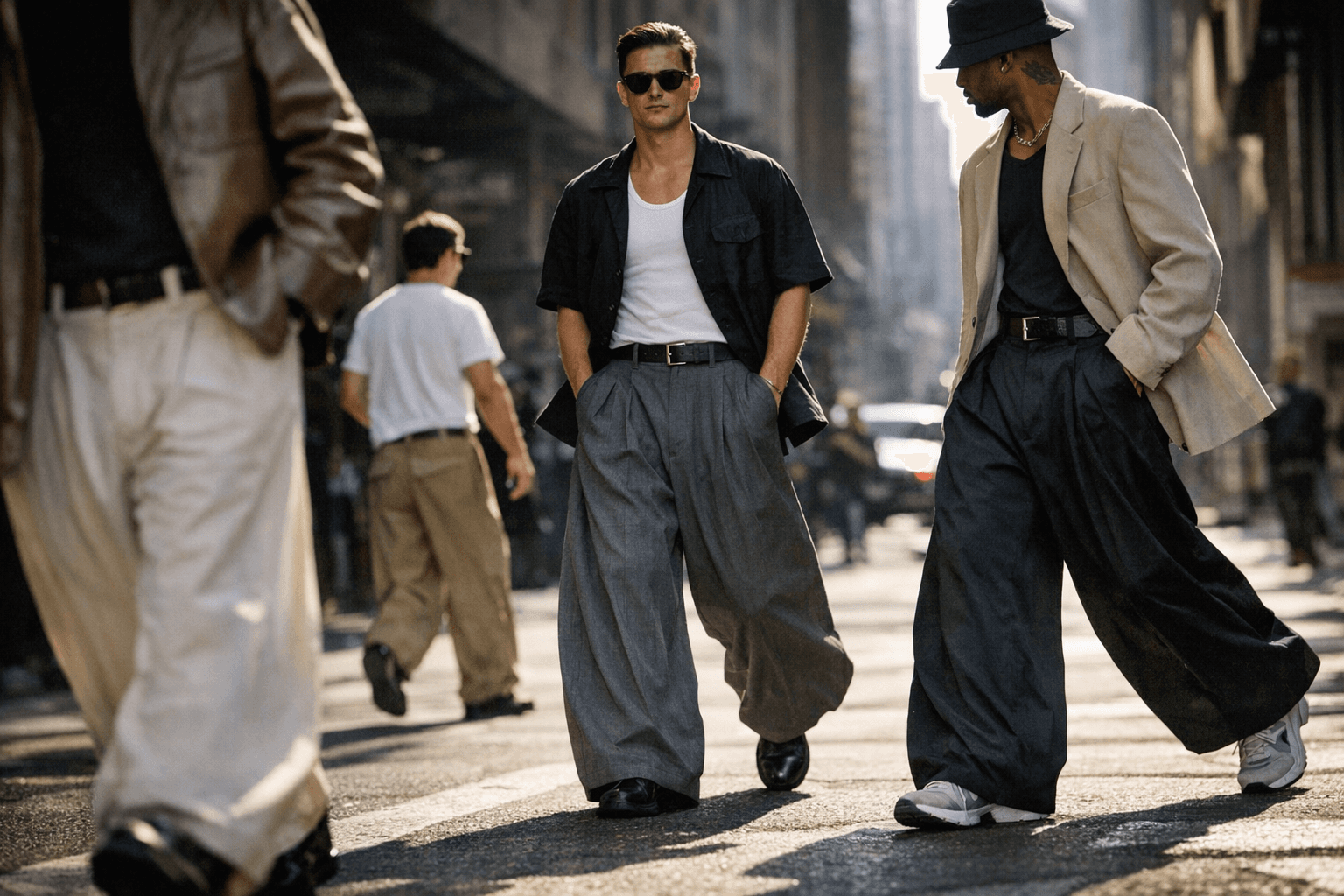
The strongest argument for this shift is simple. The quickest way to read whether a man understands clothes right now is often not his shoes or his coat, but the volume, drape, and posture of his trousers. Highsnobiety put the point plainly in its Pants Issue, framing the style du jour around how big the pants are. That may sound reductive, but it captures a real change in menswear language: skinny jeans never made the comeback people were warned about, and the ultra-baggy extreme has already started to recede. What remains is more interesting, a middle ground of controlled width, sculptural shape, and a little tension around the leg.
Why Lemaire keeps showing up in the conversation
Lemaire is one of the clearest references for this new proportion because the house builds its identity around trousers with actual architectural intent. Its Twisted Workwear Pants are treated as wardrobe classics for a reason: the twisted seams create a rounded shape through the leg, and in denim the result is a slightly curved volume that keeps the tapered line from feeling ordinary. The Twisted Belted Pants work in the same spirit, using shape rather than decoration to make the silhouette feel considered.
That subtle curve is exactly why Lemaire’s pants do not read like a costume or a nostalgia exercise. Heavy denim and heavy broken twill give the leg weight, so the volume hangs instead of flaring theatrically. The effect is disciplined, almost calm, which is what separates these trousers from trendier wide-leg experiments that can tip into parody the moment they are paired with the wrong top or shoe.
The house’s own history reinforces that point. Christophe Lemaire founded the label in 1991, has focused exclusively on Lemaire since 2014, and has worked with Sarah-Linh Tran, who co-directs the house and has helped shape its more relaxed but exacting tone since 2010. That continuity matters because this is not a brand chasing a trend from the outside. It has been refining the same idea for years: clothes should move with the body, but they should also change its outline.
The wider menswear shift is not a one-season blip
What makes the current trouser turn feel durable is that it keeps appearing across runway coverage in different cities and different seasons. WWD identified baggy pants as a top men’s trend for Fall 2024, billowy pants among the top men’s trends for Spring 2024, and high-waisted men’s pants as a shape poised for that same season. By the time Paris Spring 2025 rolled around, relaxed suiting had become a key theme, and Craig Green’s Spring 2025 collection updated wide-leg trousers as one of its signature staples.
That recurring pattern matters more than any single catwalk image. It suggests that the wider leg is not just a subcultural flourish or a nostalgic nod to one decade. It has become part of the mainstream menswear vocabulary, and the conversation has moved from whether pants should be wider to how much volume is enough, where it should sit on the waist, and what kind of break feels modern. In other words, the debate is now about proportion, not permission.
What these shapes communicate now
Wider and more sculptural trousers carry a different social message than the skinny jean era ever did. They suggest ease without sloppiness, knowledge without loud branding, and confidence without the need to perform it through a logo or a hype sneaker. A well-cut wide leg can look expensive because it implies someone cared about cloth, drape, and fit before thinking about novelty.
The pant is also becoming the most legible marker of taste because it is harder to fake. A good jacket can be borrowed from tailoring, a good sneaker can be bought into fashion, and outerwear can do a lot of the talking on its own. Trousers, especially ones with width or a sculptural seam, reveal whether an outfit is built with real proportion in mind. They show whether the wearer understands where volume should start, where it should fall, and how to stop the whole look from collapsing.
How to wear wider trousers without looking theatrical
The easiest way to keep the silhouette modern is to treat the trouser as the hero and make everything else cleaner, sharper, and less verbose. Wider legs work best when the top half is disciplined, so think cropped leather jackets, compact knit polos, slim but not tight shirts, and soft tailoring that does not fight the pant. If the trouser has a twist seam, a curved leg, or a parachute-like ease, the rest of the outfit should let that shape breathe.
A few rules keep the result from drifting into costume territory:
- Choose weighty fabrics, such as dense denim, twill, or tailoring cloth with body. Thin fabric can make a wide silhouette look accidental.
- Mind the rise. High-waisted pants, which WWD flagged as part of the shift, elongate the leg and help wider volumes look intentional.
- Keep the break controlled. A trouser that puddles too much can veer into nostalgia; one that skims the shoe feels more current.
- Balance volume with restraint elsewhere. If the pants are billowy, the shirt should not be billowy too.
- Let the shoe serve the line of the leg. Clean loafers, pared-back derbies, or slim sneakers usually work better than bulky runners when the trouser already carries a lot of shape.
The real trick is to make the pant look like part of your wardrobe grammar, not a seasonal stunt. That is where Lemaire’s twisted constructions are so useful as a reference point: they do not shout, they bend the eye. The curvature is just enough to signal that the wearer understands proportion, but not so much that the garment becomes a joke.
A sign of a more mature streetwear market
The rise of pants as the new menswear power piece also says something broader about streetwear itself. When The Business of Fashion reported Human Made’s shares beginning to trade in Tokyo on 27 November 2025, it marked a striking milestone: streetwear had become a serious market category, mature enough to move into public markets. Yet even as the business side gets more institutional, the style side remains driven by the smallest, most personal choices. The shape of a pant leg still tells you more about a man’s eye than almost anything else in his closet.
That is what makes this moment feel compelling rather than merely trendy. Menswear is no longer asking you to choose between tailoring and streetwear, or between fitted and oversized. It is asking you to think harder about proportion, volume, and the emotional effect of cloth in motion. And right now, the trouser is where all of that is happening.
Know something we missed? Have a correction or additional information?
Submit a Tip