San Francisco's Oldest Screen-Printing Shop Rises From Fire, Marks Decades of Street Culture
After a 2022 fire gutted its archives, SF's oldest screen-printing shop is back — and Babylon Burning's decades of street culture history refuse to stay ash.
Screen printing is not a glamorous trade. It smells of ink and solvent, demands physical precision, and leaves its practitioners perpetually stained. But in San Francisco, where the creative underground has always found ways to survive gentrification, tech booms, and now literal fire, Babylon Burning has done something quietly extraordinary: it has outlasted nearly everything. The city's oldest screen-printing shop, run by owner Mike Lynch, is not just a business. It is a living archive of street culture, band merch, protest graphics, and neighborhood identity — the kind of place where the walls themselves tell you something true about a city.
A Shop Built on Decades of Street Culture
Babylon Burning's longevity in San Francisco is remarkable on its own terms. The city's independent retail landscape has been hollowed out by successive waves of economic pressure, and small manufacturing operations — the kind that require space, equipment, and foot traffic from artists and musicians — have been among the first casualties. That Babylon Burning has held on, decade after decade, speaks to both Lynch's tenacity and the particular role screen printing occupies in street and subcultural fashion.
Screen printing is the medium through which streetwear became streetwear. Before the glossy collaborations and the sneaker drops and the luxury co-signs, there were T-shirts pulled through a squeegee one at a time, in shops exactly like this one. Every major wave of street culture — punk, hip-hop, skateboarding, the DIY zine era, early sneaker culture — ran through the screen-printing shop before it hit the street. Babylon Burning existed at that intersection for San Francisco's creative communities, producing the kind of work that doesn't always end up in museum retrospectives but absolutely shaped how subcultures looked and felt.
The 2022 Fire: When the Archive Burns
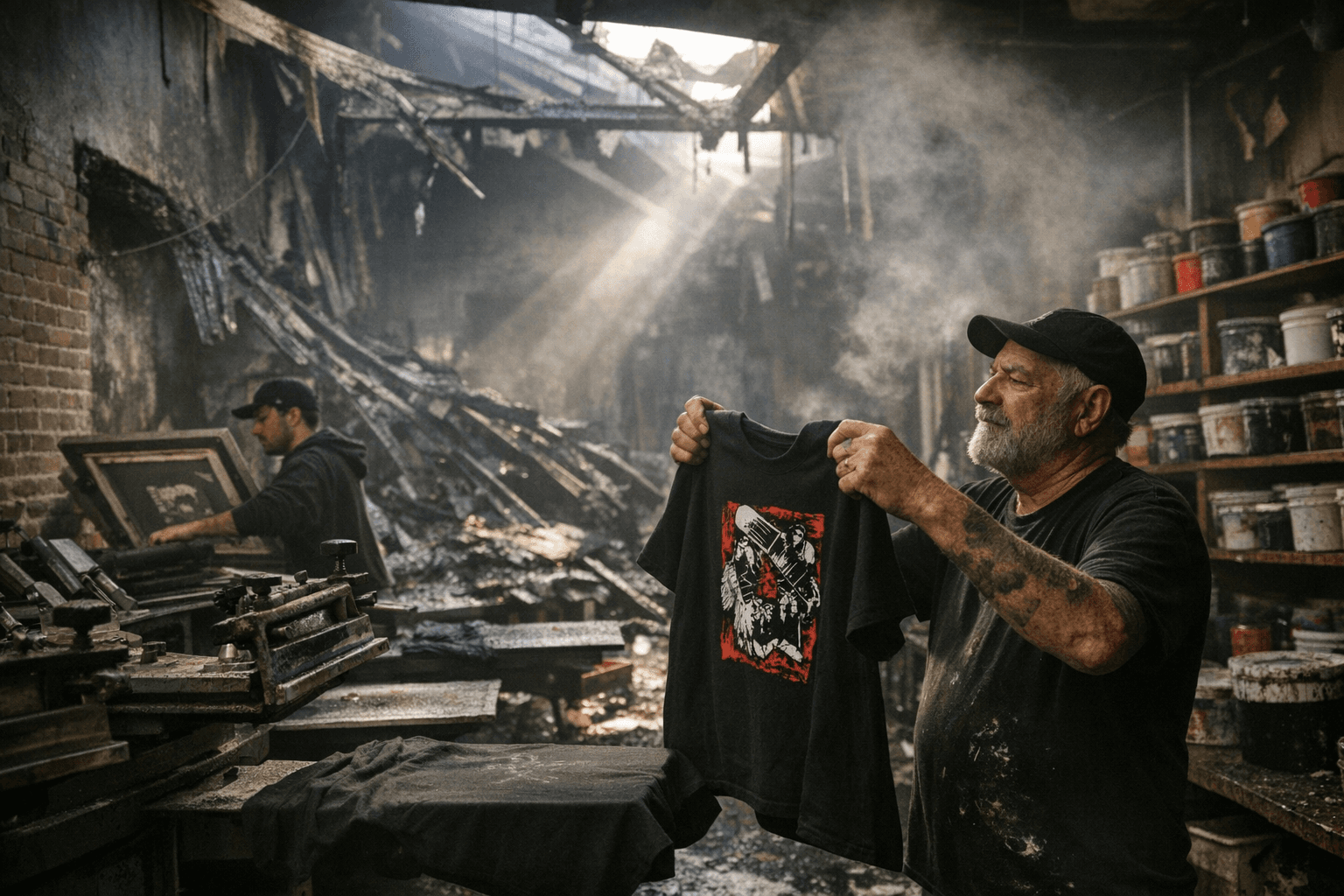
The 2022 fire that tore through Babylon Burning was not just a business setback. It was a cultural loss of a particular and painful kind. Archives and equipment were destroyed, which in a screen-printing context means decades of films, screens, original artwork, and the physical tools through which that work was produced. Unlike a digital studio, where backups might survive a disaster, a screen-printing shop's archive is largely analog: physical screens, hand-separated color layers, original films held up to light. When those burn, they do not exist anywhere else.
For Lynch, rebuilding after the fire meant starting over not just operationally but historically. The institutional memory of Babylon Burning — the record of who walked in the door, what they needed printed, what San Francisco looked like in a given decade through the lens of its graphic output — was substantially erased. That kind of loss sits differently than losing equipment. Equipment can be replaced with capital. The work that was made here, the designs that passed through these hands, cannot be reconstructed from an insurance payout.
Mike Lynch and the Craft of Survival
What the profile of Lynch reveals is the particular psychology required to run a business like this in a city like San Francisco. Screen printing is not a high-margin enterprise. It rewards volume, consistency, and relationship-building over decades. Lynch has been that kind of operator: rooted, reliable, known to the communities he serves. In a city that cycles through trends and tastemakers at a dizzying rate, that kind of steady presence becomes its own form of cultural authority.
Rebuilding after a catastrophic fire, in a commercial landscape that was already difficult before the blaze, requires a specific combination of stubbornness and optimism. Lynch's decision to continue — to source new equipment, to rebuild the shop's capacity, to keep Babylon Burning operating as San Francisco's oldest screen-printing institution — is a statement about what he believes the shop is for. It is not simply a service business. It is a commitment to a particular kind of making, and to the communities that depend on it.
Screen Printing and the DNA of Streetwear
It is worth pausing on what screen printing actually contributes to the aesthetic language of streetwear, because the craft is often invisible in the final product. A clean, plastisol-printed graphic on a heavyweight cotton tee looks effortless. What it represents, technically, is a process involving film positives, light-sensitive emulsion, a flash cure unit, and the kind of color registration that only comes with practice. The tactile quality of a properly screen-printed shirt — the slight raise of the ink, the way it sits on the fabric rather than soaking into it — is distinct from digital heat transfer and distinguishes the genuine article from its cheaper substitutes.
Shops like Babylon Burning are where that knowledge lives. They are the reason certain garments feel right in a way that is hard to articulate but immediately recognizable. When streetwear brands, particularly independent ones, talk about authenticity, they are often talking, in part, about process: about the fact that the work was made with skill, by human hands, in a real place. Babylon Burning is one of those real places.
San Francisco's Streetwear Underground
San Francisco's contribution to street culture is frequently underwritten in the dominant narrative, which tends to route the genre's history through New York and Los Angeles. But the Bay Area has its own lineage: the skateboarding culture of the 1980s and 1990s, the intersection of hip-hop and tech in the early 2000s, the long tradition of protest graphics and political print culture that runs through the city's labor and activist history. Babylon Burning has existed across all of those chapters, producing work that reflects the city's particular sensibility: irreverent, politically aware, and deeply local.
A shop that has survived for decades in San Francisco has seen the city transform around it in dramatic ways. The neighborhoods that once housed its core clientele have changed. The economics of running a small manufacturing operation in one of the most expensive cities in the world have grown steadily more hostile. And yet the shop persists, which is itself a kind of editorial statement about what endures when everything else is in flux.
After the Fire, What Remains
Recovery from the 2022 fire is not a resolved story; it is an ongoing one. Rebuilding physical infrastructure is one dimension of that work, but the longer project is restoring Babylon Burning's role as a connective tissue in San Francisco's creative community. Decades of relationships, of trust built through reliable work and shared history, cannot be replaced on a timeline. They accumulate slowly, and they matter in ways that are difficult to quantify.
What the shop's survival signals, ultimately, is that there remains an appetite in San Francisco for the kind of craft and community it represents. The city's identity has been contested and negotiated for decades, and the places that hold its subcultural memory are increasingly rare. Babylon Burning, marked by fire and still standing, is one of the few that can claim an unbroken thread from the street culture of past decades to whatever the city is becoming now.
This article was produced by Prism’s automated news system from verified source data, official records, and press releases, then run through automated quality and moderation checks before publishing. The system is built and supervised by the people who set the standards it runs under. Read our full AI policy.
Did this article answer your question?