Tyshawn Jones Steps Into His Superstar Era With Adidas Originals
Tyshawn Jones brings his downtown New York swagger to adidas Originals' wildest campaign yet, checking into Hotel Superstar alongside Samuel L. Jackson, JENNIE, and Kendall Jenner.
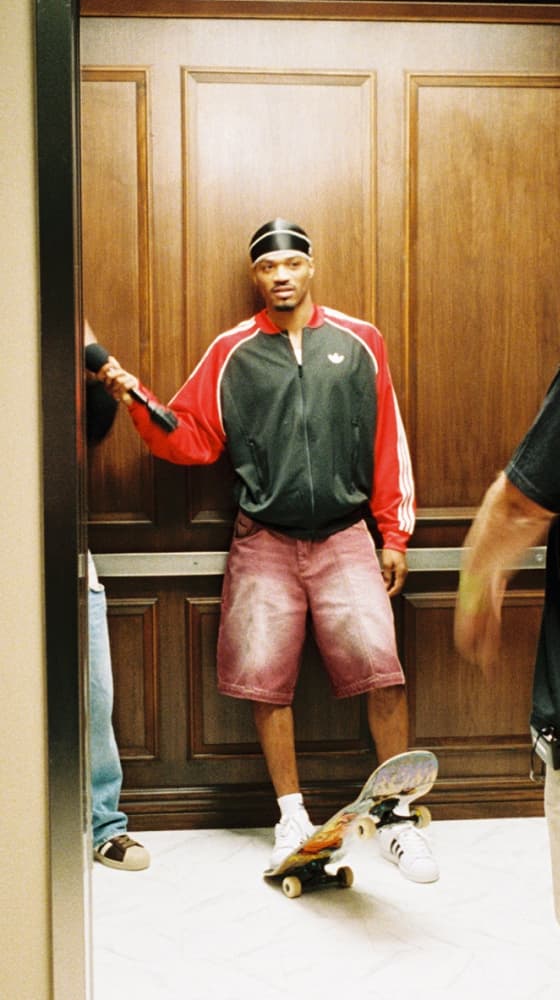
Somewhere in the surreal halls of Hotel Superstar, Samuel L. Jackson is working the concierge desk. Baby Keem hums through the speakers. And Tyshawn Jones, the 27-year-old New York native who has spent his career turning downtown sidewalks into his personal stage, is exactly where he belongs: kicking back with a game controller in hand and Starbursts nearby.
This is adidas Originals' new Superstar campaign, and it is as maximalist and self-assured as its cast. Jones joins JENNIE, Olivia Dean, and Kendall Jenner in a time-warped fantasia where, as Interview Magazine put it, "icons overlap and style is currency." The setting is fictional but the energy is unmistakably real: a hotel where culture's coolest converge, presided over by one of Hollywood's most commanding presences, soundtracked by one of rap's most distinctive voices.
A Skater Who Was Always a Star
Jones's credentials in the skate world are formidable. A two-time Thrasher Skater of the Year, he has built a reputation not just on technical brilliance but on a kind of effortless cool that translates far beyond the skatepark. Thrasher's Skater of the Year is the sport's most coveted recognition, and claiming it twice places Jones in rare company. That legacy, earned on the streets of New York, is precisely what makes his presence in a campaign of this scale feel organic rather than opportunistic.
The sweatsuit, which appears as both a visual anchor and a kind of shorthand for Jones's aesthetic in the Interview Magazine feature, says everything about how he operates. There is nothing studied or performative about his style. It is downtown New York distilled: practical, sharp, and entirely his own.
The Hotel Superstar Universe
The campaign's conceit, a surreal hotel populated by cultural icons, is the kind of creative swing that only works when the casting is right. Here, it is. Samuel L. Jackson as concierge is inspired: authoritative, charismatic, and just unpredictable enough to anchor a fantasia. His presence gives the spot a cinematic weight that elevates everyone around him.
The co-stars each bring their own distinct cultural register. JENNIE arrives with the global pop currency she has built across K-pop and solo work. Olivia Dean brings a soulful, distinctly British artistry. Kendall Jenner brings the kind of ubiquitous, high-fashion visibility that has defined the past decade of campaign casting. Placed alongside Jones, the lineup reads as a deliberate argument: that the Superstar shoe belongs to everyone who moves culture forward, regardless of lane.
Baby Keem's audio presence, humming through the speakers of Hotel Superstar, reinforces the point. His inclusion is not incidental. It connects the campaign's visual world to a specific moment in contemporary music, one that shares Jones's own sensibility: raw talent, New York proximity, and a refusal to be boxed in.

Authenticity as a Style Credo
When Interview Magazine asked Jones what never goes out of style, he did not hesitate. "Authenticity," he said. It is the kind of answer that could sound like a talking point from anyone else, but from Jones, it carries weight. His entire trajectory has been built on it. He did not arrive at the adidas campaign by reinventing himself for a mainstream audience; he arrived by being so thoroughly himself that the mainstream came to him.
That distinction matters in streetwear, where the line between genuine influence and calculated brand positioning can be razor-thin. Jones has always sat clearly on the right side of it. His style, his skating, his public persona all read as extensions of the same downtown New York sensibility, one that predates any campaign and will outlast it.
Why This Campaign Lands
The adidas Superstar has its own formidable history, decades of cultural resonance that spans hip-hop, basketball, skate, and high fashion. Campaigns of this scale carry the risk of diluting that heritage by chasing relevance too broadly. The Hotel Superstar spot sidesteps that trap by leaning into the surreal rather than the literal. It does not try to tell you what the Superstar means; it simply places the people who embody it in a room together and lets the chemistry do the work.
Jones, in that context, is not a supporting player. He is the gravitational center of his own story within the larger campaign. The controller in his hand, the Starbursts on the table beside him, the sweatsuit doing exactly what a sweatsuit should do: these are not styling choices imposed from outside. They are the visual vocabulary of someone completely at ease with who he is.
Interview Magazine's Olamide Oyenusi framed it precisely: Jones looks right at home in this time-warped fantasia. For someone who has spent years making the impossible look casual on a board, that comfort in an entirely different kind of spotlight is perhaps the least surprising thing about him. The Superstar era, it turns out, was always the next logical step.
This article was produced by Prism’s automated news system from verified source data, official records, and press releases, then run through automated quality and moderation checks before publishing. The system is built and supervised by the people who set the standards it runs under. Read our full AI policy.
Did this article answer your question?