AI and Real-Time Intelligence Are Reshaping Apparel Supply Chains for Workwear Brands
Real-time AI is rewriting how workwear brands source and protect margins, and the brands still running on seasonal gut instinct are already behind.
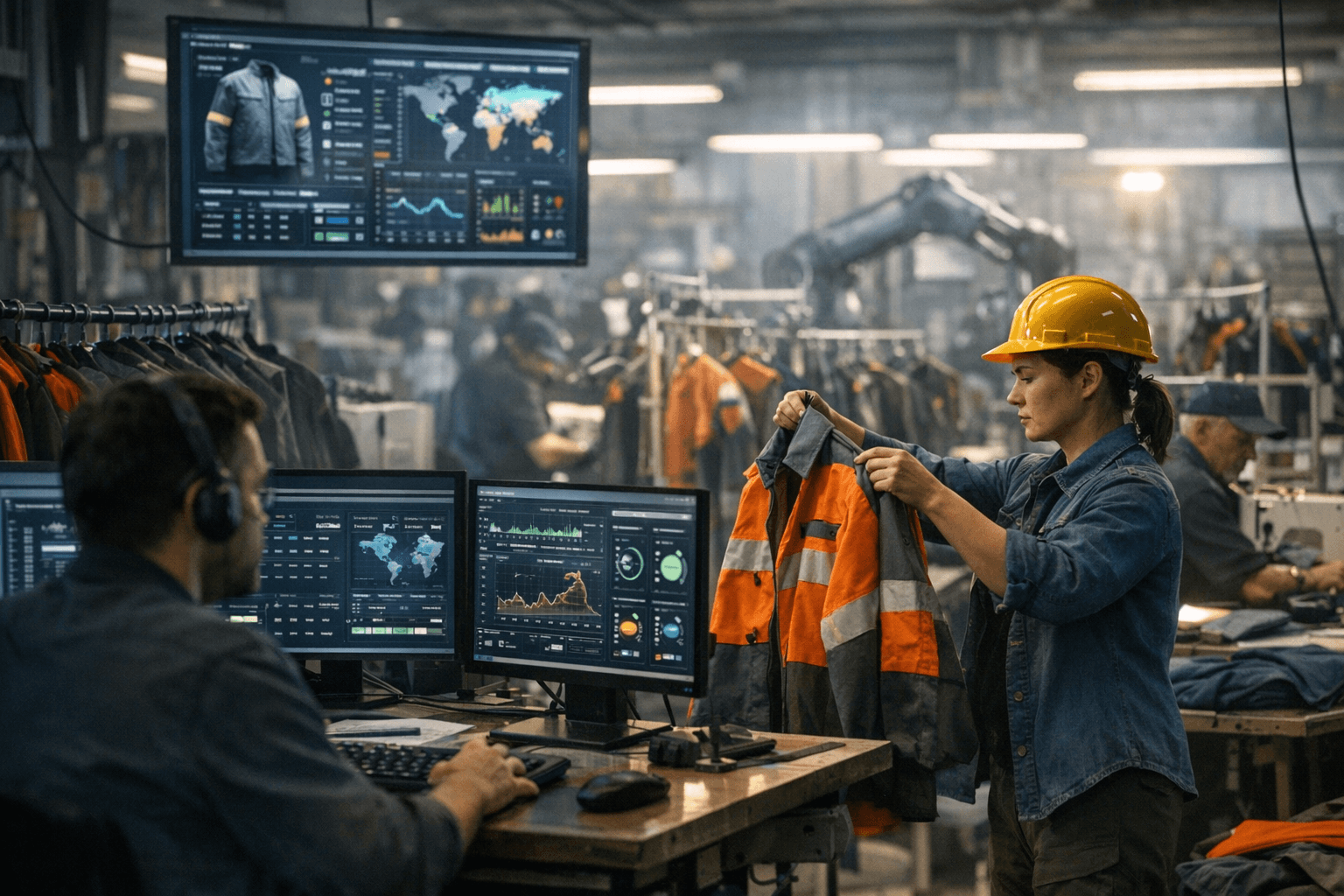
The workwear category has always lived and died by reliability. A blazer that doesn't arrive on time for a September floor reset, a trouser fabrication that shifts mid-run because a vendor substituted cloth without flagging it: these are not aesthetic failures, they are commercial ones. Which is why a recent analysis from Sourcing Journal lands with particular weight for anyone building or buying workwear at scale. The argument is direct: in-season, real-time intelligence and AI-enabled supply chain orchestration are no longer aspirational infrastructure. They are the operational baseline that margin-conscious, dependability-driven categories like workwear now require.
Why Workwear Brands Face Distinct Supply Chain Pressure
Most fashion categories can absorb a degree of sourcing volatility. A resort collection that runs late can be positioned as a mid-season drop. A color that shifts two tones in production can be re-photographed and resold as a "new shade." Workwear brands have almost none of that flexibility. The category is built on consistency: the navy that matches last quarter's trousers, the stretch fabric that performs identically across a full size run, the unit economics that justify corporate uniform contracts or wholesale minimums. Sourcing disruption hits workwear margins directly and immediately, with little room to reframe the damage editorially.
The Sourcing Journal analysis identifies this as precisely why real-time intelligence has moved from a supply chain luxury to a category necessity for workwear. When brands can see in-season signals, fabric availability shifts, factory capacity changes, and freight cost fluctuations as they happen rather than weeks after the fact, they can make decisions that protect both the product and the bottom line before either is compromised.
The Case for AI-Enabled Orchestration
The phrase "AI-enabled orchestration" risks sounding abstract, but its practical application in apparel sourcing is concrete. Traditional supply chain management in fashion has operated on a lag: brands make seasonal buys based on historical data, place orders months in advance, and then absorb whatever disruptions emerge between purchase order and delivery. That model assumes a stability that global supply chains no longer reliably provide.
AI-enabled orchestration replaces that lag with responsiveness. Systems that ingest real-time data across a brand's supplier network can identify a fabric shortage at a Tier 2 mill before it becomes a production stoppage at a Tier 1 factory. They can model the downstream cost of a delayed shipment against the cost of expedited freight and surface a recommendation before a human buyer even knows there is a decision to make. For workwear brands managing tight seasonal calendars and contractual delivery commitments, that responsiveness is not a competitive advantage in the luxury sense; it is operational survival.
Busting Cross-Functional Silos
One of the sharper arguments in the Sourcing Journal piece is that technology alone does not complete the transformation. Brands must also dismantle the cross-functional silos that have historically separated design, merchandising, sourcing, and logistics into sequential rather than simultaneous conversations. In most apparel businesses, a designer specifies a fabric, a merchandiser sets a retail price, and a sourcing team then attempts to reconcile both against what factories can actually produce at a viable cost. That linear handoff is too slow for a real-time intelligence environment.
The implication for workwear brands specifically is significant. Because workwear collections tend to be tighter in SKU count and heavier in volume per style than fashion-forward categories, a miscommunication between a fabric specification and a sourcing reality does not affect one hero piece; it affects thousands of units. Cross-functional integration, supported by AI systems that give every team member access to the same live data, compresses the decision cycle and reduces the margin erosion that comes from late-stage problem-solving.
What Real-Time Intelligence Actually Looks Like in Practice
For a workwear brand operating at meaningful scale, real-time supply chain intelligence might surface in several distinct ways:
- Fabric availability dashboards that update as mills report capacity, allowing sourcing teams to identify substitution risks before they become production holds
- Dynamic costing models that adjust landed cost projections as freight rates shift, giving merchandising teams an accurate margin picture throughout the season rather than only at the point of order placement
- Factory performance tracking that flags quality or delivery deviations early, enabling brands to redirect production or increase inspection frequency before a shipment is compromised
- Demand signal integration that connects sell-through data from retail partners directly to sourcing decisions, allowing brands to chase into high-performing styles or pull back on underperformers before commitments become sunk costs
Each of these capabilities represents a departure from the seasonal snapshot model that most apparel brands still operate on. For workwear, where the customer relationship depends on predictability and where the product's performance is often literally tested in professional environments, the stakes of sourcing accuracy are higher than in most adjacent categories.
The Margin Protection Argument
There is a straightforward financial logic underlying all of this. Workwear brands that compete on dependability rather than on trend premium often work with thinner margins than luxury or premium fashion. A disruption that adds three weeks to a delivery timeline can trigger wholesale penalty clauses. A fabric substitution that a retailer rejects means a return-to-vendor situation that can erase the profitability of an entire style. The Sourcing Journal analysis frames real-time intelligence investment as a margin protection mechanism, not just an operational upgrade.
That framing matters for how workwear brands should think about the business case for AI infrastructure. The question is not whether the technology is interesting; it is whether the cost of the technology is lower than the cost of the disruptions it prevents. For brands with significant volume and contractual delivery obligations, the math is increasingly clear.
What Comes Next
The workwear category is not known for being an early technology adopter. Its strength has historically been operational steadiness rather than innovation velocity. But the supply chain environment that steadiness was built for, predictable lead times, stable freight, reliable mill relationships, has changed materially in the years since 2020, and it has not returned to its prior state.
Brands that continue to manage sourcing on seasonal lag while their supply chains operate in real time are accepting a structural disadvantage. The intelligence exists to close that gap. The organizational will to integrate it across functions, rather than deploying it as a siloed IT solution, is the harder and more consequential challenge. For workwear brands that have staked their reputation on consistency, getting that integration right is not a future priority. It is a present one.
This article was produced by Prism’s automated news system from verified source data, official records, and press releases, then run through automated quality and moderation checks before publishing. The system is built and supervised by the people who set the standards it runs under. Read our full AI policy.
Did this article answer your question?