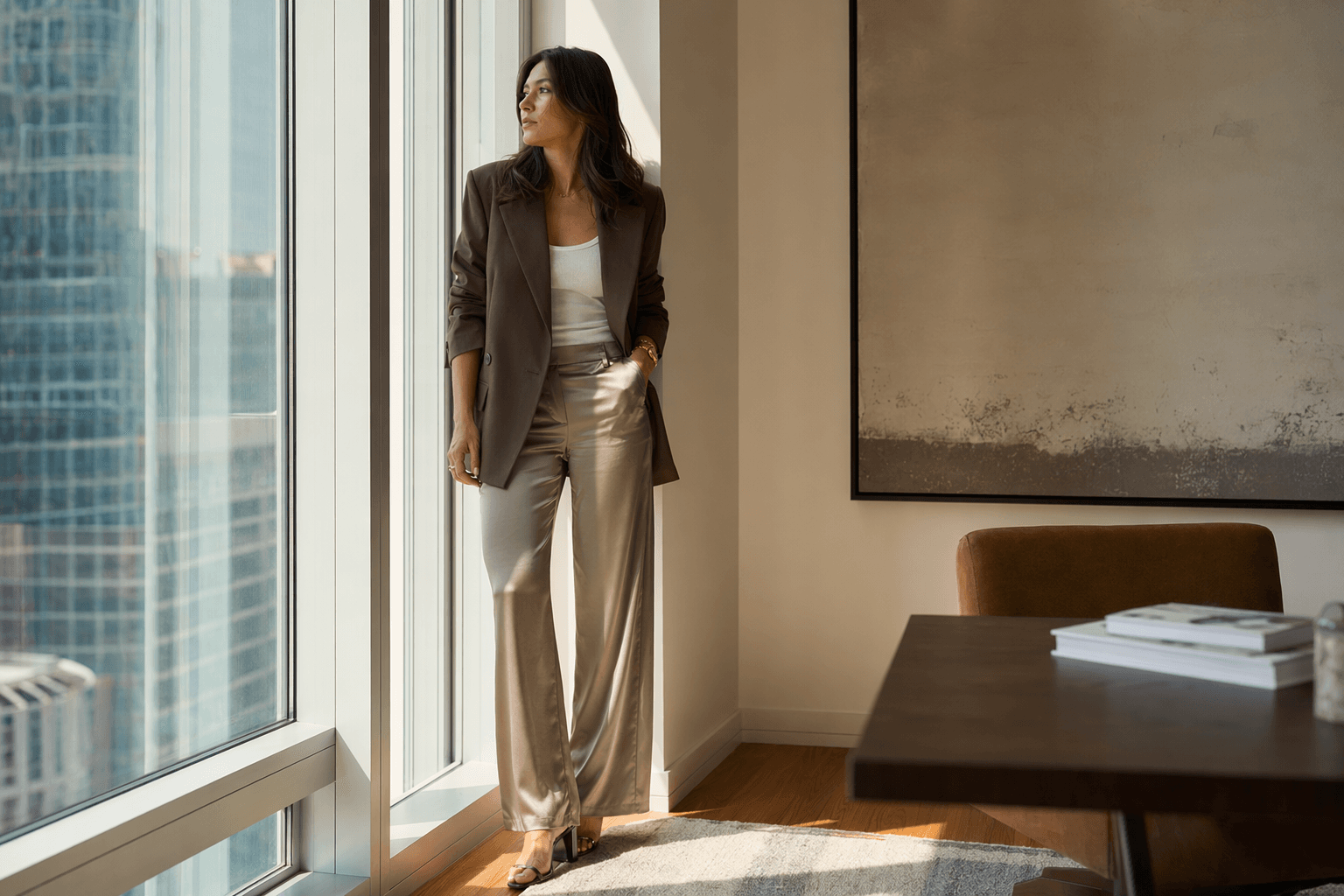
Dresses over pants return, offering polished summer office coverage
Dresses over pants are back in a sharper, office-ready register, with longer hems, slouchier trousers, and breathable fabrics doing the heavy lifting.
Why this silhouette feels right again
Dresses over pants are back, but not in the precious, try-hard way that makes you think of fashion people dressing for attention. The strongest version right now is a workwear answer: more coverage than a suit separates look, more personality than a shirtdress, and a lot less boring than another blazer.
The Strategist’s summer take on the silhouette lands on that exact sweet spot with Eileen Fisher, With Nothing Underneath, and Toast, three labels that already know how to make clothes feel lived-in enough for a desk and clean enough for a meeting. That matters. This is not about costume layering. It is about giving a professional wardrobe a new shape when standard separates have started to feel stale.
This is a silhouette with receipts
If the look suddenly feels current, that is because it has been building toward this moment for decades. Refinery29 traces the idea back to the mid-19th century, when Amelia Jenks Bloomer and Elizabeth Cady Stanton wore bloomer pants under calf-length dresses as part of the early Suffrage Movement. Back then, the point was defiance. Today, the point is control over proportion, coverage, and ease. The spirit is different, but the message still reads loud: this is a woman dressing on her own terms.
The modern comeback has its own pop-culture spark. Katie Holmes wore a Tove dress over jeans at the 2022 iHeartRadio Jingle Ball Awards, took a wave of backlash, and still kept the idea alive. She later told Drew Barrymore that she felt cool in the outfit, which is exactly the right attitude for a look that works best when it looks chosen, not apologized for. That cultural memory matters because the trend is not just a runway trick anymore. It has been tested in public and survived.
What changed from the early-2000s version
The dresses-over-pants look of now is more streamlined, more tailored, and far less awkward than the early-2000s take. Refinery29’s read is right: the newest versions lean minimalist and wearable, which is why they feel believable for office hours instead of after-hours editorial fantasy.
That shift shows up everywhere on the runway. The Row paired slouchy pants with lacy dresses in its pre-spring 2025 collection, a combination that works because the trousers are relaxed enough to keep the dress from looking overworked. Hermès and Rokh pushed similar ideas in Paris, while Boss’s spring/summer 2025 show went straight for office relevance with draped gowns over slacks and mini-skirts worn over trousers. Proenza Schouler and Louis Vuitton also sat inside the same conversation, and Copenhagen Fashion Week leaned into the layered idea too. The common thread is length, looseness, and a sense of motion. Nobody is forcing skinny pants under a frothy dress and calling it fashion.
How to make it credible at work
The easiest way to kill this look is to make it too cute. The best way to make it feel sharp is to treat it like architecture: the dress should create a line, and the pants should stabilize it. That means longer hemlines, relaxed trousers, and fabrics that have enough substance to hold their own.
A few rules make all the difference:
- Choose wide-leg or cropped trousers rather than tapered or skinny cuts. The broader leg keeps the layering intentional and avoids a pinched, dated shape.
- Let the dress hit long enough to register as a real outer layer. The current runway mood favors longer hemlines and matching layers, not a flippy top that looks borrowed from a bridal party.
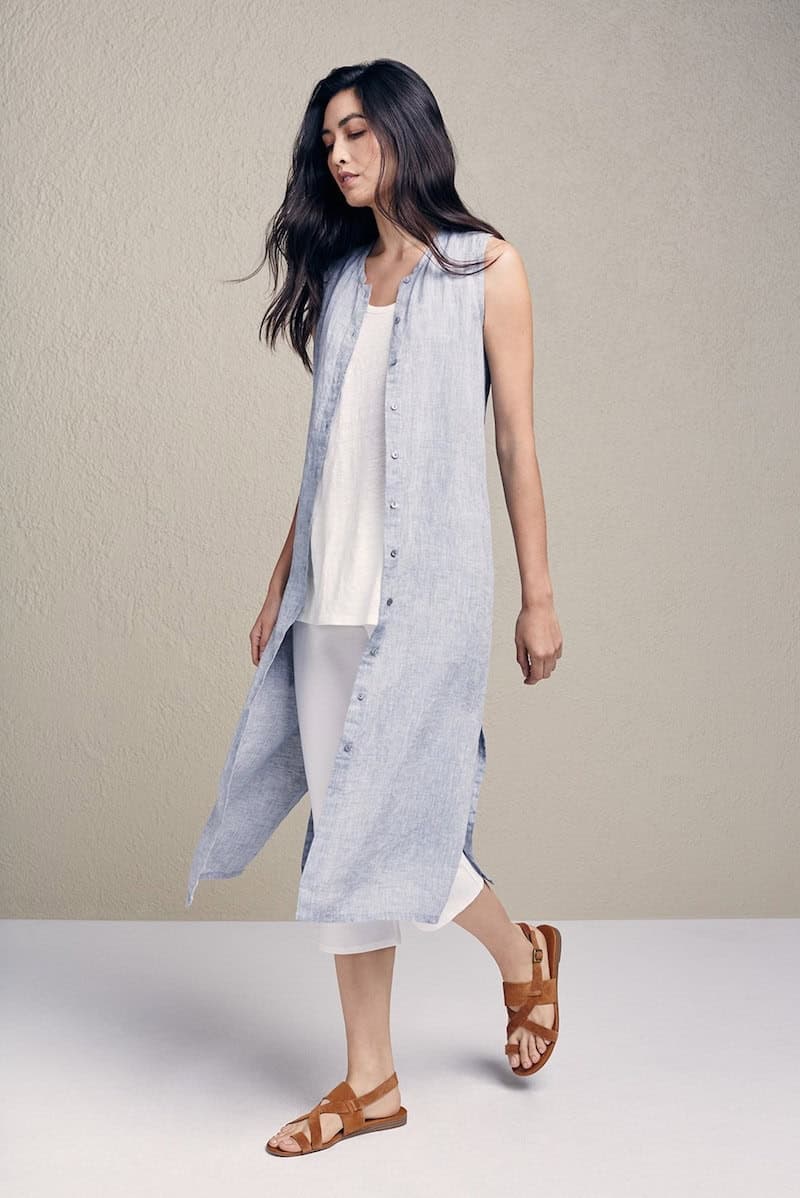
- Keep the fabric conversation smart. Linen over linen can look crisp if the weights are different. A structured dress over fluid pants can look deliberate. A dress that is too delicate over a stiff trouser can go costume fast.
- Favor dress shapes with some structure: draped gowns, clean midi lengths, and simple, architectural silhouettes read polished. Anything too ruffled or too party-dress can tip the whole thing into performance.
The most convincing office versions are the ones that look like they could have been worn all day without a costume change. That is the real appeal here. You get coverage for hot weather, visual interest for a professional setting, and a silhouette that feels considered without sliding into suit territory.
The brands getting the fabric story right
The clothes themselves matter as much as the styling. Eileen Fisher’s linen pants are described as lightweight, breathable, and made with organic fiber for warm-weather days, which makes them a strong base for anyone who wants the look to work in heat instead of just under showroom lighting. Linen is the correct move here because it softens the formality of the outfit and keeps the layers from feeling heavy.
With Nothing Underneath pushes dresses as more than shirt-adjacent basics, framing them as timeless outfitting beyond shirts. That is useful in a look like this, because the dress needs to act like a serious garment, not a decorative topper. When the dress has enough clarity in its shape, the pants underneath stop looking like an afterthought and start reading like part of the design.
Toast brings another angle with women’s trousers made from garment-dyed linen and regenerative cotton denim, including rounded-leg workwear styles and easy pull-on cuts. That rounded leg is especially relevant, because it gives the silhouette volume without the stiffness of a tailored trouser. It looks practical, which is exactly what makes it feel expensive in a real-life setting.
How to wear it without making it fussy
The clothes should look like they belong together, even if they were not sold that way. The sharpest combinations have some repetition, whether that is a matching tone, a shared softness in the fabric, or a similar level of drape. When the dress and pants feel like they are speaking the same language, the whole outfit reads as modern professional uniform instead of experiment.
The other trick is restraint. If the dress is detailed, keep the trouser clean. If the pant has texture, let the dress stay simple. If you want the look to feel office-ready, the silhouette should feel easy from a distance and precise up close. That is where the trend has grown up: not into nostalgia, but into a new kind of power dressing for people who are bored by standard separates and want their clothes to do more than the obvious.
Know something we missed? Have a correction or additional information?
Submit a Tip